
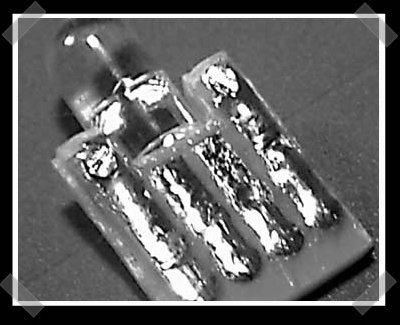
I’m more into this one just for the simple USB plug than the joke that it’s used for. I’ve seen similar on extra small USB flash drives, but those are generally pre-etched. The idea is to use a piece of proto board to make a USB plug an mount a superbright LED on it. Pie indeed.
Peripherals Hacks1579 Articles
Stroboscope LED Fan Clock
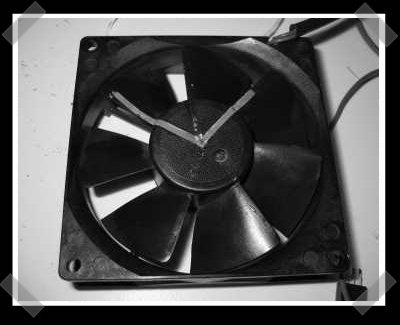
[sprite_tm] sent in one of his latest little adventures – and I love it. To create his stroboscope fan clock, he put a couple of red and green clock hands onto a standard PC fan(I love Panaflo fans), then he built a circuit to strobe a RGB LED to create a set of virtual clock hands on the spinning fan. An ATTiny2313 does all the work, with the help of some transistors to drive the LEDs.
USB Driver Hacking
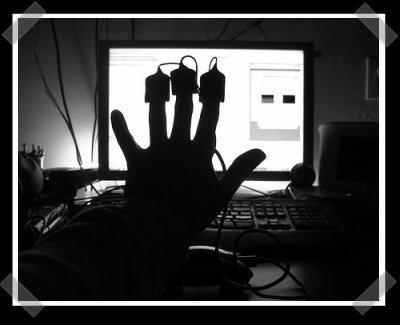
[qDot] sent in his efforts to hack the oddest USB interface I’ve seen. The game is played by relaxing, so the controller senses biometrics. His notes on his adventure in hacking a driver are a bit entertaining, and definitely interesting if you’ve considered doing a little USB driver hacking of your own. If there’s enough interest, maybe he’ll post some more code to get things rolling.
Back From Belize Extra

Yesterday, I was standing on a tropical island off the coast of Belize. Vacation rocked with lots of SCUBA diving, spearfishing and snorkeling. I’m back home, shaking off the jet lag and clearing up my inbox. Thanks to [fabienne] for filling in and letting me unplug for a while!
[Darkrom] has set a new standard for Hack-A-Day readers… I haven’t seen it in person, but that looks like a legit Hack-A-Day tattoo.
[null] sent in a new use for a frequency generator, a spare car amp, a sub-woofer and a plastic coffee can – brass cartridge polishing.
[LoopyMind] sent in this Game Boy Advanced Movie Player IDE hack. It’s pretty much a direct CF to laptop drive cable with an external battery supply.
[Dingolishious] sent in a POE UPS/remote power control solution. Could be handy if you’re using many POE devices, or if you’re having power issues. He added an inexpensive remote power monitor/switch solution behind his UPS. It senses power outages and kicks out an email – and allows remote power cycling of his POE devices. Of course, if you’ve got a linux box behind the UPS, it can monitor the output from the UPS and send notifications.
[William] added a preamp stage to his iKEY usb recorder. looks like an interesting toy – it’ll record audio directly to a USB flash key. The pre-amp allows him to record in more challenging environments.
[Andrew] noted a simple mod to increase the deadly fire power of the ubiquitous airsoft pellet gun. It’s just a matter of reducing some extra space in the spring compression area.
Last but not least, [VIPER] modded his projector to use a 12v halogen headlight bulb. Not a bad idea – at one point I was pondering a 550 watt source four halogen as a possible replacement.
Interactive Textile Construction
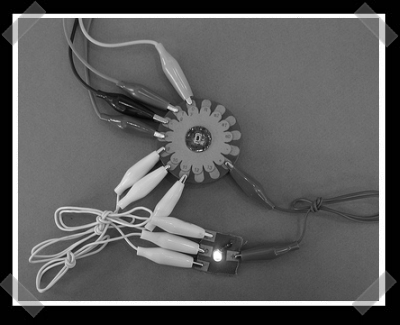
The e-textile construction kit by [Leah Buechley] consists of stitch-able sensors and microcontrollers. Stitch-able refers to the fact that these parts can be sewn with a needle and thread into wearable clothing or other fabric-based housings. A paper (PDF) on the e-textile construction kit project contains the first version. The second version of the e-textile construction kit, the LilyPad Arduino, is available this month through SparkFun’s site. Especially interesting are her instructions for modifying the clock speed on the Arduino to make it suitable for battery powered wearables.
We’ve covered [Leah Buechley]’s work twice in 2005 for her wearable led matrix work.
Update: [Leah] updated her site since we posted this and added this new how-to.
Read Every Bit On A DVD

If you are curious about reading all the bits on a DVD, [tmbinc] has devised a hardware hack that uses a Pioneer DVD drive with leads soldered onto it and a Cypress FX2 microcontroller board to grab the flow of bits and push them over USB2.0. My favorite part of this tutorial is when you slow the spinning DVD down very slightly with your finger with a scope hooked up over what you believe to be the raw data stream from the disk. If the data rate slows when you physically slow down the disk, you probably are grabbing data from the correct pin. [tmbinc] even put together a software tool to process the resulting raw DVD data.
USB 2.0 FPGA Based 24 Channel Logic Analyzer
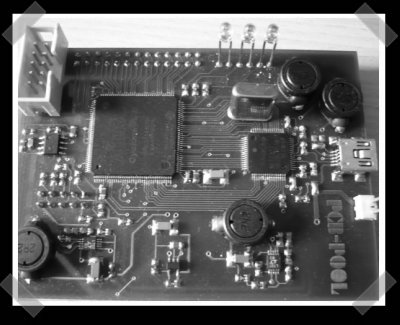
[lekernel] sent in his USB logic analyzer. I might just have to build this one for my work bench. It’s based on an Altera Cyclone 2 FPGA and he’s provided full schematics, source and a quick and dirty Linux driver to get things going. The board is nearly all surface mount, but he points out that the entire thing was soldered with a standard iron and de-soldering wick. If you’re looking for a good starter FPGA project, this looks like a good one.
I started writing for Hack-A-Day a little over a year ago. I’ve barely taken a break, but for the next week I’m going to be taking some serious time off on a Caribbean island. Thanks for a great year guys! While I’m gone, [fbz] has kindly consented to take over the reins. I’m looking forward to another year when I get back, but right now I’ve got to finish packing my dive gear.









