Raspberry Pi Used As A Beacon Transmitter

rpi-beacon-transmitter

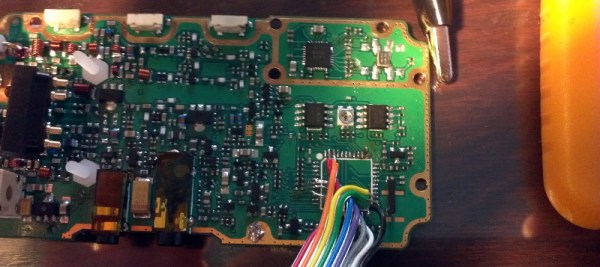
[m0xpd] got his hands on an inexpensive AD9850 DDS Module from eBay but needed a way to control it. He took inspiration from the projects that used a PIC microcontroller, but decided to add his own twist by using a Raspberry Pi to build a multi-mode beacon transmitter.

At the center of this breadboarded circuit lies the green AD9850 module. To its left is a level converter he built to get the 3.3V levels from the RPi board to work with the rest of the 5V hardware. The signal then feeds into a QRP amplifier and a low pass filter.

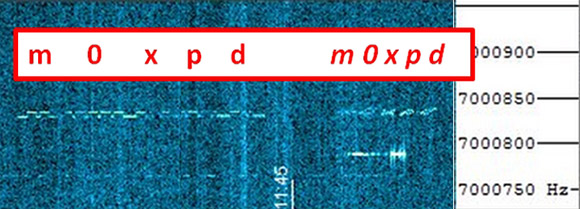
He didn’t start from square one when it came time to write the code for the RPi. Instead he grabbed an Arduino sketch for the very same DDS and ported it over to Python. The first test signal was his call sign sent in Morse code at QRSS speeds. But he also managed to get Hellschreiber messages working, making it a multiple-mode device.

[via Solder Smoke]

Putting The BBC In Seattle

radio

Among great British traditions, there’s tea, knowing how to lose an empire, tea, Parliament, big ben, tea, incalculable wit, Parliament, big ben, tea, and BBC radio. While Britons in foreign lands may not be able receive BBC radio over the airwaves, there is the remarkable BBC iPlayer that allows online streaming of all those awesome BBC radio stations. Unfortunately, moving away from the Prime Meridian means the BBC radio schedule deviates from the schedule ordained by divine right. In Seattle, for example, a Friday evening comedy would be broadcast in the middle of the afternoon. Basically, it’s like listening to  Prairie Home Companion on Saturday morning. It just feels wrong.

[Adam] came up with a clever solution to this problem. Yes, it’s really just a Raspberry Pi-powered web radio, but there’s a twist to this build: everything from BBC radio is buffered and time shifted. A program that airs at noon in London will now play on [Adam]’s radio at noon in Seattle.

The hardware portion of the build is an exceedingly British radio which [Adam] deftly modified to include an auxiliary input. The software portion of the build uses ffmpeg, mplayer, and a PHP script to stream the iPlayer audio to a file, wait 8 hours (or whatever the offset from GMT is), and start playing the audio.

In the end, the time shifted BBC radio works perfectly, and even caught the attention of a few people at BBC Radio 4. [Adam] was interviewed about his project, and was even able to listen to his interview several hours later.

Listening In On Weather Balloons With RTL SDR

sonde

Every day, twice a day, over 800 weather balloons are launched around the world at exactly the same time. The data transmitted from these radiosondes is received by government agencies and shared with climatologists and meteorologist to develop climate models and predect the weather. Near [Carl]’s native Auckland, a weather balloon is launched twice a day, and since they transmit at 403 MHz, he decided to use a USB TV tuner to receive data directly from an atmospheric probe.

The hardware portion of this project consisted of building a high gain antenna designed for 162 MHz. Even though the radiosonde transmits at 403 MHz, [Carl] was easily able to receive on his out-of-band antenna.

For the software, [Carl] used SDRSharp and SondeMonitor, allowing him to convert the coded transmissions from a weather balloon into pressure, temperature, humidity, and GPS data.

Pictures From Weather Satellites With A USB TV Tuner

europe

Several times a day, a NOAA weather satellite passes over your head, beaming down pictures of weather systems and cloud formations. These transmissions aren’t encrypted, and given the requisite hardware it’s possible for you to download these images from space as [Lovro] shows us in a tutorial video.

To get these near real-time satellite pictures, [Lovro] used one of those USB TV tuners we’ve grown so fond of. A somewhat specialized antenna is required to receive the right hand polarized transmissions from NOAA weather satellites, but with a few bits of wood and wire, [Lovro] made a helical antenna to listen in on the weather satellites transmitting around 137 MHz. After gathering a whole bunch of data from the satellites with SDRsharp, [Lovro] used an image decoder to turn an audio file into a picture taken from space just hours ago.

This isn’t the first time we’ve seen images from a NOAA weather satellite downloaded with a software defined radio; last year [hpux735] did just that with a somewhat inexpensive Softrock SDR. [Lovro]’s use of a USB TV tuner to receive the transmission from NOAA satellites is a lot easier on the pocketbook, though, with the largest expense being an investment in time to build a helical antenna.

Arduino Using A Straight Key For Morse Code Assistance

arduino-morse-code-straight-key

For those unfamiliar with Ham Radio, there are lots of fancy tools these days to make it easier for the radio operator. But enthusiasts still like to get back to basics, and one way to do this is to participate in Straight Key Night. This is when you pull out your traditional Morse code keyer and have a chat with others around the world. The most recent event was on New Year’s Eve. The only drag is that it sometimes takes a while to find another Ham who’s listening, and this can mean repetitively keying the letters QC SKN for long periods of time (QC invites listeners to respond, and SKN is to inform them you’re participating in Straight Key Night). Sure, a programmable keyer will do this for you, but that is against the spirit of the event. [Mike Herr] found a grey area by mechanically interfacing an Arduino with a straight key.

You can see the straight key being pressed by a hobby servo in the image above. The servo is driven by the Arduino, which will transmit the series of letters automatically. As you can see in the video after the break, once [Mike] hears back from a fellow operator he switches to a huge wooden straight key for the rest of the conversation.

Continue reading “Arduino Using A Straight Key For Morse Code Assistance”

Open Source Software Defined Radio Transceiver

SDR

As the year draws to a close, we must look back and look at the advances in amateur radio this year. The RTL-SDR tuner hack, a USB TV Tuner to create a software defined radio receiver, is one of the greatest hacks of the last 12 months and a great justification for 2012 being the year of software defined radio receivers. 2013 is shaping up to have even more advances in the state of software defined radio. This time we’ll be transmitting as well, possibly with [AE9RB]’s Peaberry SDR transceiver.

The Peaberry SDR transceiver is a kit to both transmit and receive on every HAM band between 160 meters (1.8 MHz) to 17 meters (18 MHz). It does this through a USB interface and a 48kHz, 24-bit interface that is (or will shortly be) compatible with all the major SDR interfaces.

While the Peaberry SDR requires an amateur radio license to operate, we can’t wait to see what else will be coming to the software defined radio scene in the next year.

Thanks [Zach] for sending this one in.

Build A $360 Synthetic Aperture Radar With MIT’s OpenCourseware

A few profs from MIT’s Lincoln Lab are giving those poor MIT undergrads something to do over winter break: they’re teaching a three-week course on building a laptop-powered radar system capable of radar ranging, doppler, and synthetic aperture imaging. Interestingly, the radar system that teams will build for the class has a BOM totaling $360, and they’re also putting the entire class online if you’d like to follow along and build your own.

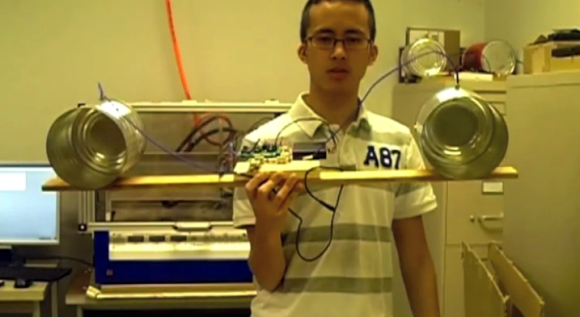
From the lecture notes from the course, the radio system is made out of an off-the-shelf  LNA, oscillator, and  splitter. By connecting two coffee can ‘cantennas’, it’s possible to record a .WAV file from the signal coming from the radar and use MATLAB to turn that audio signal into a doppler radar.

It’s a very ambitious project that goes deep down the rabbit hole of RF and analog design. One of the lecturers made a YouTube demo of the radar in ranging mode; you can check that out after the break.

Continue reading “Build A $360 Synthetic Aperture Radar With MIT’s OpenCourseware”