Internet-controlled Robotic Arm

internet_robotic_arm

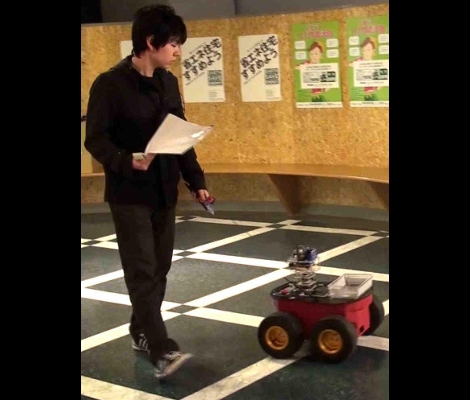
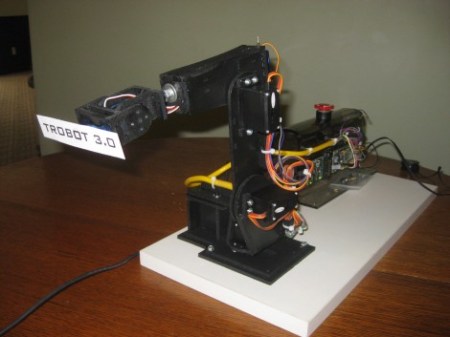
[Trav] was pondering virtual reality and decided it was no longer all that it was cracked up to be, so he created an experience in what he calls “Remote Reality”. While we have seen many installations over the years that allow people to remotely interact with objects across the globe, his Orbduino project consists of more than simply toggling lights on and off (though he’ll let you do that too).

In his house, he has set up a robotic playground of sorts that allows anyone who visits a chance to play around with the robotic arm he has installed there. The arm is situated in a pen filled with random objects which can be stacked and moved around. He also promises to show you something fun, provided you can guide the arm to pick up an object and hold it against the target positioned outside the pen.

He didn’t forget the obligatory remote light controls either. You can turn the overhead lights on and off, as well as control a multi-colored orb situated in the corner of the room. Most of the project’s interface is done with an Arduino Mega, which handles the robot arm interface, as well as messing with the light installations.

If you have some free time, swing by his site and give the robotic arm a try. It’s a fun little time waster that you will likely enjoy.  Just make sure to take it easy on his web server!

Amazing Quad Pick And Place System Tirelessly Sorts Your Legos

delta_robots

[Chris] is quite the devoted tinkerer. He recently wrote in to share what can only be described as a labor of love. His Quad Delta Robot system has been in the works for about six years now, split into periods of research, building, more research, and rebuilding until arriving at its current form.

The system is made up of four Lego NXT robots which are tasked with sorting Lego cubes by color as they come down a pair of conveyer belts. The robots were built to mimic commercially available pick and place robots which can be found on assembly lines all over the world.

Each robot operates independently, receiving signals via a light sensor which tells the robot where the next brick is located, as well as what color it is. This data is sent by the main NXT unit, which uses a lights sensor to determine brick color and position, relaying the information to the other bots via flashing LEDs. All of the robots receive the same signal, but much like NIC cards ignore frames not destined for their MAC, the bots ignore messages that are not addressed to them.

The machine is truly amazing to watch – it’s clear that all of [Chris’] research and planning has paid off. You have to check out the video embedded below to truly appreciate all of the work that went into this system. Also, be sure to swing by his site for a far more in-depth look at how the machines work, it is definitely worth the time.

Continue reading “Amazing Quad Pick And Place System Tirelessly Sorts Your Legos”

Robotics Merit Badge Just Announced

So you know how to build and program robots; what do you want, a badge? Now you can get just that, assuming you’re 11-18 years old and know all of the secret (or not so secret) handshakes, oaths, and pledges. The Boy Scouts of America recently announced the brand-new robotics merit badge. Now kids who cut their teeth building rule-breaking entries in the Pinewood Derby can have a go with robotics kits.

The requirements which must be satisfied to earn the badge start with safety and end with an exploration of the careers associated with the field. Along the way the Boy Scouts are encouraged to learn about keeping an engineering notebook during the design process, planning and programming the hardware, and attending a robotics competition like FIRST or VEX.

It’s not hard to see that this merit badge is right up our alley. We just hope it can grab some attention from the uber-popular badges like Stamp Collecting and Basketry.

Ball Bot Constructed From Power Tools And Pet Toys

ballbot

Hackaday forum member [machinelou] says he’s been fascinated with remote controlled hamster balls for quite some time. Inspired by a ball bot he saw on a BBC show, he finally picked up a 12″ plastic ball and got to work.

He used a small drill to provide the power required to roll the ball, and an Arduino is used as the brains of the device. This is his first major project outside of simple I/O and servo control, so he’s taking things slowly. While all this is a bit new to him, he already has things up and running to a degree as you can see in the video below. In its current state, the ball is programmed to roll forward and backwards for a few seconds before going back to sleep.

His future plans include adding a servo-controlled weight to allow him to steer the ball as well as using a pair of Zigbee modules in order to control the ball remotely.

It’s a neat little project, and definitely one that would be a fan favorite among kids. Stick around to see a quick video of his bot’s progress thus far.

Continue reading “Ball Bot Constructed From Power Tools And Pet Toys”

One-eyed, One-armed Metal Rolling Roomba Robot

roomba_robot

[Erik] was looking for a sturdy robotics platform and was initially considering the iRobot Create, until he found that he could score a Roomba Discovery series for a fraction of the price. The Discovery includes a battery, which is missing from the iCreate, though it also has all of the standard vacuum bits included as well.

He immediately removed all of the vacuum parts once he got his hands on the Roomba, and began adding the support structure to house the rest of his robot’s components. The robot is controlled via a small laptop which sits on top of the Roomba’s base, and features a panning and telescoping webcam to provide feedback to the operator.

The robot has been under construction for a little over a year now, and has had a few upgrades over that time. The original laptop was swapped out for a newer dual-core model, and the webcam was upgraded to a model featuring motion tracking. The whole thing has been skinned in thin sheet metal for a sleek look, and he has added a servo-driven arm as well.

The project is not quite complete, and he hasn’t really stated what he plans on using the robot for, but it looks good so far – we can’t wait to see it when it’s finished.

Retake On A Wii Remote Controlled Balancing Robot

[Tijmen Verhulsdonck] built his own version of a Wii remote-controlled balancing robot. He drew his inspiration from the SegWii, which was built by [Ara Kourchians].

The body is built using one of our preferred fabrication methods; threaded rod makes up a rail system, with three sheets of hard board serving as a mounting structure for the motors, electronics, and battery. This does away with the 9V batteries used on the original SegWii, opting for a very powerful lithium battery perched on the highest part of the assembly. It uses an Arduino as the main microcontroller. That detects roll, pitch, and tilt of the body by reading data from a Sparkfun IMU 5 board (we’re pretty sure it’s this one). Check out the videos after the break. The first demonstrates the robot balancing on its own, then a Wii remote is connected via Bluetooth and [Tijmen] drives it around the room by tilting the controller. The second video covers the components that went into the build.

This is impressive work for a 17-year-old. [Tijmen] lists his material cost at $800 but since he’s Dutch this might not be a USD currency.

Continue reading “Retake On A Wii Remote Controlled Balancing Robot”

Class Up Your Next Party With The Drink Making Unit 2.0

drink_making_unit_20

The crew over at [Evil Mad Scientist Laboratories] has been hard at work preparing for the Barbot 2011 cocktail robotic exhibition. This year, they are packing some serious drinking fun with the Drink Making Unit 2.0. The predictably named follow-up to last year’s wildly popular Drink Making Unit doubles the mixing capability with six, rather than three fluids, and provides a visually stimulating drink mixing experience.

While they are similarly named, the new unit has been completely redesigned since last year. No longer are they relying on breast pumps to move the alcohol along. Instead, they are using compressed air to dispense fluids from wash bottles which were constructed from laboratory beakers. The fluids are measured in specially altered graduated cylinders that are designed to tip over and release their contents when the appropriate amount of alcohol has been poured. These cylinders are designed to mimic the movement of Japanese garden fixtures called “deer chasers”, tipping back and forth solely powered by the ingress and egress of liquid.

The dispenser’s control panel houses an ATmega164, which orchestrates the entire operation. It interfaces with the LED driver boards that make up the display via SPI. The micro controller is also tasked with monitoring when the graduated cylinders tip their libations into the dispensing funnel, which is done using IR LEDs and photogates.

It’s a great looking machine, and while there isn’t any drink mixing video as of yet, we can’t wait to see it in action.