Utah’s FORGE: A Research Laboratory For Enhanced Geothermal Systems

Geothermal heat is a tantalizing source of energy that’s quite literally right below our feet. At the same time geothermal energy is hard to develop as the Earth’s crust is too thick in most places, limiting this to areas where magma is close enough to the surface and the underground rock permeable enough for water. The Utah FORGE facility is a field site were researchers are developing and testing ways to increase the scope of geothermal energy.

An Enhanced Geothermal System (EGS) is designed to be capable of using geothermal energy where this is normally not feasible through a technique that’s reminiscent of the hydraulic fracturing (‘fracking’) used by the oil and gas industry, but rather than creating more fractures, it instead uses hydro-shearing to prop open existing fractures and thus create the through-flow of water needed to extract geothermal energy.

So far FORGE has reported the successful creation of a geothermal reservoir where before there was none. This facility is located in the Milford valley in southwest Utah, which has some hydrothermal activity at the nearby Roosevelt Hot Springs, but through EGS other parts of this valley and similar areas could conceivably be used for generating electricity and for community heating as well. In a 2024 study by University of Utah scientists, it is described how the Milford valley’s volcanic past has left a large body of magma below a thick barrier of granitic rock that could provide access to geothermal resources with EGS to create the requisite fluid permeability.

FORGE is not the only facility working on EGS, but many other sites around the world having ceased activities after issues ranging from induced seismicity, susceptibility to earthquakes and budget shortages. Much like fracking, EGS is likely to cause earthquakes. Whether EGS can be made economically feasible still remains to be seen.


Image Credit: Eric Larson, Flash Point SLC

High-Speed Reservoir Computing With Integrated Laser Graded Artificial Neurons

So-called neuromorphic computing involves the use of physical artificial neurons to do computing in a way that is inspired by the human brain. With photonic neuromorphic computing these artificial neurons generally use laser sources and structures such as micro-ring resonators and resonant tunneling diodes to inject photons and modulate them akin to biological neurons.

General reservoir computing with laser graded neuron. (Credit: Yikun Nie et al., 2024, Optica)

One limitation of photonic artificial neurons was that these have a binary response and a refractory period, making them unlike the more versatile graded neurons. This has now been addressed by [Yikun Nie] et al. with their research published in Optica.

The main advantage of graded neurons is that they are capable of analog graded responses, combined with no refractory period in which the neuron is unresponsive. For the photonic version, a quantum dot (QD) based gain section was constructed, with the input pulses determining the (analog) output.

Multiple of these neurons were then combined on a single die, for use in a reservoir computing configuration. This was used with a range of tests, including arrhythmia detection (98% accuracy) and handwriting classification (92% accuracy). By having the lasers integrated and the input pulses being electrical in nature, this should make it quite low-power, as well as fast, featuring 100 GHz QD lasers.

Pixel Watch 3’s Loss Of Pulse Detection: The Algorithms That Tell Someone Is Dying

More and more of the ‘smart’ gadgets like watches and phones that we carry around with us these days come with features that we’d not care to ever need. Since these are devices that we strap onto our wrists and generally carry in close proximity to our bodies, they can use their sensors to make an estimation of whether said body is possibly in the process of expiring. This can be due to a severe kinetic event like a car crash, or something more subtle like the cessation of the beating of one’s heart.

There is a fairly new Loss of Pulse Detection (LoPD) feature in Google’s Pixel Watch 3 that recently got US FDA approval, allowing it to be made available in the US after previously becoming available in over a dozen European countries following its announcement in August of 2024. This opt-in feature regularly polls whether it can detect the user’s pulse. If not found, it cascades down a few steps before calling emergency services.

The pertinent question here is always whether it is truly detecting a crisis event, as nobody wants to regularly apologize for a false alert to the overworked person staffing the 911 or equivalent emergency line. So how do you reliably determine that your smart watch or phone should dial emergencies forthwith?

Continue reading “Pixel Watch 3’s Loss Of Pulse Detection: The Algorithms That Tell Someone Is Dying”

Josephine Cochrane Invented The Modern Dishwasher — In 1886

Popular Science has an excellent article on how Josephine Cochrane transformed how dishes are cleaned by inventing an automated dish washing machine and obtaining a patent in 1886. Dishwashers had been attempted before, but hers was the first with the revolutionary idea of using water pressure to clean dishes placed in wire racks, rather than relying on some sort of physical scrubber. The very first KitchenAid household dishwashers were based on her machines, making modern dishwashers direct descendants of her original design.

Josephine Cochrane (née Garis)

It wasn’t an overnight success. Josephine faced many hurdles. Saying it was difficult for a woman to start a venture or do business during this period of history doesn’t do justice to just how many barriers existed, even discounting the fact that her late husband was something we would today recognize as a violent alcoholic. One who left her little money and many debts upon his death, to boot.

She was nevertheless able to focus on developing her machine, and eventually hired mechanic George Butters to help create a prototype. The two of them working in near secrecy because a man being seen regularly visiting her home was simply asking for trouble. Then there were all the challenges of launching a product in a business world that had little place for a woman. One can sense the weight of it all in a quote from Josephine (shared in a write-up by the USPTO) in which she says “If I knew all I know today when I began to put the dishwasher on the market, I never would have had the courage to start.”

But Josephine persevered and her invention made a stir at the 1893 World’s Fair in Chicago, winning an award and mesmerizing onlookers. Not only was it invented by a woman, but her dishwashers were used by restaurants on-site to clean tens of thousands of dishes, day in and day out. Her marvelous machine was not yet a household device, but restaurants, hotels, colleges, and hospitals all saw the benefits and lined up to place orders.

Continue reading “Josephine Cochrane Invented The Modern Dishwasher — In 1886”

Conservationists Are Flying Microlites To Teach Birds How To Migrate

When it comes to what birds have and what humans don’t, your mind might first land on the ability to fly. However, birds are also pretty good at navigating from the air… assuming, that is, they know where they’re trying to go in the first place.

In recent decades, conservationists have been trying to reintroduce the northern bald ibis to central Europe. There’s just one problem—when the birds first died out on the continent, so did their handed-down knowledge of their traditional migration route. Somehow, the new generation had to be taught where to go.

Continue reading “Conservationists Are Flying Microlites To Teach Birds How To Migrate”

You Are Already Traveling At The Speed Of Light

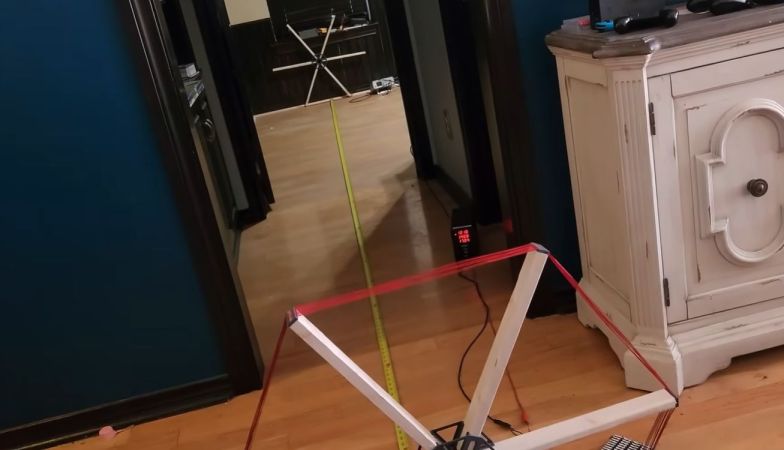
Science fiction authors and readers dream of travelling at the speed of light, but Einstein tells us we can’t. You might think that’s an arbitrary rule, but [FloatHeadPhysics] shows a different way to think about it. Based on a book he’s been reading, “Relativity Visualized,” he provides a graphic argument for relativity that you can see in the video below.

The argument starts off by explaining how a three-dimensional object might appear in a two-dimensional world. In this world, everything is climbing in the hidden height dimension at the exact same speed.

Continue reading “You Are Already Traveling At The Speed Of Light”

self-stabilizing robot on tabletop

Taming The Wobble: An Arduino Self-Balancing Bot

Getting a robot to stand on two wheels without tipping over involves a challenging dance with the laws of physics. Self-balancing robots are a great way to get into control systems, sensor fusion, and embedded programming. This build by [mircemk] shows how to make one with just a few common components, an Arduino, and a bit of patience fine-tuning the PID controller.

At the heart of the bot is the MPU6050 – a combo accelerometer/gyroscope sensor that keeps track of tilt and movement. An Arduino Uno takes this data, runs it through a PID loop, and commands an L298N motor driver to adjust the speed and direction of two DC motors. The power comes from two Li-ion batteries feeding everything with enough juice to keep it upright. The rest of the magic lies in the tuning.

PID (Proportional-Integral-Derivative) control is what makes the robot stay balanced. Kp (proportional gain) determines how aggressively the motors respond to tilting. Kd (derivative gain) dampens oscillations, and Ki (integral gain) helps correct slow drifts. Set them wrong, and your bot either wobbles like a confused penguin or falls flat on its face. A good trick is to start with only Kp, then slowly add Kd and Ki until it stabilizes. Then don’t forget to calibrate your MPU6050; each sensor has unique offsets that need to be compensated in the code.

Once dialed in, the result is a robot that looks like it defies gravity. Whether you’re hacking it for fun, turning it into a segway-like ride, or using it as a learning tool, a balancing bot is a great way to sharpen your control system skills. For more inspiration, check out this earlier attempt from 2022, or these self-balancing robots (one with a little work) from a year before that. You can read up on [mircemk]’s project details here.