Solar Chimneys: Viable Energy Solution Or A Lot Of Hot Air?

We think of the power we generate as coming from all these different kinds of sources. Oil, gas, coal, nuclear, wind… so varied! And yet they all fundamentally come down to moving a gas through a turbine to actually spin up a generator and make some juice. Even some solar plants worked this way, using the sun’s energy to heat water into steam to spin some blades and keep the lights on.

A solar updraft tower works along these basic principles, too, but in a rather unique configuration. It’s not since the dawn of the Industrial Age that humanity went around building lots of big chimneys, and if this technology makes good sense, we could be due again. Let’s find out how it works and if it’s worth all the bluster, or if it’s just a bunch of hot air.

Continue reading “Solar Chimneys: Viable Energy Solution Or A Lot Of Hot Air?”

a) Schematic illustration of energy storage process of succulent plants by harnessing solar energy with a solar cell, and the solar cell converts the energy into electricity that can be store in APCSCs of succulent plants, and then utilized by multiple electrical appliances. b–d) The energy is stored in cactus under sunlight by solar cell and then power light strips of Christmas tree for decoration.

Succulents Into Supercapacitors

Researchers in Beijing have discovered a way to turn succulents into supercapacitors to help store energy. While previous research has found ways to store energy in plants, it often required implants or other modifications to the plant itself to function. These foreign components might be rejected by the plant or hamper its natural functions leading to its premature death.

This new method takes an aloe leaf, freeze dries it, heats it up, then uses the resulting components as an implant back into the aloe plant. Since it’s all aloe all the time, the plant stays happy (or at least alive) and becomes an electrolytic supercapacitor.

Using the natural electrolytes of the aloe juice, the supercapacitor can then be charged and discharged as needed. The researchers tested the concept by solar charging the capacitor and then using that to run LED lights.

This certainly proposes some interesting applications, although we think your HOA might not be a fan. We also wonder if there might be a way to use the photosynthetic process more directly to charge the plant? Maybe this could recharge a tiny robot that lands on the plants?

Using Sound Waves As A Fire Extinguisher

In order for a fire to sustain itself, it needs three things: fuel, heat, and oxygen, with the disruption of just one of those causing the fire to extinguish. Water, sand, and carbon dioxide-based fire extinguishers are commonly used, but you’re probably familiar with blowing out a candle using your breath. Counter-intuitively, we also blow on a fire (or use bellows) to make it burn better, so what is happening here? Starting with a novelty app for smartphones that can be used to blow out small flames like candles, [The Action Lab] digs into the topic in a recent video.

Using an air vortex cannon strapped to a bass reflex port to wiggle a flame to death. (Credit: The Action Lab)

Using a fairly beefy speaker to blast a 70 Hz tone at a big alcohol flame was not enough to extinguish it, but using the bass reflex port on the back was more effective, yet still not nearly enough. Using an air vortex cannon to focus the sound waves from the bass reflex port, it ‘wiggles’ the flame out in a matter of seconds, as illustrated with a thermal camera. Compared to the much stronger airflow from the box fan that was also used in one attempt, the difference with the sound waves is that they oscillate, constantly fluctuating the air pressure.

This churns the air and thus the flame around, diffusing the suspended fuel, cooling the air, and alternatingly pushing oxygenated air and carbon dioxide-heavy combustion fumes into the flame. This differs from the constant flow from the box fan, which only pushes oxygen-rich air into the flame, thus keeping it intact and burning brightly. Perhaps the main question that remains here is just how practical this approach is for extinguishing flames. Some commentators suggested using this approach in low- and zero-gravity situations, as found in space stations, where regular fire extinguishers based around smothering a flame aren’t as practical.

(Thanks to [Hyperific] for the tip)

Continue reading “Using Sound Waves As A Fire Extinguisher”

Telescope Rides On 3D Printed Equatorial Table

In the realm of amateur astronomy, enthusiasts find themselves navigating a cosmos in perpetual motion. Planets revolve around stars, which, in turn, orbit within galaxies. But the axial rotation of the Earth and the fact that its axis is tilted is the thing that tends to get in the way of viewing celestial bodies for any appreciable amount of time.

Amateur astronomy is filled with solutions to problems like these that don’t cost an arm and a leg, though, like this 3D printed equatorial table built by [aeropic]. An equatorial table is a device used to compensate for the Earth’s rotation, enabling telescopes to track celestial objects accurately. It aligns with the Earth’s axis, allowing the telescope to follow the apparent motion of stars and planets across the night sky.

Equatorial tables are specific to a location on the Earth, though, so [aeropic] designed this one to be usable for anyone between around 30° and 50° latitude. An OpenSCAD script generates the parts that are latitude-specific, which can then be 3D printed.

From there, the table is assembled, mounted on ball bearings, and powered by a small stepper motor controlled by an ESP32. The microcontroller allows a telescope, in this case a Newtonian SkyWatcher telescope, to track objects in the sky over long periods of time without any expensive commercially-available mounting systems.

Equatorial tables like these are indispensable for a number of reasons, such as long-exposure astrophotography, time lapse imaging, gathering a large amount of observational detail for scientific purposes, or simply as an educational tool to allow more viewing of objects in the sky and less fussing with the telescope. They’re also comparatively low-cost which is a major key in a hobby whose costs can get high quickly, but not even the telescope needs to be that expensive. A Dobsonian telescope can be put together fairly quickly sometimes using off-the-shelf parts from IKEA.

37C3: You Think It’s Bad With Pluto? A History Of The Planets

Not every talk at the Chaos Communication Congress is about hacking computers. In this outstanding and educational talk, [Michael Büker] walks us through the history of our understanding of the planets.

The question “What is a planet?” is probably more about the astronomers doing the looking than the celestial bodies that they’re looking for. In the earliest days, the Sun and the Moon were counted in. They got kicked out soon, but then when we started being able to see asteroids, Ceres, Vesta, and Juno made the list. But by counting all the asteroids, the number got up above 1,200, and it got all too crazy.

Viewed in this longer context, the previously modern idea of having nine planets, which came about in the 1960s and lasted only until 2006, was a blip on the screen. And if you are still a Pluto-is-a-planet holdout, like we were, [Michael]’s argument that counting all the Trans-Neptunian Objects would lead to madness is pretty convincing. It sure would make it harder to build an orrery.

His conclusion is simple and straightforward and has the ring of truth: the solar system is full of bodies, and some are large, and some are small. Some are in regular orbits, and some are not. Which we call “planets” and which we don’t is really about our perception of them and trying to fit this multiplicity into simple classification schemas. What’s in a name, anyway?

Moving Iron-Coated Polymer Particles Uphill Using External Magnetic Field

Microscopy of PMMA ferromagnetic Janus particle as used in the study (Credit: Wilson-Whitford et al., 2023)

Granular media such as sand have a range of interesting properties that make it extremely useful, but they still will obey gravity and make their way downhill. That is, until you coat such particles with a ferromagnetic material like iron, make them spin using an external magnetic field and watch them make their way against gravity. This recent study by researchers has an accompanying video (also embedded below) that is probably best watched first before reading the study by Samuel R. Wilson-Whitford and colleagues in Nature Communications.

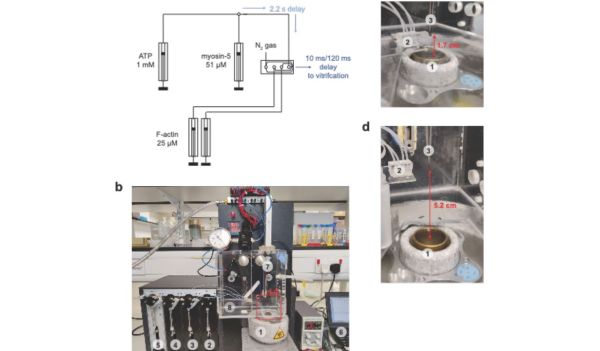
In the supplemental material the experimental setup is shown (see top image), which is designed to make the individual iron-coated polymer particles rotate. The particles are called Janus particles because only one hemisphere is coated using physical vapor deposition, leaving the other as uncovered PMMA (polymethyl methacrylate).

While one might expect that the rotating magnetic field would just make these particles spin in place, instead the researchers observed them forming temporary chains of particles, which were able to gradually churn their way upwards. Not only did this motion look like the inverse of granular media flowing downhill, the researchers also made a staircase obstacle that the Janus particles managed to traverse. Although no immediate practical application is apparent, these so-called ‘microrollers’ display an interesting method of locomotion in what’d otherwise be rather passive granular media.

Continue reading “Moving Iron-Coated Polymer Particles Uphill Using External Magnetic Field”

Keeping Watch Over The Oceans With Data Buoys

When viewed from just the right position in space, you’d be hard-pressed to think that our home planet is anything but a water world. And in all the ways that count, you’d be right; there’s almost nothing that goes on on dry land that isn’t influenced by the oceans. No matter how far you are away from an ocean, what’s going on there really matters.

But how do we know what’s going on out there? The oceans are trackless voids, after all, and are deeply inhospitable to land mammals such as us. They also have a well-deserved reputation for eating anything that ventures into them at the wrong time and without the proper degree of seafarer’s luck, and they also tend to be places where the resources that run our modern technological society are in short supply.

Gathering data about the oceans is neither cheap nor easy, but it’s critically important to everything from predicting what the weather will be next week to understanding the big picture of what’s going on with the climate. And that requires a fleet of data buoys, outnumbering the largest of the world’s navies and operating around the clock, keeping track of wind, weather, and currents for us.

Continue reading “Keeping Watch Over The Oceans With Data Buoys”