A Little Bit Of Science History Repeating Itself: Boyle’s List

In a recent blog post, [Benjamin Breen] makes an interesting case that 2023 might go down in history as the start of a scientific revolution, and that’s even if LK-99 turns out to be a dud. He points to several biomedical, quantum computing, and nuclear fusion news items this year as proof.

However, we aren’t as convinced that these things are here to stay. Sure, LK-99 was debunked pretty quickly, but we swim in press releases about new battery technologies, and new computer advances that we never hear about again. He does mention that we aren’t alone in thinking that as [Tyler Cowen] coined the phrase “Great Stagnation” to refer to the decline in disruptive tech since 1945. Still, [Benjamin] argues that people never know when they live through a scientific revolution and that the rate of science isn’t as important as the impact of it.

Continue reading “A Little Bit Of Science History Repeating Itself: Boyle’s List”

The World ID Orb And The Question Of What Defines A Person

Among the daily churn of ‘Web 3.0’, blockchains and cryptocurrency messaging, there is generally very little that feels genuinely interesting or unique enough to pay attention to. The same was true for OpenAI CEO Sam Altman’s Ethereum blockchain-based Worldcoin when it was launched in 2021 while promising many of the same things as Bitcoin and others have for years. However, with the recent introduction of the World ID protocol by Tools for Humanity (TfH) – the company founded for Worldcoin by Mr. Altman – suddenly the interest of the general public was piqued.

Defined by TfH as a ‘privacy-first decentralized identity protocol’ World ID is supposed to be the end-all, be-all of authentication protocols. Part of it is an ominous-looking orb contraption that performs iris scans to enroll new participants. Not only do participants get ‘free’ Worldcoins if they sign up for a World ID enrollment this way, TfH also promises that this authentication protocol can uniquely identify any person without requiring them to submit any personal data, only requiring a scan of your irises.

Essentially, this would make World ID a unique ID for every person alive today and in the future, providing much more security while preventing identity theft. This naturally raises many questions about the feasibility of using iris recognition, as well as the potential for abuse and the impact of ocular surgery and diseases. Basically, can you reduce proof of personhood to an individual’s eyes, and should you?

Continue reading “The World ID Orb And The Question Of What Defines A Person”

Got Fireflies? Try Talking To Them With A Green LED

[ChrisMentrek] shares a design for a simple green LED signal light intended for experiments in “talking” to fireflies. The device uses simple components like PVC piping and connectors to make something that resembles a signal flashlight with a momentary switch — a device simple enough to make in time for a little weekend experimenting.

Observe and repeat flashing patterns, and see if any fireflies get curious enough to investigate.

Did you know that fireflies, a type of beetle whose lower abdomen can light up thanks to a chemical reaction, flash in patterns? Many creatures, fireflies included, are quite curious under the right circumstances. The idea is to observe some fireflies and attempt to flash the same patterns (or different ones!) with a green LED to see if any come and investigate.

[ChrisMentrek] recommends using a green LED that outputs 565 nm, because that is very close to the colors emitted by most fireflies in North America. There’s also a handy link about firefly flashing patterns from the Massachusetts Audubon society’s Firefly Watch program, which is a great resource for budding scientists.

If staying up and learning more about nocturnal nightlife is your thing, then in between trying to talk to fireflies we recommend listening for bats as another fun activity, although it requires a bit more than just a green LED. Intrigued? Good news, because we can tell you all about the different kinds of bat detectors and what you can expect from them.

LK-99: Diamagnetc Semiconductor, Not Superconductor?

Every so often, along comes a story which, like [Fox Mulder] with his unexplained phenomena, we want to believe. EM drives and cold fusion for example would be the coolest of the cool if they worked, but sadly they crumbled when subjected to scientific inquiry outside the labs of their originators. The jury’s still out on the latest example, a claimed room-temperature superconductor, but it’s starting to seem that it might instead be a diamagnetic semiconductor.

We covered some of the story surrounding the announcement of LK-99 and subsequent reports of it levitating under magnetic fields, but today’s installment comes courtesy of a team from Beihang University in Beijing. They’ve published a paper in which they characterize their sample of LK-99, and sadly according to them it’s no superconductor.

Instead it’s a diamagnetic semiconductor, something that in itself probably bears some explanation. We’re guessing most readers will be familiar with semiconductors, but diamagnetic substances possess the property of having an external magnetic field induce an internal magnetic field in the opposite direction. This means that they will levitate in a magnetic field, but not due to the Meissner effect, the property of superconductors which causes magnetic field to flow round their outside. The Beijing team have shown by measuring the resistance of the sample that it’s not a superconductor.

So sadly it seems LK-99 isn’t the miracle it was billed as, unless there’s some special quirk in the production of the original Korean sample which didn’t make it to the other teams. We can’t help wondering why a sample from Korea wasn’t subjected to external evaluation rather than leaving the other teams to make their own. Never mind, eh!

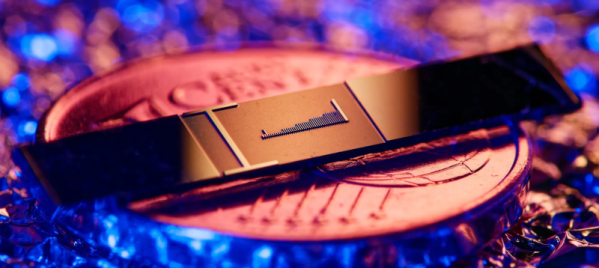
Stack of Si3N4-LiNbO3 forming the integrated laser and integrated into test setup (d). (Credit: Snigirev et al., 2023)

Fast Adjustable Lasers Using Lithium Niobate Integrated Photonics

Making lasers smaller and more capable of rapidly alternating between frequencies, while remaining within a narrow band, is an essential part of bringing down the cost of technologies such as LiDAR and optical communication. Much of the challenge here lies understandably in finding the right materials that enable a laser which incorporates all of these properties.

A heterogeneous Si3N4–LiNbO3 chip as used in the study. (Credit: Snigirev et al., 2023)

Here a recent study by [Viacheslav Snigirev] and colleagues (press release) demonstrates how combining the properties of lithium niobate (LiNbO3) with those of silicon nitride (Si3N4) into a hybrid (Si3N4)–LiNbO3 wafer stack allows for an InP-based laser source to be modulated in the etched photonic circuitry to achieve the desired output properties.

Much of the modulation stability is achieved through laser self-injection locking via the microresonator structures on the hybrid chip. These provide optical back reflection that forces the laser diode to resonate at a specific frequency, providing the frequency lock. What enables the fast frequency tuning is that this is determined by the applied voltage on the microresonator structure via the formed electrodes.

With a LiDAR demonstration in the paper that uses one of these hybrid circuits it is demonstrated that the direct wafer bonding approach works well, and a number of optimization suggestions are provided. As with all of these studies, they build upon years of previous research as problems are found and solutions suggested and tested. It would seem that thin-film LiNbO3 structures are now finding some very useful applications in photonics.

(Heading image: Stack of Si3N4-LiNbO3 forming the integrated laser and integrated into test setup (d). (Credit: Snigirev et al., 2023) )

(a) Structure of the discharged capillary to produce the curved and straight plasma channel. (b) Spectrum distribution and calculated profile of the plasma density along the radial direction at the entrance of the discharged capillary. (c) Experimental setup for the measurements of laser guiding and electron acceleration. (Credit: Xinzhe Zhu et al., 2023)

Accelerating Electrons To TeV Levels Using Curved Laser Beams

There are many applications for particle accelerators, even outside research facilities, but for the longest time they have been large, cumbersome machines, not to mention very expensive to operate. Here laser wakefield accelerators (LWFAs) are a promising alternative, which uses lasers to create accelerated particles along the wake in a plasma field. One of the major struggles has been with reinjecting the thus accelerated particles into another stage of a multi-stage accelerator, which would be required to obtain energies closer to one TeV. In this area researchers have now demonstrated a way around this, by using curved channels for the laser beams (paywalled paper) which inject the laser beam into the continuous cavity. Continue reading “Accelerating Electrons To TeV Levels Using Curved Laser Beams”

“Room Temperature Superconductor” LK-99, Just Maybe It Could Be Real

To have been alive over the last five decades is to have seen superconductors progress from only possible at near-absolute-zero temperatures, to around the temperature of liquid nitrogen in the 1980s and ’90s, and inching slowly higher as ever more exotic substances are made and subjected to demanding conditions. Now there’s a new kid on the block with an astounding claim of room-temperature and pressure superconductivity, something that has been a Holy Grail for physicists over many years.

LK-99 is a lead-copper-phosphate compound developed by a team from Korea University in Seoul. Its announcement was met with skepticism from the scientific community and the first attempts to replicate it proved unsuccessful, but now a team at Huazhong University of Science and Technology in China claim to have also made LK-99 samples that levitate under a magnetic field at room temperature and pressure. This is corroborated by simulation studies that back up the Korean assertions about the crystal structure of LK-99, so maybe, just maybe, room temperature and pressure superconductors might at last be with us.

Floating on a magnetic field is cool as anything, but what are the benefits of such a material? By removing electrical resistance and noise from the equation they hold the promise of lossless power generation and conversion along with higher-performance electronics both analogue and digital, which would revolutionize what we have come to expect from electronics. Of course we’re excited about them and we think you should be too, but perhaps we’ll wait for more labs to verify LK-99 before we celebrate too much. After all, if it proves over-optimistic, it wouldn’t be the first time.