UK’s JET Tokamak Retires After 40 Years And 105,842 Pulses

The UK’s most famous fusion reactor – the Joint European Torus (JET) tokamak – saw its first plasma on June 25th of 1983. Its final plasma pulse was generated on December 18th of 2023, for a total of 105,842 pulses over forty-and-a-half years and countless experiments.

Comparison of toroidal field (TF) coils from JET, JT-60SA and ITER (Credit: QST)

Originally designed in the 1970s by Euratom members, JET formed the core of Europe’s fusion research program, allowing many of the aspects of tokamak systems to be explored, including deuterium-tritium fusion. Its final day of experiments involved an inverted plasma shape prior to targeting electrons at the tokamak’s inner wall, to study the impact of such damage.

Although JET has received a number of upgrades over the decades, the MAST Upgrade and upcoming STEP fusion reactors at the Culham Centre for Fusion Energy (CCFE) are now headed where JET’s design cannot go. Current advanced tokamak reactors like Japan’s JT-60SA are increasingly using super-conducting coils with  often plasma volumes far beyond JET’s, with the focus shifting from plasma research to net energy production.

This means that unless JET somehow gets repurposed/upgraded and recommissioned, this is the final goodbye to one of the world’s most famous and influential fusion reactors.

(Top image: Internal view of the JET tokamak superimposed with an image of plasma flows)

A Transistor, But For Heat Instead Of Electrons

Researchers at UCLA recently developed what they are calling a thermal transistor: a solid-state device able to control the flow of heat with an electric field. This opens the door to controlling the transfer of heat in some of the same ways we are used to controlling electronics.

Heat management can be a crucial task, especially where electronics are involved. The usual way to manage heat is to draw it out with things like heat sinks. If heat isn’t radiating away fast enough, a fan can be turned on (or sped up) to meet targets. Compared to the precision and control with which modern semiconductors shuttle electrons about, the ability to actively manage heat seems lacking.

This new device can rapidly adjust thermal conductivity of a channel based on an electrical field input, which is very similar to what a transistor does for electrical conductivity. Applying an electrical field modifies the strength of molecular bonds in a cage-like array of molecules, which in turn adjusts their thermal conductivity.

It’s still early, but this research may open the door to better control of heat within semiconductor systems. This is especially interesting considering that 3D chips have been picking up speed for years (stacking components is already a thing, it’s called Package-on-Package assembly) and the denser and deeper semiconductors get, the harder it is to passively pull heat out.

Thanks to [Jacob] for the tip!

The Hot Chocolate Effect Explained

This is the time of year when people in the Northern Hemisphere like to enjoy hot beverages like hot chocolate. [The Action Lab] uses hot chocolate to demonstrate an odd acoustic effect. Tapping a container of hot chocolate — or even just hot water — will make a sound at a certain frequency. But if you keep tapping, the frequency of the sound will gradually increase. Don’t know why? Don’t worry, neither did scientists until around 1980.

The secret is bubbles and the speed of sound through air vs a liquid. The speed of sound in the liquid and the height of the liquid in the cup set the frequency. However, the speed of sound changes based on the bubbles, which alters the frequency.

Continue reading “The Hot Chocolate Effect Explained”

Conductive Cellulose-Based Fibers For Clothing: Coming Soon?

Summary of the process of producing side-by-side PANI and cotton cellulose fibers. (Credit: Wongcheng Liu et al., 2023)

With the rise of ‘smart’ devices, it seems like only a matter of time before smart fabrics become an every day thing. Yet a complication with these is that merely threading copper wires into clothing is neither practical nor very durable, which is why researchers have been trying to find a way to combine cellulose-based fibers like cotton with another, conductive material like carbon to create an affordable, resilient material which can provide the pathways for these smart fabrics. Recently a team at Washington State University created a version that integrates polyaniline (PANI, press release for paywalled paper), which is a well-known conductive polymer.

A recent review article by Duan-Chao Wang and colleagues in Polymers covers the research in conductive fibers, with conductive additives ranging from carbon nanotubes (CNT) and graphene to various metallic compounds and conductive polymers. As noted by Wang et al., a major aspect to successful commercialization is enabling scaling and cost-effectiveness of producing such fibers. This is the core of the achievement by the WSU team, who used a side-by-side structure of a cellulose substrate and the PANI conductive covering, which should be easier to produce and more durable than previous attempts to merge these two materials into conductive fibers suitable for fabrics.

Other research by Zhang-Chi Ling and colleagues, as reported earlier this year in NPG Asia Materials, details the creation of composite, conductive fibers made from bacterial cellulose with in-situ entanglement of CNTs. With even 100,000 bending cycles not showing much degradation, this could be another good candidate for conductive fabrics. Which of these approaches will first hit mass-production is still anyone’s guess, but we might see them sooner rather than later.

How Germany’s Troubled Pebble Bed Reactor Came Of Age In China

Although the concept of nuclear fission is a simple and straightforward one, the many choices for fuel types, fuel design, reactor configurations, coolant types, neutron moderator or reflector types, etc. make that nuclear fission reactors have blossomed into a wide range of reactor designs, each with their own advantages and disadvantages. The story of the pebble bed reactor (PBR) is among the most interesting here, with its development winding its way from the US Manhattan Project over the Atlantic to Germany’s nuclear power industry during the 1960s, before finding a welcoming home in China’s rapidly growing nuclear power industry.

As a reactor design, PBRs do not use fuel rods like most other nuclear reactors, but rather spherical fuel elements (‘pebbles’) that are inserted at the top of the reactor vessel and extracted at the bottom, allowing for continuous refueling, while helium acts as coolant. With a strong negative temperature coefficient, the design should be extremely safe, while providing high-temperature steam that can be used for applications that otherwise require a coal boiler or gas turbine.

With China recently having put its twin-PBR HTR-PM plant into commercial operation, why is it that it was not the US, Germany or South Africa to first commercialize PBRs, but relative newcomer China?

Continue reading “How Germany’s Troubled Pebble Bed Reactor Came Of Age In China”

The Geometry Of Transistors

Building things in a lab is easy, at least when compared to scaling up for mass production. That’s why there are so many articles about fusion being right around the corner, or battery technology that’ll allow aviation to switch away from fossil fuels, or any number of other miraculous solutions that never come into being. They simply don’t scale or can’t be manufactured in a cost effective way. But even when they are miraculous and can be produced on a massive scale, as is the case for things like transistors, there are some oddities that come up as a result of the process of making so many. This video goes into some of the intricacies of a bipolar junction transistor (BJT) and why it looks the way it does.

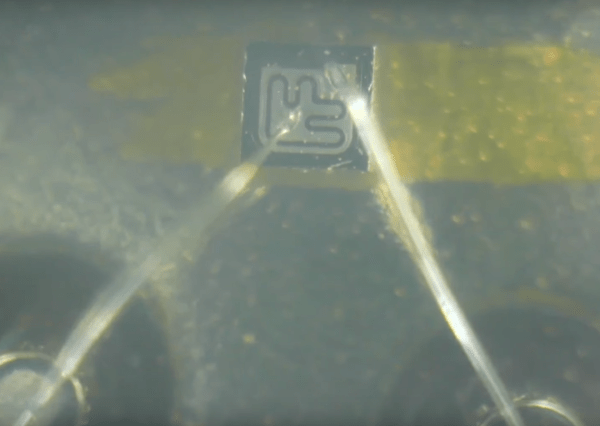
The BJT in this video is a fairly standard NPN type, with three layers of silicon acting as emitter, base, and collector. Typically when learning about electronics devices the drawings of them are simplified two-dimensional block diagrams, but under a microscope this transistor at first appears nothing like the models shown in the textbook. Instead it resembles more of a bird’s foot with a few small wires attached. The bird’s foot shape is a result of attempting to lower the undesirable resistances of the device and improve its performance, and some of its other quirks are due to the manufacturing process. That process starts with a much larger layer of doped silicon that will eventually become the collector, and then the other two, much smaller, layers of the transistor deposited on top of the collector. This also explains while it looks like there are only two layers upon first glance, and also shows that the horizontal diagram used to model the device is actually positioned vertically in the real world.

For most of the processes in our daily lives, the transistor has largely been abstracted away. We don’t have to think about them in a computer that much anymore, and unless work is being done on high-wattage power electronics devices, radios, or audio amplifiers it’s not likely that an average person will run into a transistor. But this video goes a long way to explaining the basics of one of the fundamental building blocks of the modern world for those willing to take a dive into the physics. Take a look at this video as well for an intuitive explanation of the close cousin of the BJT, the field-effect transistor.

Continue reading “The Geometry Of Transistors”

Some Bacteria Could Have A Rudimentary Form Of Memory

When we think of bacteria, we think of simple single-celled organisms that basically exist to consume resources and reproduce. They don’t think, feel, or remember… or do they? Bacteria don’t have brains, and as far as we know, they’re incapable of thought. But could they react to an experience and recall it later?

New research suggests that some bacteria could have a rudimentary form of memory of their experiences in the environment. They could even pass this memory down across generations via a unique mechanism. Let’s dive into the latest research that is investigating just what bacteria know, and how they happen to know it.

Continue reading “Some Bacteria Could Have A Rudimentary Form Of Memory”