Model Rocket Radio Telemetry

rocket_telemetry_data-analysis

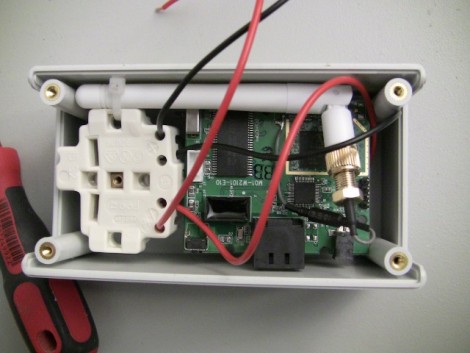
[Ken] sent us his Instructable in which he used radio telemetry to monitor the status of his air-powered model rocket through a series of launches. His setup is centered around an Arduino IDE-compatible board that looks to be about the size of a Boarduino, but has the benefit of an embedded 915 MHz radio module. The vendor he used also sells a good handful of add-on modules which he used for his in-flight recording, including a barometric pressure monitor and a 3-axis accelerometer. During flight, the rocket constantly sends data to a base station, provided it stays within radio operating range.

For is initial tests, [Ken] launched his rocket four times, getting usable data on half of them. He found out some interesting things about his model rocket, including the fact that it creates a maximum launch force of 60 Gs. He has plans to revise his setup in the future, such as lightening the battery load as well as adding a high-G analog sensor for recording the forces at take off. This kit, or a more reasonably priced clone, would make for a great addition to any rocket buff’s inventory.

Batman Inspired Hidden Light Switch

hidden_switch

[Chris] over at the New Hobbyist sent in his latest creation, a wireless light switch hidden within a statue bust. While shopping around for another project, he came across a wireless relay that can can be used to switch a standard 120v AC load. He bought the part without a project in mind, but inspiration quickly struck. Some of you young’uns might not remember the original Batman television series, but [Chris] certainly does. To access the Bat Cave, Bruce Wayne had to flip a secret switch located inside a bust of William Shakespeare that adorned his desk. While he doesn’t have a secret door to activate, [Chris] couldn’t think of any better way to switch on the lights in his man cave. He found a similar-looking bust of Beethoven and got to chopping his head off.

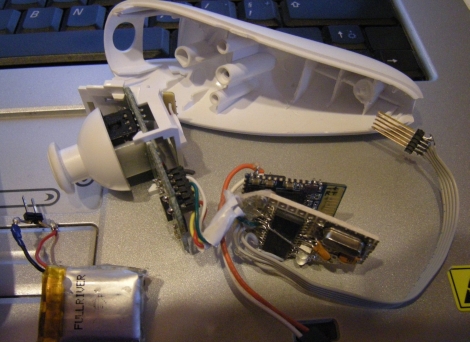
He fabricated a small mount for a push button, hiding the battery powered remote underneath, and an old 12v wall wart was repurposed to drive the wireless receiver. While not overly complicated, this is definitely a fun project and could make for a neat light switch in a kid’s room. Interested in some more Batman inspired hacks? Be sure to check out this Bat Cave-style entrance switch from a few years back.

Keep reading to see a video of his hidden light switch in action.

Continue reading “Batman Inspired Hidden Light Switch”

Radio-controlled LED Light Show

HL1606_radio_controlled_light_show

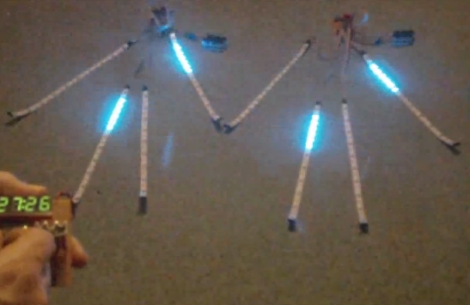
[Alan] was commissioned to make some wearable, radio-controlled LED strips for the Travelling Light Circus. It has taken some time, but he has recently finished some prototypes, and thought it was a good time to do a writeup on the project. The system is managed by a single controller unit, which communicates with any number of LED driver units, each controlling 4 HL1606 LED strips. The light displays are synchronized across all of the LED driver units via a 2.4 GHz radio, with each driver falling into synch almost immediately after being powered on. While some might be turned off to the fact that he uses Arduino Pro Minis to control the LEDs, this is far from a simple project.

[Alan’s] blog contains several posts about this project, with everything documented in detail. He spends quite a bit of time talking about the project’s software, as well as hardware issues he ran into along the way.

His blog is a must read, but even more so, it is a must see. The lighting effects are mesmerizing, as there are a ton of different light patterns these units can generate, so be sure to check out the following video of the lights in action.

Continue reading “Radio-controlled LED Light Show”

Target Hunting UAV Armed With Fireworks

Don’t just build a UAV, use it to blow things up. In this case a tri-copter seeks out colored balloons and pops them using low-grade fireworks. We’ve seen this type of flying armament before, but not in a ‘copter form factor. It looks like the targeting and firing is done by an operator, and is not an automated system despite what the text overlays on the video after the break says. The lack of autonomous firing capability makes this delightful, rather than scary. Don’t miss the build log for the tri-copter itself. How do you think this one stacks up to the last 3-bladed build?

Continue reading “Target Hunting UAV Armed With Fireworks”

Snail Mail Notification System

[Mime] lives on one of the upper levels of an apartment complex. The mailboxes, being located at the ground floor can be somewhat inconvenient to check regularly. [Mime] decided to rig up a device to let him know when his mailbox had been accessed. He started with a wireless doorbell, thinking he could use the door side button inside his mailbox as a trigger with only some slight modification. On the receiver side, he wanted an LED to flash, letting him know that it was time to check his mail. One simple circuit and a self blinking LED later and the whole setup was finished. Great job [Mime]

Wireless Electricity Enables Next Generation Of Annoying Packaging

Yep, these cereal boxes light up. They’re using a new branded-technology called eCoupling that provides electricity via induction, which means the shelves have a coil with AC power running through it. The “printed coils” on the boxes allow inventory control and data exchange presumably thanks to a low-power microcontroller. But in the video after the break you can see that the printed lighting on the boxes lets them flash parts of the box art as a way to attract customers’ attention. We’d bet that they’re using electroluminescent materials but we weren’t able to get find specifics on how this is done. We just hope advertisers don’t start rolling noise-makers into their packaging.

Continue reading “Wireless Electricity Enables Next Generation Of Annoying Packaging”

The Pirate Box

One of the most fun aspects of a LAN party was exploring the shared files of all the other users on the network. There were people that would show up, solely for the file swapping. That is exactly what this project is about. From the projects wiki, the Pirate box is a mobile p2p sharing and collaboration platform. Basically it is a wireless hotspot with a slick interface and a shared folder. It doesn’t connect to the internet, and it doesn’t log any connections. You can have a file swapping session simply by flipping it on and sharing its space with other people. They’ve included a step by step guide to setting up your own, but if you’re going to do some subversive file swapping we might suggest putting it in a less conspicuous enclosure. Imagine this as a portable verion of dead drops.