Hackaday Links Column Banner

Hackaday Links: July 26, 2026

At a time when so-called “artificial intelligence” seems inescapable, we were encouraged to see news that Amazon will be cracking down on third-party sellers that use AI-generated images for their product listings. They won’t be prevented from using the images, but they will need to clearly indicate that they don’t represent reality and were produced via artificial means. This comes in response to a recently enacted New York law that requires the disclosure of AI in advertisements.

Will this be the end of the cat sleeping bag?

But it’s not quite a clear cut as it might seem on the surface, as the New York law is actually about AI-generated people rather than products. Specifically, it’s designed to make it clear when a “synthetic performer” has been used in place of a human actor. As such, it would appear that the easiest way for Amazon sellers to dodge the new rule is to simply not include any humans in their AI slop images and videos. In other words, they can continue to post fake pictures of products without having to inform the consumer so long as they don’t show a fake person holding it.

Under normal circumstances we’d leave something like this next one for our weekly security column, but the utter lack of security in the Pope’s official “Click To Pray” mobile application revealed by researcher BobDaHacker on Friday is just too good a story to pass up. For one thing, who knew that there was an “official” prayer app? We don’t dabble in theology around these parts, but we’re fairly sure the good book didn’t mention anything about requiring a smartphone to give praise.

Continue reading “Hackaday Links: July 26, 2026”

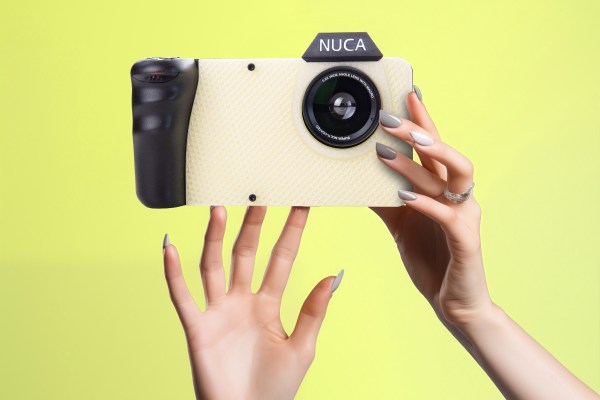
A pair of hands holds a digital camera. "NUCA" is written in the hood above the lens and a black grip is on the right hand side of the device (left side of image). The camera body is off-white 3D printed plastic. The background is a pastel yellow.

AI Camera Only Takes Nudes

One of the cringier aspects of AI as we know it today has been the proliferation of deepfake technology to make nude photos of anyone you want. What if you took away the abstraction and put the faker and subject in the same space? That’s the question the NUCA camera was designed to explore. [via 404 Media]

[Mathias Vef] and [Benedikt Groß] designed the NUCA camera “with the intention of critiquing the current trajectory of AI image generation.” The camera itself is a fairly unassuming device, a 3D-printed digital camera (19.5 × 6 × 1.5 cm) with a 37 mm lens. When the camera shutter button is pressed, a nude image is generated of the subject.

The final image is generated using a mixture of the picture taken of the subject, pose data, and facial landmarks. The photo is run through a classifier which identifies features such as age, gender, body type, etc. and then uses those to generate a text prompt for Stable Diffusion. The original face of the subject is then stitched onto the nude image and aligned with the estimated pose. Many of the sample images on the project’s website show the bias toward certain beauty ideals from AI datasets.

Looking for more ways to use AI with cameras? How about this one that uses GPS to imagine a scene instead. Prefer to keep AI out of your endeavors to invade personal space? How about building your own TSA body scanner?


AI Camera Imagines A Photo Of What You Point It At

These days, every phone has a camera, and few of us are ever without one. [Bjørn Karmann] has built an altogether not-camera, though, in the form of the Paragraphica, powered by artificial intelligence.

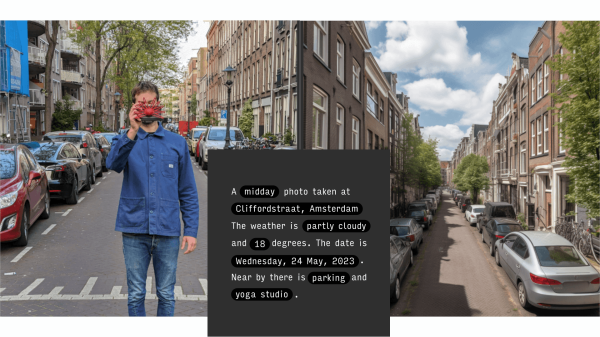
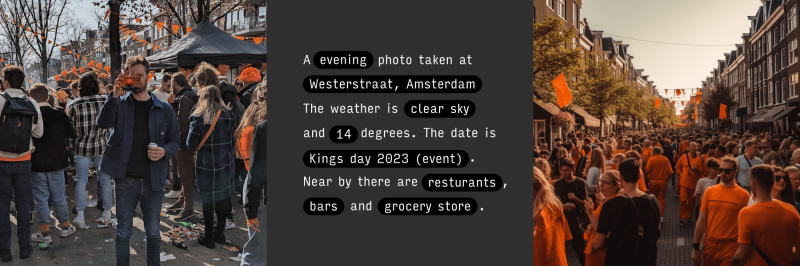
The Paragraphica doesn’t actually take photographs at all. Instead, it uses GPS to determine the user’s current position. It then feeds the address, time of day, weather, and temperature into a paragraph which serves as a prompt for an AI image generator. It also uses data gathered from various APIs to determine points of interest in the immediate area, and feeds those into the prompt as well. It then generates an artificial image that is intended to bear some resemblance to the prompt, and ideally, the real-world scene. In place of a lens, it bears a 3D printed structure inspired by the star-nosed mole, which feels its way around in lieu of using its eyes.

Three dials on the Paragraphica control its action. The first dial controls the radius of the area which the prompt will gather data about; it’s akin to setting the focal length of the lens. The second dial provides a noise seed value for the AI image generator, and the third dial controls how closely the AI sticks to the generated textual prompt.

The results are impressive, if completely false and generated from scratch. The Paragraphica generates semi-believable photos of a crowded alley, a public park, and a laneway full of parked cars. It’s akin to telling a friend where you are and what you’re seeing over the phone, and having them paint a picture based on that description.

Through their unique abilities and stolen data sets, AI image generators are proving controversial to say the least. As all good art does, Paragraphica explores this and raises new questions of its own.

AI Image Generation Gets A Drag Interface

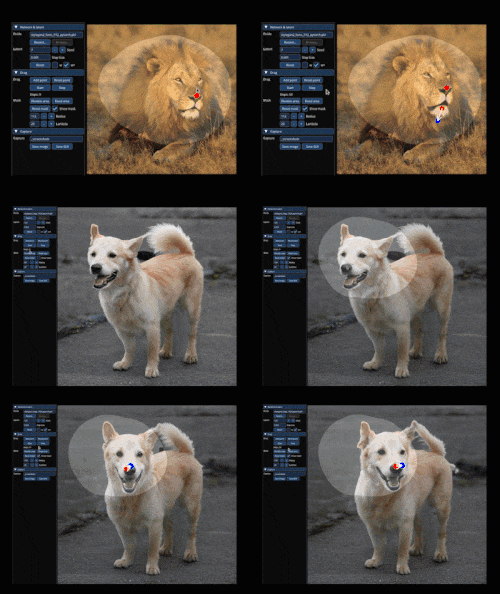
AI image generators have gained new tools and techniques for not just creating pictures, but modifying them in consistent and sensible ways, and it seems that every week brings a fascinating new development in this area. One of the latest is Drag Your GAN, presented at SIGGRAPH 2023, and it’s pretty wild.

It provides a point-dragging interface that modifies images based on their implied structure. A picture is worth a thousand words, so this short animation shows what that means. There are plenty more where that came from at the project’s site, so take a few minutes to check it out.

GAN stands for generative adversarial network, a class of machine learning that features prominently in software like image generation; the “adversarial” part comes from the concept of networks pulling results between different goalposts. Drag Your GAN has a GitHub repository where code is expected to be released in June, but in the meantime, you can read the full paper or brush up on the basics of how AI image generators work, as well as see how image generation can be significantly enhanced with an understanding of a 2D image’s implied depth.