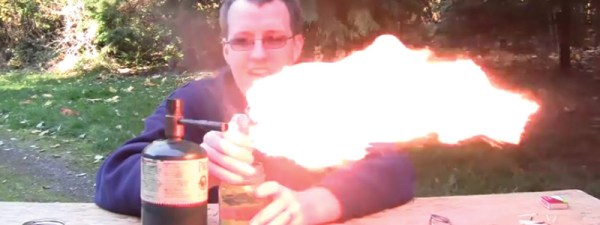
This video from [Just Think] caught our attention for open-flame testing of 6 different commonly used liquid fuels: Jet-A, diesel, heating oil, kerosene, avgas (100LL), and gasoline (or petrol, for our international readers). We love his low-tech approach to testing – just some mason jars and a back yard. The results are quite interesting.
He starts with testing Jet-A fuel. Yep, the same stuff you’d fill up your Boeing 737 with. We flinched for a second as he drops a match into it – then nothing happened. It’s a common misconception that jet fuel will sustain a flame by its self. It needs to be atomized to burn, as he shows in the video. He moves on to test both diesel and heating oil – making note that both are exactly same, except for color. Heating oil has a red dye added to it, to mark it “not for sale” for cars and trucks, as it’s not taxed. Neither would keep a flame.
Next up is kerosene, and it would just barely keep a flame. kerosene is commonly used as a replacement for diesel in extremely cold climates, were diesel fuel would gel and clog fuel systems. Finally, he tests avgas and gasoline. Both would sustain a flame quite well.
We think this small experiment is interesting, in that the results are kind of counter-intuitive. All these different fuels are used in different applications because of their different properties, and of course there is some really interesting science behind that, if you want to learn more.
We don’t need to tell you to be safe when working with fuels. Even though something like Jet-A fuel won’t carry a flame in a container on its own, doesn’t mean that it won’t burn aggressively when combined with other things (like clothing) and in other situations. So we’re filing this one under “don’t try this at home” – instead, sit back and enjoy the YouTube video after the break.
Continue reading “Trying To Set Things On Fire, You Know…for Science.” →