Another Take On A Bicycle Built For Two

We normally advocate wearing a helmet when biking in case you get hit by a car. In this case the guy on the bottom of this double-decker bicycle should wear a helmet to avoid a boot to the head. When we started watching the video after the break we thought that [James] had just built a really really high bike. Not the case, he built an over-under tandem bicycle. What’s more outrageous? Check out that killer kick-stand twenty seconds into the clip.
Continue reading “Another Take On A Bicycle Built For Two”

Velosynth Annoys Those Around You As You Ride

We’ve always put stock in ‘the quieter the better’ when it comes to road bikes. You’ll find this truth if you spend 100k on the back wheel of someone with a sqeaky rear derailleur. But apparently the folks at Effalo never learned this lesson as they’ve produced a bike computer that generates noise as you ride.

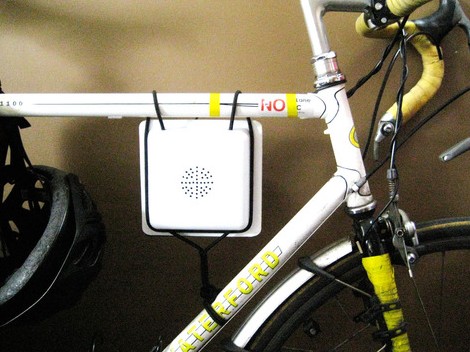
Perhaps it just takes some ingenuity to turn this into a beautiful music maker along the lines of the Force Trainer hack. No problem because the velosynth is a hackable design. The case was made with a vacuum form and inside you’ll find a bunch of small breadboards. The JeeNode, which is an Arduino/Xbee combination, serves as the heart of the device by taking speed and acceleration data from the bicycle wheel. From there it is passed on to various modules, Bob’s your uncle, and sound comes out. Check out their sales pitch after the break and if you’re starting to get some ideas about using this check out the open source info they’ve provided.

Continue reading “Velosynth Annoys Those Around You As You Ride”

Light Up Your Ride With An LED Mohawk

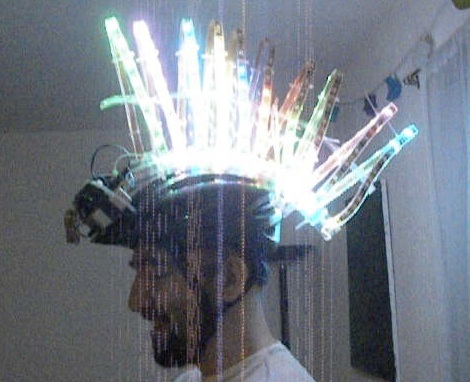
[Garrett Birkel’s] weekly ride usually features some pretty wild costumes. He wanted something to step up his own look so he make this LED mohawk bike helmet. He had an LED strip to start with and found a way to use acrylic and clear plastic tubing to fold the lights into the appropriate shape. From there he designed a PCB for some DC-DC converters to provide regulated power. The juice comes from Lithium Iron-Phosphate cells, the same kind we saw in the electric bike assist battery a few days ago. We find it a bit wild that you can pick out the PWM of the LEDs in the lens effect of that photograph.

Guerilla Theater Hits Two Wheels

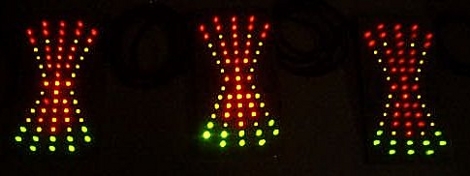
[Tom] wanted to take the show on the road so he added lights to his bike using theater grade control hardware. The picture above shows three tail lights comprised of 195 LEDs. Built on perf-board, a DMX512 controller can display several patterns on each module. The lighting technician (bike pilot) controls the patterns through a series of switches on the handlebars. There’s several pages of details posted including schematics and firmware. This would bring a little extra fun the next time you ride in a Critical Mass event.

Google Bike Hack, Quick And Dirty

Many of the projects we post are so well thought out and engineered, they could hardly be called “hacks”.  This one, however, falls neatly into the hack category. [Dave] wanted his very own exercise bike hooked to Google maps. Instead of setting up a control system and writing software to control Google maps, he simply hacked a USB game controller. He wired a magnetic switch directly into the board, where the “up” button is. Then he mounted the switch so that it would be triggered each time he rotated the pedal.  Though he only has the forward movement done right now, it would be pretty easy to set up a couple more switches at the base of the handle bar for left and right.

While the experience may not be quite as nice as the more complicated one, aside from head tracking, it isn’t that far off.

Bike Controller For Xbox 360

ProjectExciteBike is on its second iteration of an exercise bike controller for Xbox 360. The controller takes pedal input from the cranks of the exercise bike. The sensing is handled by a ring of five hall effect sensors that detect a passing magnet attached to the crank. The sensor data is collected and processed by an Arduino which connects to a wireless Xbox 360 controller for output.

This version of the gaming device includes a fine adjustment widget. It uses a row of LEDs to represent the speed of the pedals and has a slider to adjust how much of an effect this has on the game. This is what we envisioned for the trainer computer we saw yesterday. Take a look at some game play video after the break and dig through the code if you have an exercise bike waiting to be recommissioned.

Continue reading “Bike Controller For Xbox 360”

Bike Trainer Computer: Speed, Cadence, Heartrate, Trainer Temp

[Kurt] was using a bike trainer to get in shape for warmer and dryer biking months. Unfortunately it’s pretty hard to train if you don’t have reliable data concerning how hard you’re working. There’s commercial solutions for trainer computers but he’d read some rough reviews about them and decided to build his own trainer computer. He’s done a great job of integrating a lot of different data collection sources. He picked up two replacement bike computer sensors to use on the back wheel for speed (the front wheel is stationary with this type of trainer) and on the crank for cadence. He also wears a heart rate monitor and sourced a SparkFun heart rate module to gather that data. Finally, an LM235 analog temperature sensor was combined with a spring clamp to detect the temperature of the trainer’s resistance module.

Data from the sensors is collected with a PIC16F73 microprocessor and fed to a computer over a serial connection. He’s got a screenshot of the realtime graphs that he’s using for feedback while on the bike. This is a useful and practical setup but when he get’s tired of exercising he’s just a few lines of code from converting this into a gaming controller.

[Thanks Justin]