CNC Conversions With [Bob]

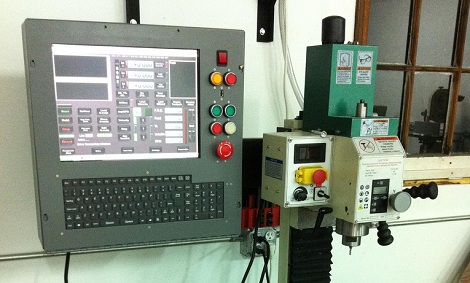
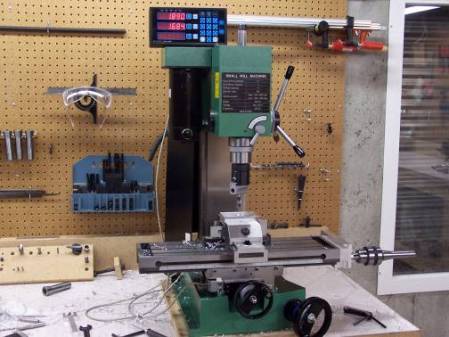
[Bob Berg] emailed in to request that we take a look at his website. We did, and we liked what we saw! [Bob] has done a couple CNC mill conversions and documented the process quite thoroughly.

The first one listed on his site is a Sieg x-3, seen above. [Bob] explains that the first thing he did when he received it was tore it apart and  cleaned it meticulously. We’re not sure if [Bob] was being insanely neat, or if he bought a used dirty unit. Either way, you can’t argue that a nice clean machine is the way to start. After a short while using it the way it was, he added a digital read out for a little more accuracy. From there, he went for a fully motorized conversion.

Keep looking around his site. There is another full build (a lather master RF45) as well as some miscellaneous other projects that are quite interesting.
3D Printer With Insane Accuracy Uses A DLP Projector

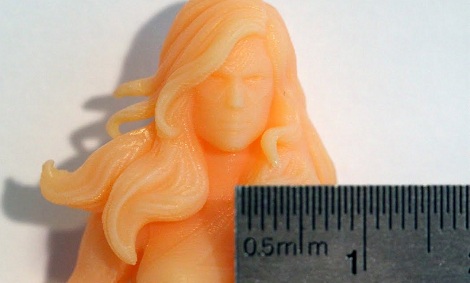
After years of work, [Junior Veloso] is finally getting his 3D printer project out to the public. Unlike the Makerbots and repraps we usually see, [Junior]’s printer uses light-curing resin and a DLP projector to build objects with incredibly fine detail.

One highlight of [Junior]’s project is the development of low-cost resins. Normally, light curing resins are extremely expensive, but [Junior] is actively trying to get the price of resin down to $150 USD per kilogram. A quick back-of-the-wolfram calculation tells us you should be able to print about 7-800 cubic centimeters with a kilogram of resin. It’s much more expensive than plastic filament used in other 3D printers, but that’s the price you pay for quality.

There’s a very popular Indiegogo campaign that is trying to raise money to mass produce the resin and some components of this kit. We’re not impressed with the rewards for this campaign – $59 for a .PDF description of the printer without any dimensions, $159 for a BOM, dimensions and the formula to make your own resin, and $400 for the closed-source software [Junior] devleoped – but hopefully this Indiegogo gets cheap resin out onto the market. There’s a short FAQ about this printer, so we’ll leave our readers to tactfully discuss the merits of this printer in the comments below.

You can check out the process of printing a remarkably detailed alien skull in the video after the break.

Continue reading “3D Printer With Insane Accuracy Uses A DLP Projector”

A Little Geneva Drive Made Of Wood

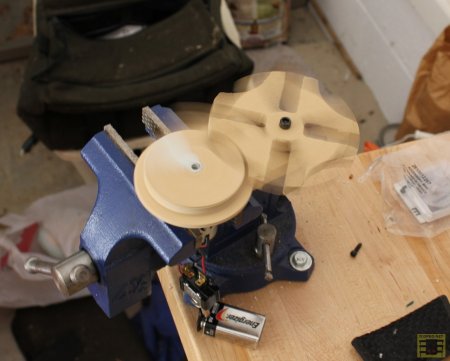
MDF Geneva drive in action

Long ago, before servo motors and linear actuators were common, clever mechanical devices were what engineers used to produce the needed motion for their processes. The CNC-cut Geneva Drive may not be fit for industrial use, but this type of device has been used in everything from film projectors to rotating assembly tables. The constant rotation of the driving wheel is translated into intermittent motion by the [Maltese cross] driven wheel.

The drive and Maltese cross section of this particular drive are made out of MDF with the exception of a putty material that the motor shaft press-fits into. The article claims that this is the only Geneva drive in existence made out of MDF, however, we’d love to see that proven wrong in the comments!

If you’d like to make one of these yourself, CAD and G-code files are given for the hand-cranked version that this Drive is based off of in a separate post.  If you’re not familiar with how a drive like this works, or would just like to see everything in action, be sure to check out the video of it after the break! Continue reading “A Little Geneva Drive Made Of Wood”

Ask Hackaday: Building Nano Scale Antennas

As an RF engineering student, [Camerin] is usually tasked with pointless yet educational endeavors by his advisor and professors. Most of the time (we hope) he sees the task through and ends up pulling something out of his hat, but a few days ago a professor dropped a bombshell on him. After reading this article on nano scale antenna fabrication, a professor asked [Camerin] if it was possible to build a 3D inkjet printer with a ludicrous amount of accuracy and precision.

The full article, Conformal Printing of Electrically Small Antennas on Three-Dimensional Surfaces, was recently published in Advanced Materials and is available via Google Scholar. The jist of the article is that three-dimensional antennas printed on a sphere approach the physical limits of how good an antenna can be. To test out these small, spherical antennas, the authors of the paper built an extremely high-precision 3D inkjet printer that draws antenna traces on a glass sphere with conductive ink.

The positional accuracy of this printer is 50 nanometers, or about half the size of an HIV virus. The conductive silver ink is delivered by a nozzle with a diameter of 100 to 30 µm and prints onto a glass sphere about 6 mm in diameter. This is a level of precision that companies and research institutions pay top dollar for, so we’re left wondering how the authors built this thing.

We’re turning this question over to the astute readers of Hackaday: how exactly would you build a 3D inkjet printer with this much accuracy and precision? Would it even need to be that precise? Post your answer in the comments.

Handheld CNC Fabrication

While loading a 3D model into a CNC program and letting a machine go to town on a piece of stock is awesome, there’s a lot to be said about the artistry, craftsmanship and tactile feedback of carving a project by hand. [Amit Zoran] and [Joe Paradiso] created a nice bridge between these two approaches with their hand-held, but still digitally controlled milling device they call The Free D.

The Free D looks like your run-of-the-mill handheld Dremel tool with an engraving attachment and a few extra servos attached for good measure. These extra parts serve a purpose: the tool actually keeps track of its own orientation in 3D space. With the help of a few magnets underneath the work piece, the Free D sends its orientation back to a computer running a CNC program. When the computer detects the engraving attachment is getting too close to the desired shape, the Free D automatically retracts its own tool head.

Given the insanity or expense in building our buying a mill with six degrees of freedom, the Free D looks like it could be a useful tool in a few model maker’s toolboxes. Check out the demo video of the Free D after the break.

Continue reading “Handheld CNC Fabrication”

CNC Light Painting

Light painting is a technique where a shape is drawn with a light source while a camera is taking a very long exposure shot of it. To do this well by hand would take a lot of skill, so I naturally decided to make my “light art” with a CNC router.

Using this technique, the LED light is treated just like an engraving bit would be under normal circumstances. The difference is that the Y axis is swapped with the Z axis allowing for easy movement in the plane that you see displayed in the picture above. This allows the old Y axis to switch the light on and off in the same way that an engraving bit is lifted to stop engraving and lowered to start (explained here). Instead of a bit though, it’s a switch.

Be sure to check out the video of the router in action (with the lights on) after the break: Continue reading “CNC Light Painting”

Converting A Mill To CNC

For most of the past year, [Joel] has been working on converting a manual mill to a CNC mill with the addition of a computer, brackets and stepper motors. He’s put an amazing amount of effort into his project, and the result is awesome and much less expensive than buying and shipping an old Bridgeport mill.

The project started with this mill from Grizzly. It’s a step above the small ‘hobby mills,’ but still very affordable at $1200 shipped to [Joel]’s driveway. The work began by fabricating an enclosure for the PC and motor drivers out of an electrical panel box. The controller box includes a touch screen, keyboard and computer running Mach3 CNC software. The computer connects to a breakout board with a trio of motor drivers providing power for the stepper motors on each axis.

After a few months (good things take time), [Joel] was ready to attach the stepper motors to the axes of the mill. He’s just put up a few videos of milling copper-clad board for PCBs and surface machining ABS, viewable after the break. For a total investment that is less than finding, buying, and repairing an old industrial mill, we’ll call [Joel]’s project a success.

Continue reading “Converting A Mill To CNC”