Win A Harley In This Design Contest

EBVElectronik of Germany is hosting a design contest based around the STM32F microcontroller. They are inviting engineers and inventors to come up with the best general purpose design ideas, with prizes including a Harley Davidson Motorcycle and a 1000 euro Apple voucher. Even better, they are offering a free STM32 Discovery Kit to anyone who enters, just to get them started. Sound too good to be true? Well, there is one catch. As of right now, entrants are limited to:

Any individual or group of individuals, age 18 and over as of the date of entry and located in EMEA (Europe and Middle East and Africa)

Sorry USA. We have to save some love for the international crowd. Do us a favor and let us know what you are planning to build, or if you win any of the prizes!


BBB #1: The Santa-pede Challenge

Welcome to the first Buy Break Build at hackaday,  sponsored by Adafruit Industries and Make. This challenge will be focusing on dancing Santas, or what is inside them. We’ve seen them everywhere, and may even have one or two in an attic somewhere. These annoying little guys should have enough bits and pieces inside to build some pretty interesting stuff. This time, we want to see a multi-legged walking device. We don’t care if it has 2 legs, 7 legs, or 32 legs, as long as it “walks” using its legs.

Join us after the break for the rules, the prize breakdown, and to find out who the guest judge will be!

Continue reading “BBB #1: The Santa-pede Challenge”

Buy Break Build: A Hackaday Contest Series

We are proud to introduce a new contest here at Hackaday. Buy Break Build will be regular event where we challenge you to make something from something else. We want to work out your hacker brains to come up with inventive ways to use limited parts. We may have a specific product or genre in mind, and a specific out come we would like to get, then we let you guys loose to make it happen. The contests will usually be judged for winners in 3 categories; best presentation,  best use of only the existing parts, and most massive overkill. You don’t have to be an electronics engineer, or even know how to program a microcontroller. You simply document your entire hack with pictures and notes, then submit it to BBB@hackaday.com and we’ll choose the winners. Those winners will be awarded fabulous prizes and Internet fame as we’ll publish your writeup for everyone to enjoy.

Here’s an example to make things a little more clear. Don’t actually go do this one, it is just an example.

Contest: Radio controlled faces.  Everyone has an old R/C car lying around right? Can you use those parts to make an animatronic face? It doesn’t have to be humanoid, but at least recognizable as a face. There would be 3 winners, the one that made the best use of only the included parts, the one that had the best presentation, and the one that went absolutely the furthest overboard.

Remember, this one is just an example, so please don’t run out and get started just yet. We’ll be announcing our first Buy Break Build very soon.

Trossen Robotics Holding Another Contest

3rd place doesn't really shoot lasers that make stuff blow up.

You have until December 1st to get your entry into the Trossen DIY robotics contest. Unlike the last Trossen contest we told you about, this one has no clear theme. The goal is simply to make an awesome robot. Registration is free, and entries will be judged on Ingenuity, Originality, and presentation/documentation. There are prizes for 1st, 2nd, and 3rd places, with the 1st place prize being the Interbotix Hexapod. If you haven’t seen it yet, it is a kit of a hexapod that is pretty quick on its feet. You can catch a video of it after the break.

Continue reading “Trossen Robotics Holding Another Contest”

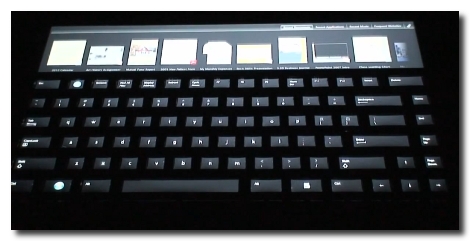
Microsoft Engineers Reinvent The Optimus Keyboard

Looks like Microsoft has come up with a pretty slick little keyboard. It’s very much like the Optimus, which has an OLED screen in every key, except that it doesn’t have a screen in every key. Instead there’s just one screen on the whole unit and they keys have been overlayed on top while allowing the image to show through. Brilliant really, since this should drastically reduce the $2400 price tag of the original. That is, if you could buy the device. Microsoft’s not selling this hardware (yet anyway), but offering it up as test hardware for the UIST Innovation Contest. It will be interesting to see what the students come up with. This keyboard should be easier to program for since it involves manipulating just one screen. There is also extra space at the top that is touch-sensitive. See for yourself after the break.

Continue reading “Microsoft Engineers Reinvent The Optimus Keyboard”

Hack Together Some Science Stuff, Win Money

plumbers_special_vacuum_pump

Ok hackers, it is time to show what you are made of. [Michael] has issued a challenge. He is willing to pay for hacked together science tools that meet some accuracy and price  requirements. You could win money for doing what most of you are already doing. He needs a few specific things, so go to his site to see what he’s looking for. The goal here is to bring scientific equipment down to a price level that allows a broader audience  to access it. Come on guys, it’s for science!

[via Makezine]

Review: The Manga Guide To Electricity

title

“The Manga Guide to Electricity”, part of “The Manga Guide” series by No Starch Press, is a novel approach to the old problem of getting over the initial mental block when trying to learn electronics.

We decided to compare this book to another introductory text: “Getting Started in Electronics” by [Forrest M. Mims].  [Mims]’ book is a handwritten masterpiece of electronic literature. The writing style is friendly and concise, the examples are simple, and the drawings are excellent. It also makes sure to keep the learning process as application based as possible. Unlike other books, it doesn’t bog the reader down with math and theory that is only useful to advanced students. Since its original printing in 1983, [Mims]’ has become the de facto standard for beginner electronic literature. Continue reading “Review: The Manga Guide To Electricity”