MIT Students Take Tetris To A Grand Scale

Careful, this hack might foster doubts about the level of fun you’re having at you own Computer Science department. Last weekend a group of students at MIT pulled off a hack of great scale by turning a building into a Tetris game board.

The structure in question is the Green Building on the Massachusetts Institute of Technology Campus. It houses the Earth, Atmospheric, and Planetary Sciences Departments, but was chose based on the size and regularity of the grid formed by the windows on one side. The group hasn’t provided much in the way of details yet, but the video after the break shows the game play and start-up screen. The middle portion of the building is used as a scrolling marquee to display the word “Tetris” before the game pieces start falling. We’re only guessing (and we hope you will add your conjecture in the comments section) but we’d bet they assembled a set of wireless RGB LED lamps and set one on the sill of each window. There does seem to be a number of ‘dead’ pixels, but it doesn’t diminish the fun of the overall effect.

If you don’t have your own building to play on, you should go small-scale and implement Tetris on a character display.

Continue reading “MIT Students Take Tetris To A Grand Scale”

Drilling Precise Grids

precision_hole_drilling

Drilling precise grids without a CNC machine can be tough to pull off. [Ookseer] has come up with a nifty method for dilling aligned holes with a drill press. He uses a right-angle jig on a Dremel drill press with stacks of business cards as spacers. The same number of cards is added between the substrate and the jig to space each new hole evenly. This method comes in handy when drilling grids in an enclosure for speakers, temperature sensors, or for an aesthetically pleasing design.

Maker Faire 2008: Puzzlemation


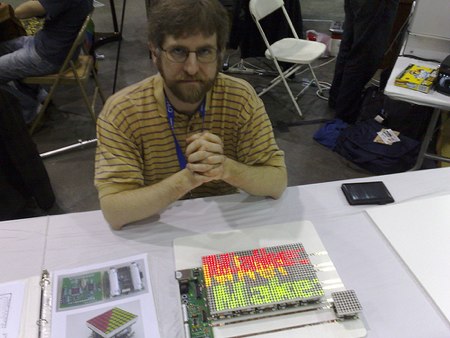
[John Peterson] showed us his Puzzlemation, animated tile puzzle at Maker Faire. It was originally designed for the Microchip 16-bit Embedded Control Design Contest. The puzzle is made from multiple modules each with an 8×8 LED grid. The tiles are battery powered and each one has PIC24FJ64GA004 microcontroller. They sit on a tray with flat copper strips as a serial bus. The tray controller broadcasts the animation to the tiles. Each tile waits for its unique identifier and saves that portion of the animation. The tiles don’t actually know what order they’re in so once the animation is in motion you can figure out their proper order; rearranging them so the animation is correct. We’ve got a video of it in action after the break.

Continue reading “Maker Faire 2008: Puzzlemation”