
AMOC And The Planet-Wide Impact Of Ocean Currents

Although it can be hard to tell from looking at the often placid waters of the Earth’s oceans, their currents carry immense amounts of water around the globe on a daily basis, underlying a dynamic system that – much like the Earth’s atmosphere – plays a major role in everything from weather systems to local climates and ecosystems.

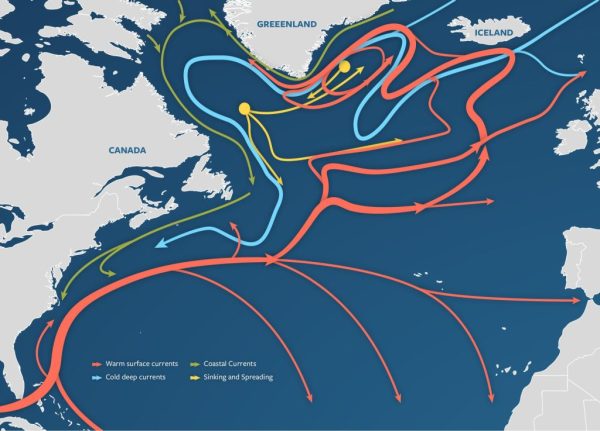
Of all these ocean currents the Atlantic meridional overturning circulation (AMOC) is perhaps the most famous, as it is basically the sole reason why Europe has the mild climate that it does today, courtesy of it carrying thermal energy from the equator all the way to the coast off Scandinavia.

Although collapsing an ocean current seems as improbable as stopping the jet streams in the upper atmosphere, it’s actually significantly easier due to how much ocean currents rely on factors that we can fairly easily influence. Over the past decades we have seen worrying signs that the AMOC is indeed weakening, with the million-dollar question being what scenario we’ll be looking at.

While collapsing the AMOC within a decade may be theoretically possible, current models seem to point towards a weakening by about half by the end of this century, with a recent research article by Valentin Portmann et al. inĀ Science Advances going over the various statistical models to come to this conclusion.

Continue reading “AMOC And The Planet-Wide Impact Of Ocean Currents”
Drone Buoy Drifts Along The Gulf Stream For Citizen Science

It may be named after the most famous volleyball in history, but “Wilson” isn’t just a great conversationalist. [Hayden Brophy] built the free-drifting satellite buoy to see if useful science can be done with off-the-shelf hardware and on a shoestring budget. And from the look of the data so far, Wilson is doing pretty well.

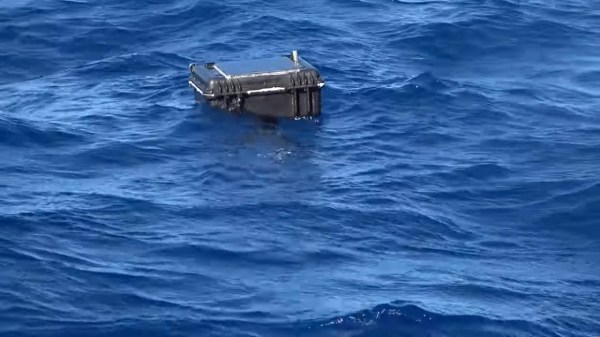
Wilson belongs to a class of autonomous vessels known as drifters, designed to float along passively in the currents of the world’s ocean. The hull of [Hayden]’s drifter is a small Pelican watertight case, which contains all the electronics: Arduino Pro Trinket, GPS receiver, a satellite modem, and a charger for the LiPo battery. The lid of the case is dominated by a 9 W solar panel, plus the needed antennas for GPS and the Iridium uplink and a couple of sensors, like a hygrometer and a thermometer. To keep Wilson bobbing along with his solar panel up, there’s a keel mounted to the bottom of the case, weighted with chains and rocks, and containing a temperature sensor for the water.

Wilson is programmed to wake up every 12 hours and uplink position and environmental data as he drifts along. The drifter was launched into the heart of the Gulf Stream on August 8, about 15 nautical miles off Marathon Key in Florida, by [Captain Jim] and the very happy crew of the “Raw Deal”. As of this writing, the tracking data shows that Wilson is just off the coast of Miami, 113 nautical miles from launch, and drifting along at a stately pace of 2.5 knots. Where the buoy ends up is anyone’s guess, but we’ve seen similar buoys make it all the way across the Atlantic, so here’s hoping that hurricane season is kind to Wilson.

We think this is great, and congratulations to [Hayden] for organizing a useful and interesting project.

Continue reading “Drone Buoy Drifts Along The Gulf Stream For Citizen Science”






