High Voltage Hacks: Shrinking Coins

The anthem for the Great Recession might be something along the lines of, “That we’re gonna do it anyway, even if doesn’t pay.” Some men just want to watch the world burn, so Hackerbot Labs posted a great walkthrough about shrinking coins and in the process making our pocket change worth just a little bit more.

Their build pushes 15,000 Joules (from a 10kV 300μF cap) through a coil of wire wrapped around a coin. This creates a magnetic field in the coil and the coin. These two fields repel each other, and there’s only one way that it can end: the coin shrinks and the coil of wire explodes. The team at Hackerbot Labs linked to a great theory of operations that does a great job explaining the physics has some awesome pictures.

During our research, we saw a few questions about the legality of altering currency. According to the U.S. Code, shrinking coins only illegal if it’s done fraudulently, like shrinking a penny down to the size of a dime to fool a pay phone or vending machine. Check out a video of the Hackerbot Labs setup putting as much energy as 100 heart defibrillators into a coin after the break.

Continue reading “High Voltage Hacks: Shrinking Coins”

High Voltage Plasma Lamp Is Also Tasteful Steampunk

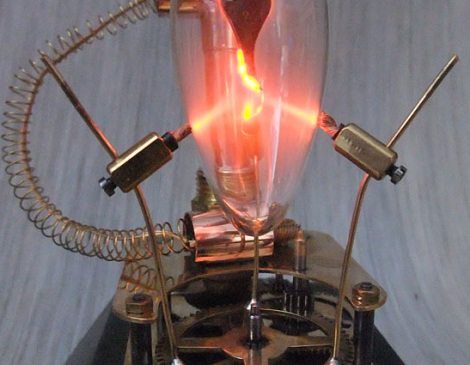
Instructables user [Admiral Aaron Ravensdale] just finished a high voltage plasma bulb build that makes creative use of off-the-shelf parts. As a self-described steampunk, [Adm. Ravensdale] also earned some cred by included working gears in his build.

The heart of the build is a “flicker flame” candle light bulb. These light bulbs have two flame-shaped plates inside the bulb to act as electrodes. Instead of the Argon that normally fills an incandescent light bulb, the candle bulb is filled with Neon. When excited, Argon gives off a rather unnatural purple glow – not very convincing for a simulated candle and certainly not steampunk. The Neon in the flickering candle bulb gives off a brilliant orange, perfect for simulating a flame and will surely impress the duchess during afternoon tea.

After the right plasma bulb was found, [The Admiral] scavenged the rest of the high voltage electronics from disposable cameras. Attaching three electrodes to a brass gear, the entire mechanism was made to spin using parts from an old clock and a CD drive motor. We’re always impressed with the scavenging abilities of steampunkers – we’d still be waiting for our gears to arrive if we attempted this. Check out the video of this really cool and very inexpensive plasma bulb after the break.

Continue reading “High Voltage Plasma Lamp Is Also Tasteful Steampunk”

Who Knew Jacob’s Ladder Builds Had So Many Options?

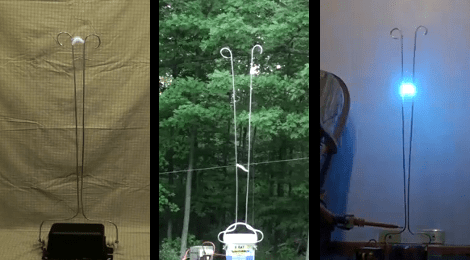
[Grenadier] has a thing for the high voltage and, as you can see, he’s found multiple ways to build the icon of HV toys – a Jacob’s Ladder.

The three look similar, but they use different means of generation the voltages necessary to get a spark to jump through the air. The exhibit on the left uses a neon sign transformer, the one in the middle is based on a transformer from an X-ray machine, and the example to the right uses a microwave oven transformer. [Grenadier] discusses the pros and cons of each method, then links to his in-depth posts about working with each one them. There are also videos for all three. We’ve embedded the video for the microwave oven transformer after the break. That version of the Jacob’s Ladder requires some way to start the spark and in the video he’s doing it manually. There is always the option to add a solenoid to do the job but he does mention that you can’t just let it run because that cheap transformer will burn out before long.

If you like what you see here, perhaps you’ll be entertained when he runs HV through some soda cans.

Continue reading “Who Knew Jacob’s Ladder Builds Had So Many Options?”

Controlling Muscles With High Intensity Magnetic Pulses


ben_krasnows_transcranial_magnetic_stimulation

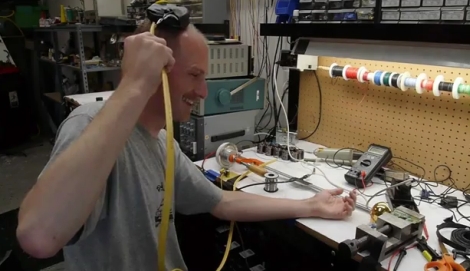
We’re not quite sure what’s going on with our fellow hackers lately, but they all seem quite interested in finding inventive ways to scramble their brains. [Ben Krasnow] has put together a pair of videos detailing his experiments in transcranial magnetic stimulation, a process that looks like it would go quite nicely with the Brainwave Disruptor we showed you just yesterday.

Instead of building a coil gun with a set of supercapacitors he had on hand, [Ben] decided to build a magnetic coil that can be used to stimulate his brain through his skull. Once his capacitor bank is charged, a high current pulse is sent through the coil held against his head. This pulse generates a strong magnetic field in the coil, which in turn produces neuron stimulation in his primary motor cortex.

Be sure to watch both videos embedded below, as the first one mostly covers the theory behind his experiments, while the second video gives us the goods.

[Ben’s] day job involves working with professional grade TMS devices, so he has some experience with this technology. Before you try this on your own, be sure that you are doing this safely, because a misdirected pulse of 1700 volts to the head does not sound like a fun time at all.

Continue reading “Controlling Muscles With High Intensity Magnetic Pulses”

Turning Beer Cans Into Bells With 35kV

It looks like we now have another way to annoy ourselves with extremely high voltage.

The bells operate under the same principles as the electrostatic see-saw we covered last month. A voltage is applied to one can while the other can is grounded. An insulated pendulum is placed between each can, and with a little coaxing can be made to oscillate back and forth between the cans. As the pendulum touches the charged can, it is repelled as it gains the charge and moves to the grounded can. There, the charge is released and the cycle continues again. A homemade Cockcroft Walton multiplier is used to generate the +35kV needed to get the pendulum moving.

[Ben Franklin] invented the Franklin Bells while he was investigating electricity in the 1750s. Originally an extension of the kite & key experiment, the bells were historically used to warn of approaching thunderstorms – when the bells rang, the atmosphere was charged and lightning could strike. Even though the voltage between the bells is huge, very little current is drawn – the Oxford Electric Bells have been ringing since 1840 using the same electrostatic battery.

A Big Transformer, Because It’s Cool!

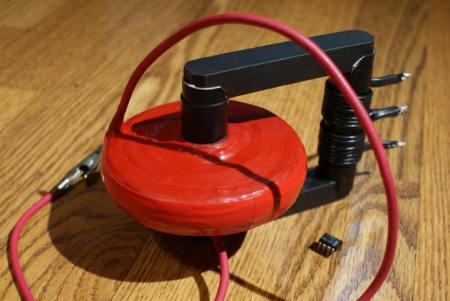
[Grenadier] Had some spare wire, electrical tape, and a giant ferrite core laying about and decided to create a massive and pretty snappy looking disk shaped flyback transformer. Dubbed the Fryback, he claims that it will “revitalise your health and bring wondrous wealth and prosperity to your family”.

He chose a disk shaped transformer because they look cooler, fair enough.. (oh and they reduced inter-winding capacitance and the voltage difference between layers). The construction is fairly simple, but time consuming. Grenadier goes through the important steps on his website, but be prepared for 25 hours of winding wire if you decide to make your own.

Running at 48V the Fryback can output 8kV at a very high current, producing some nice thick 30cm long sparks. Check out the video after the break to see the Fryback in action.

Continue reading “A Big Transformer, Because It’s Cool!”

DIY High Voltage Electric Field Detector

electric_field_detector

Who needs a Fluke high voltage detector when you’ve got one of these things?

Actually, we still recommend a professional high voltage detector for serious work, but you’ve got to like this electric field detector that [Alessandro] recently put together.

The detector works by using a JFET to detect the high impedance electric fields that are generated by high voltage lines. The JFET amplifies the signal while dropping the impedance in order to drive a pair of NPN transistors which are used as a threshold amplifier. Once the voltage hits 3V, an LED is lit, indicating the presence of high voltage near the detector’s probe. A wire-wrapped resistor does double-duty serving as the probe while providing a high impedance path to ground, ensuring that stray charge does not accumulate on the JFET’s gate, causing false readings.

It’s a neat project, and something that can be constructed in no time, making it perfect for beginner electronics classes.

Keep reading to see a quick video of the HV detector in action.

Continue reading “DIY High Voltage Electric Field Detector”