Although identifying what we can see with our eyes feels like the most natural thing in the world, the responsible cognitive processes running on our brain’s wetware are quite a marvel. Even when pushed beyond their evolutionary design by e.g. driving a car at high speeds does our vision system mostly manage to keep up. Emulating these cognitive processes with artificial cognition (AC) systems like computer vision required the development of feature extraction algorithms, such as the Hough Transform that’s the topic of this video by [The Synthetic Mind].
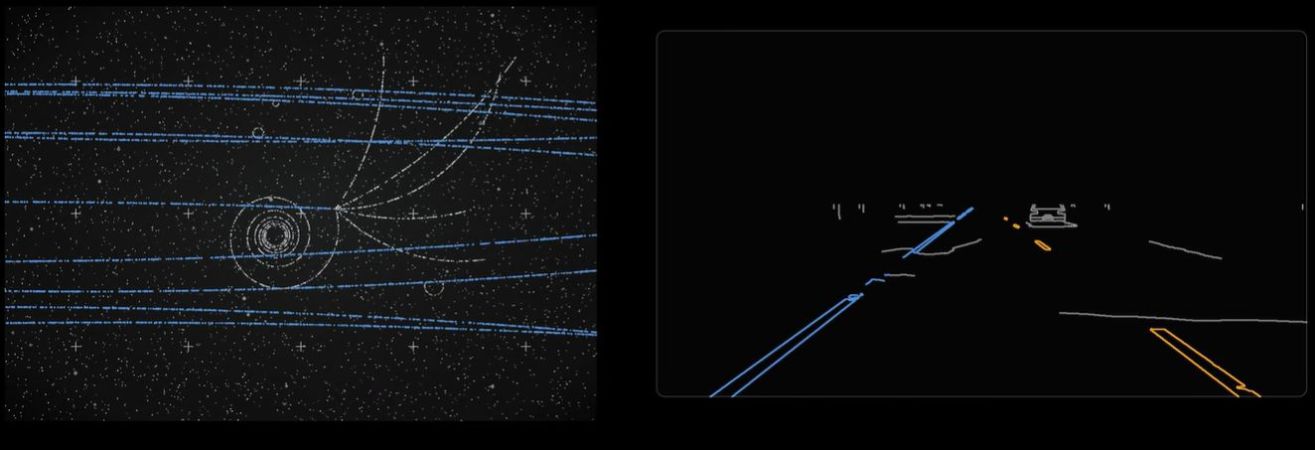
 The Hough Transform was developed originally by [Paul Hough] in the 1960s for machine analysis of patterns in bubble chamber photographs. From there the basic algorithm has evolved beyond merely detecting the straight lines of particles zipping through said bubble chambers.
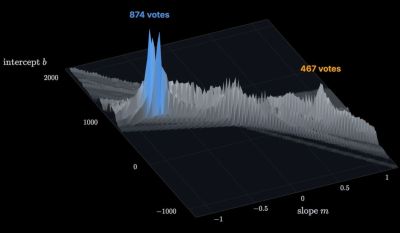
Key however remains determining the points in a scene which potentially make up the lines, which requires edge detection. Yet unlike in basic examples, real-life use of these algorithms is made hard by how complex a real-life scene is. Naively checking all possible lines as in the original algorithm would take far too long, which led to the development of optimizations that take considerably less time and deal better with pixel noise.
Of course, after finding all potential lines and borders of objects in a scene the next step for a computer vision is to identify what has been spotted, what it means for the current task and determine an appropriate action. Here getting additional scene information other sensors like radar or Lidar can be incredibly helpful, especially when you’re the system in control of something like a car.
Examples like these definitely promote an appreciation of how hard it is to create AC algorithms that can emulate what we animals can seem to do almost effortlessly. Even before considering the intelligence subset of cognition, one cannot help but marvel at the sheer effort it takes for us humans to not constantly bump into things.
Continue reading “How Hough Transforms Enable Computers To See”