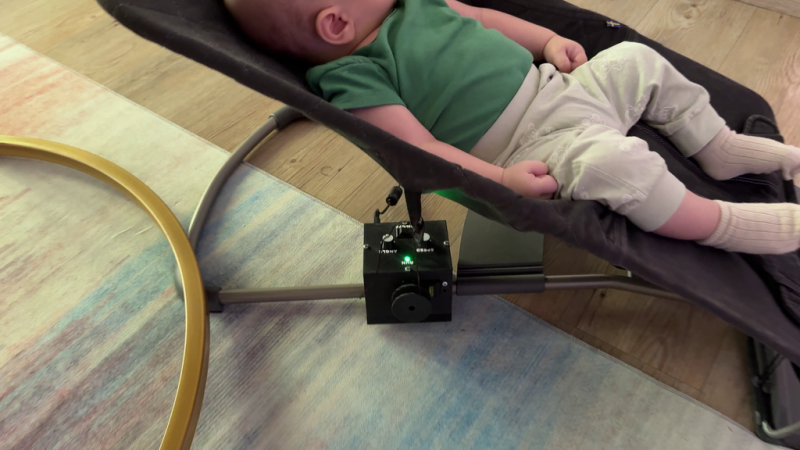
Any parent with a baby and deep pockets– or friends with deep pockets– will probably sing the praises of the BabyBjorn rocking sling chair. A simple spring-loaded sling seat allows you to rock a child to sleep like magic– but you do have to rock the child. In the tradition of fathers everywhere since the stone age, [Ceyhun Karataş] saw that as something to tinker around, creating his Automatic BabyBjorn Bouncer/Rocker with a servo, an Arduino, and some 3D printed parts.
You still can’t leave your child unattended with this hack, [Ceyhun] takes pains to point out, but it will free a hand so you can keep junior happy while tinkering up other toys for him or her. Music players are a popular staple, for example.
You should have plenty of time for such projects, because it won’t take long for you to replicate [Ceyhun]’s invention– it’s only as complicated as it needs to be, which is not very. The servo, a Futaba S3003 which is mounted to the bottom of the rocker in a 3D printed case, reels the baby in with a string tied to the bouncing seat portion. The BabyBjorn’s built-in spring bounces junior back up. As stated, Arduino Nano controls the servo, with two potentiometers in the build allowing you to control the speed and amplitude of the bounce independently to get the perfect naptime ratio. Everything you need to get started — aside from the hardware and the child– is available at the link above. You can see it in action in the video below, which in spite what you may fear from the Turkish thumbnail, does have authentic English audio, not AI auto-dubbing.
If you’ve got the baby but not the bouncy chair, have a gander at this mechatronic crib that does something similar on a much larger budget.
Thanks to [Ceyhun] for overcoming the new-parent sleep deprivation to document this project and send in a tip.
Continue reading “Automatic Naptime With BabyBjorn Bouncing Servo”