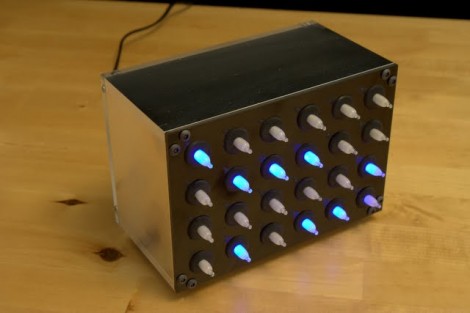
Neon Binary Clock

[Josiah] said ‘no’ to LEDs and instead used blue-phosphor neon lamps to build this binary clock. The ATmega328 inside uses three 8-bit shift registers to control the display. Each lamp needs a high-voltage NPN transistor in order to switch on the 150V necessary for proper illumination. A simple circuit was used to pull a 60 Hz clock signal out of the incoming 16VAC power. Unfortunately it was a bit too simple and didn’t provide a clean signal. [Josiah’s] workaround is something of a debounce subroutine in the firmware to prevent multiple interrupts on the falling edge.

The last project we saw from [Josiah] was the Coachella Lamp. That was a show piece of antiquated technology and this is another show piece with a minimalistic style. We also liked seeing the protoboard work on the inside. That’s a pretty jam-packed circuit board and keeping everything in the right place while you build up each trace with blobs of solder is no small feat.
Waking Up With The (fake) Sun

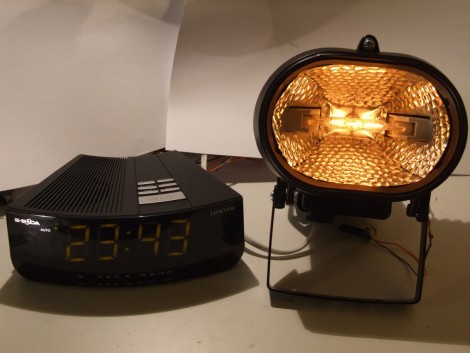
[Bogdan] has some trouble getting up in the morning. A blaring alarm will do the trick but that’s no way to start the day. To get him through the dark winter months he wanted to try a sunrise simulator. He patched into the alarm signal of his bedside clock, intercepting the command from the clock’s microprocessor and using it as an input for his own ATtiny13. From there, the tiny13 gradually brightens a 150W halogen lamp using a triac until his room is as bright as a July morning. A signal is then sent to the alarm clock’s audio amplifier to turn on the audible alarm. He’s got the system set for a 20-minute sunrise so it’s just a matter of programming his alarm 20-minutes early than the ‘I absolutely have to get out of bed now’ time.

No Touch LED Lamp

[youtube=http://www.youtube.com/watch?v=8wV2UIOV1Fk]

This elegant looking lamp uses capacitance sensing to turn on and off. [Mikey77] takes us through the process of making the curved circuits and putting it all together. The circuit is built to be modular, so he could use it elsewhere. That’s a pretty good idea for someone who is always tossing projects together. As usual, schematics are available in the instructable. We love this design and would proudly use this at our office desk.

Cooling LEDs By Heating The Water Saves On Electricity

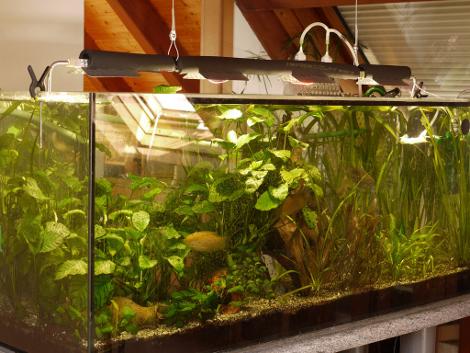
[Matthias] swapped out his twin-tube florescent aquarium lights for LEDs. By running tank water through the aluminum LED mounts he’s transferring excess heat into the water in the tank, in turn saving some of the electricity that would have been used to heat the tank. Couple this with roughly 35 Watts saved by moving away from fluorescent tubes and he’s got a great energy-saving hack. The LEDs used in the last aquarium light conversion were cooled by heat sinks and fans. We’d love to see this concept incorporated into that design.

Fix A Projector On The Cheap

[j] sent in this nice writeup on how to revive a dead projector. he managed to pick one up for $20 that had a broken bulb. While the prices of bulbs have come down considerably, they can still be a couple hundred dollars. Being resourceful, he decide to just use a halogen bulb that he picked up at his local big box shop. In the photos, he’s using a 50w mr16 bulb. The results really aren’t too bad. Especially considering that his cost for the entire project is now roughly $25. He does, however suggest that a 100 watt bulb wouldn’t be a bad investment.  His projector seems to need some cleaning and adjustment in the lenses as well, but for $25 it isn’t too shabby. We’ve had this submission for a bit, but it didn’t have any pictures of the projector actually working. During our conversation, we may have possibly suggested a picture we’d like to see. You can find it after the break.

We did cover a very similar one last year, which had the driver integrated into a custom bracket, but the project page seems to be gone. There is also the possibility that the projector you get doesn’t just have a bulb problem. Sometimes it is the polarizer that needs replaced.

Continue reading “Fix A Projector On The Cheap”

Roundup: Simple Hacks

simple-hack-110909

Here’s a collection of simple hacks you can do in between larger projects. After the break we’ll look at converting an iPod from hard drive storage to Compact Flash, build an LED desk lamp using LEGO and USB power for charging, and use an Arduino shield to add network control at the touch of a button.

Continue reading “Roundup: Simple Hacks”

700 Lumen LED Bike Lamp

700_lumen_bike_lamp

We’ve seen bright bike lamps before. This one caught our eye because it needs a heat sink while in operation. [700lumenLED] built a super bright light for his bike that features an aluminum enclosure and heat sinks to protect the LEDs against overheating.  Some nice work was done incorporating the 12v battery into a bike bottle with the power switch and a dimming potentiometer attached to the bottle cap.