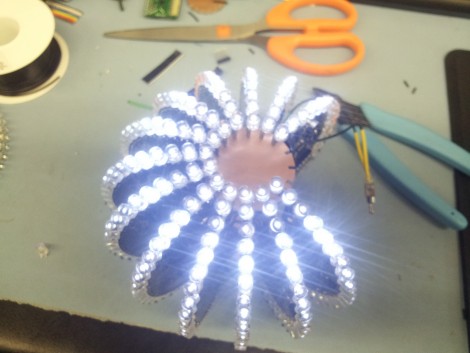
Display Made Out Of Hundreds Of Seven Segment LEDs

While huge LED panels are a relatively common project du jour for people wanting to flex their engineering muscle, we’re taken aback by the sheer beauty of [Skot9000]’s huge LED display made of seven-segment displays. He calls the build DigitGrid, and it’s a wondrous display the likes of which we’ve never seen.

To build a display based on seven-segment LEDs, [Skot] went with a modular approach in designing the DigitGrid. To power and control all these seven-segment displays, [Skot] used a Texas Instruments TLC5920 to run four 4-digit displays as a single module. Four of these modules connect together to form a row of 32×2 digits, and eight rows of digits come together to make a 512-digit display. With seven LEDs for each digit, that works out to 3,584 4,096 individual LEDs for the entire panel.

To power and control this gigantic array of LED displays, each row uses a PIC16F microcontroller which, in turn, is controlled by an FPGA. After several hours of writing Verilog, [Skot] had a reasonably good hunk of software that allowed him to send frames from his computer to the display. The results, quite simply, are amazing. [Skot] managed to put up a short film showing off the animation capabilities of his new display, and it’s a wonder to behold. You can check that video out after the break.

Continue reading “Display Made Out Of Hundreds Of Seven Segment LEDs”
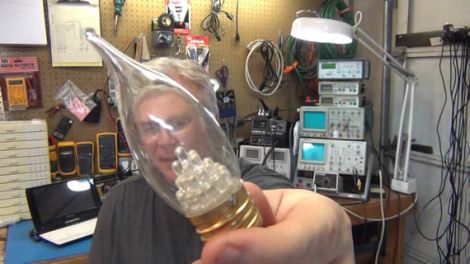
Tearing Down A Failed LED Bulb

todd-harrison-led-bulb

[Todd Harrison] was thinking of replacing some incandescent light bulbs in his house with LED models, so and his wife picked up a single candelabra bulb to test before they spent the cash to swap them all out. The bulb died in about a week’s time, so [Todd] got out his trusty electronic disassembly device (his hammer), sharing his post-mortem examination with us.

After taking a cursory look at it, [Todd] found that the circuit powering the bulb was not overly complicated. A small bridge rectifier along with a few caps and resistors are all that was used to power the device, making it’s failure a bit puzzling. When [Todd] wired it up to his power supply, the bulb lit up, much to his surprise. His best guess as to why it died is that the shrink wrap around the PCB managed to cause a short, though he also noticed that one of the bridge rectifier’s legs was not soldered down.

He started tooling with the light to find out more about it, but he managed to blow out a handful of LEDs in the process. All in all the LED lighting swap was a disappointment, but at least he had some fun along the way!

Continue reading if you’re interested in seeing [Todd’s] diagnosis in its entirety.

Continue reading “Tearing Down A Failed LED Bulb”

USB Controlled SPÖKA Night Light

usb-controlled-spoka-nightlight

[wejp] picked up an IKEA SPÖKA night light, but he wasn’t entirely impressed with its functionality. Pressing the top of the ghost’s head causes it to cycle through a few colors, and pressing it a second time locks it into displaying the current color until its tapped again. Inspired by this SPÖKA hack which used a different version of the night light, he tore his down to see what he could do with it.

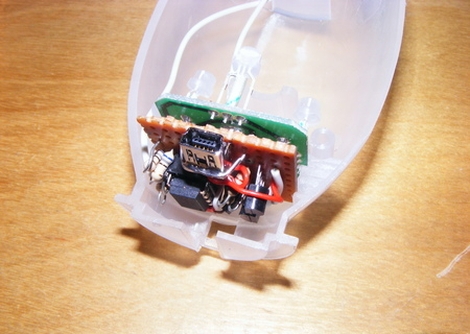
Upon stripping off the outer cover, he found that the internals were considerably different than those found in its glowing brethren, though they were perfect for what [wejp] had in mind. He removed the rechargeable battery pack as well as the controller board, which sits on a PCB separate from the LEDs. He replaced the stock micro with an ATtiny25, which he uses to give himself a bit more control over the light display.

He couldn’t quite cram all the functionality he desired into the ATtiny, but he planned on powering the light using his computer anyhow, so he installed a small USB port in the back. When connected to his PC, the SPÖKA can be controlled more precisely than when it operates alone.

Unfortunately there’s no video available of the SPÖKA light in action, but there are plenty of images available on his site.

Doubling Up On The USB Supercap Flashlight

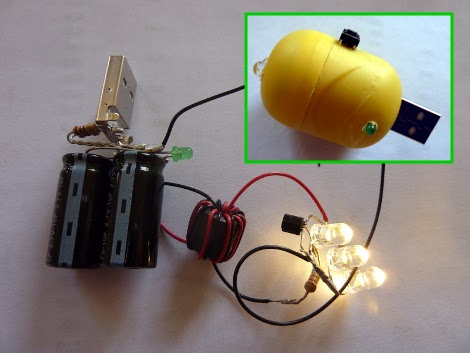
[Antoine] wrote in to let us know that he soldiers on with his flashlight project. He’s doubled up on the supercaps and tripled the LEDs (translated).

The core concept has stayed the same since the original version. He wanted a flashlight that was small and used no batteries. This iteration came about as he looked at increasing the light output of the device. He’s switched to some warm-white LEDs which are easier on the eyes, but was unhappy with the charge life now that he’s using current at a faster rate. The solution, of course, is more potential from the capacitor. He’s now using two 10 Farad caps in parallel. We are a little skeptical about his capacitor theory and ended up using this lecture to defog the issue of parallel and series capacitance.

The upgraded hardware is right at home in that plastic egg like you’d find in a coin-op trinket vending machine. You’ll see there’s still a colored LED to warn when the charge is getting too low.

Giving Old Appliances A Second Life With Simple Tweaks

blender-light

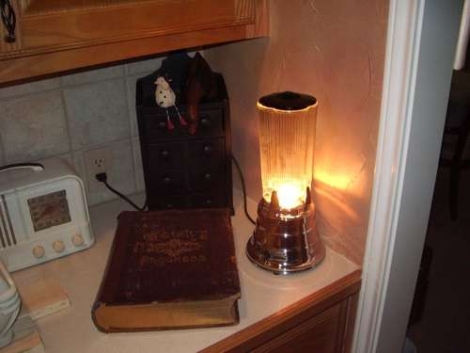
Cruising estate sales can be a total crapshoot – sometimes you find a goldmine, other times nothing but junk. [John Ownby] recently found a sleek-looking old blender at such a sale and decided to take it home. The chrome plated base and fluted glass immediately caught his eye, but he didn’t buy the blender so he could make mediocre frozen drinks – he wanted a lamp instead.

The conversion was fairly simple, requiring him to gut the machine of its moving parts including the motor and blades, replacing them with a small incandescent candelabra base. While his modifications themselves are not groundbreaking, taking them a step further would make for some really cool (and functional) retro house fixtures.

Indulge me for a moment, if you will, and imagine swapping out the simple incandescent bulb for some LED strips or even EL wire. Replace the blender’s cap with a small speaker, and you can use several of these together as retro-looking surround satellites.

We can definitely get behind his reuse of the blender, which would have otherwise likely ended up in a landfill. It’s great to see solid, durable appliances given a second life, even in ways which were never intended. Have you rescued anything from the trash heap like [John], or do you have other ideas for your fellow hackers who might come across similar goods? Let us know in the comments.

Ask Hackaday: Did You Catch The Grammys?

Although award shows aren’t necessarily our thing, [T. D.] sent in something that piqued our interest. His friends recently got back from the Grammy awards where they witnessed thousands of LED bracelets blinking in time to a performance by Coldplay. A little bit of YouTubing pulled up this video that demonstrates the effect (because that video will probably be taken down shortly, just pick something from this link).

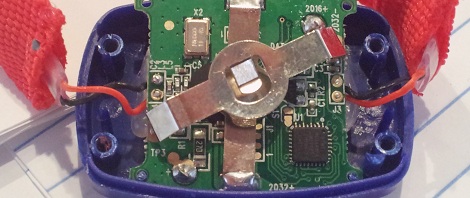
[T.D.]’s friends brought one of these bracelets back with them and like a good Hackaday reader, he cracked it open. This is the precious board pic that [T.D.] sent in. We’re pretty confident that the IC is an ATMega48PA, but beyond that we’re not quite sure how these bracelets can, “light up and flash at precisely the right time” as [T.D.] puts it.

From what we saw on the Grammy broadcast, it’s possible these bracelets merely flashed whenever the user clapped their hands. A circuit that simple doesn’t require a microcontroller, so we’re left wondering what the heck is going on here. If you’ve got an idea of how these choreographed light display bracelets work, drop a note in the comments.

EDIT: Commentors have pointed out these wristbands are called ‘Xylobands.’ There’s a great video of these wristbands in action at the 2011 X Factor finale.

384-LED Ball Receives Animation Wirelessly And Knows Its Orientation

We get a ton of tips about Kickstarter projects. Here is a great example of what we need to see in order to feature one of them. This LED Blinky Ball developed by Null Space Labs is the target of a rather ambitious fundraising campaign. But in addition to the fundraising write-up they’ve shared extensive details about the prototype.

The ball is made up of sixteen slices; each is its own circuit board hosting an LED driver. All slices use the same PCB design, but one of them has an ATmega328 populated on the board to act as master. Optional components on the master board include an accelerometer, and a Bluetooth module to receive animation data. To get the full effect of the most recent prototype you’re going to want to see the video on their Kickstarter page.

Think this ball looks familiar to you? The original design was developed by [Nikolai] as a performance piece for a friend. This version was inspired by our feature of that earlier project.

So, use this as a template if you’re planning to submit your Kickstarter links to Hackaday’s tips line. We want to juicy details on the project!