Dr. Boardman’s Color Conundrum

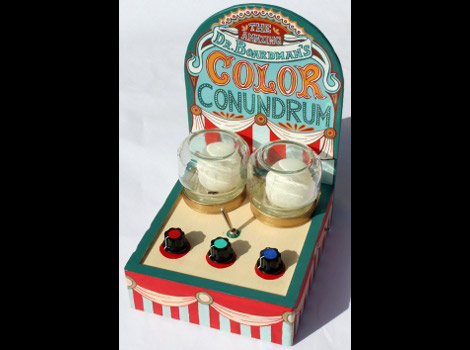
We feel like trumpets should be sounding. Someone took the overused project of connecting RGB LEDs to a microcontroller and produced something useful. [Paul] created Dr. Boardman’s Color Conundrum which works much like a simple mechanical coin-op game you might find at a carnival. When switched on, a random color is displayed by the ping-pong ball covered LED on the left. The player then manipulates three knobs to color-match the two lights.

Inside you’ll find a minimalist set of hardware. An ATmega8 polls the three potentiometers and uses them to mix the appropriate user color. Everything is wired-up using prototyping board and draws power from two AA batteries. He’s using a random seed stored in EEPROM and increments it every time the uC boots up. This keeps the input color different for every game.

Fun and simple, it’s not going to make your guests marvel at the complexity but [Paul’s] come up with a unique game that we think has marketing potential.
Lucid Dreaming

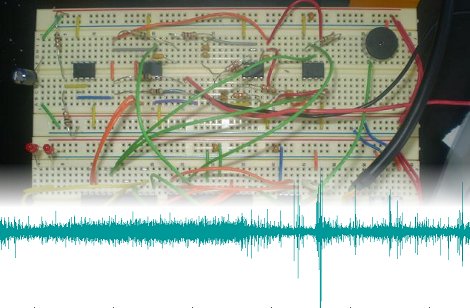
When we saw [merkz] use of an Arduino to produce lucid dreaming we were quite shocked. Unlike typical setups that just flash a light through sleep, his system monitors eye movement through electrodes and is able to send the data to a computer for graphing and analyzing.  The only problem being we couldn’t find a circuit diagram or code.

Not ones to be shot down so quickly, a Google revealed this thread on making ‘Dream Goggles’, which was really a Brain-Wave Machine based on the parallel port. Some modifications of an ECG collector’s electrodes using sound cards, and you could have your own lucid dreaming.

[Thanks Phil]

LED And Fan Controller

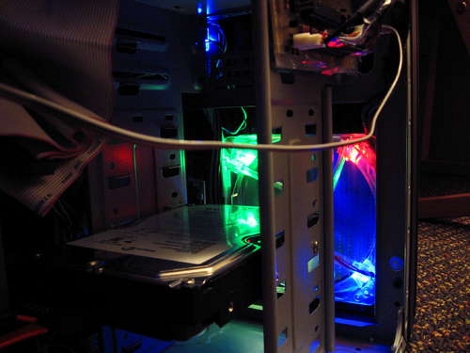
Needing a front fan to keep his hard drive cool, [CalcProgrammer1] found he was unhappy with a single LED color for the fan. He swapped them out for a set of four RGB LEDs and whipped up his own controller board for the unit. It is based around an ATmega168 and patches into the COM2 header on the motherboard, providing a serial interface. [CalcProgrammer1] wrote a GUI to control fan speed, and individual LED color settings. You can take a look at and enthralling, edge-of-your-seat demonstration of how slider controls work after the break. Wouldn’t it be great if the HDD LED clock could be adapted to use a fan so that the front panel had a colorful analog dial on it? Continue reading “LED And Fan Controller”

10×10 LED Matrix

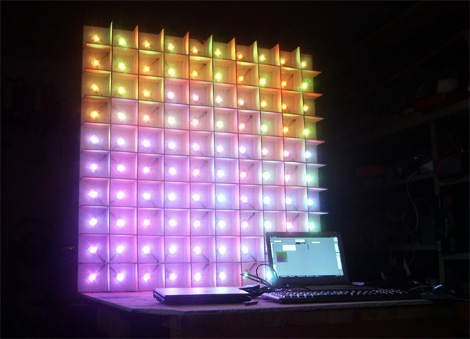
[KopfKopfKopfAffe] just finished a 3-year labor of love resulting in this 10 by 10 LED Matrix. This trumps the Shiftbrite table from earlier today by bringing an actual 100 LEDs to the display. These LEDs cost much less than the Shiftbrites, but since they don’t have their own on-board controller this project requires much more back end work. A total of 25 ATmega8 microcontrollers drive this display, in turn controlled via an RS-232 connection to a computer.

We love the Lemmings animations. It made us realize that this would be a great candidate to play Super Pixel Bros on. Check out the video after the break for snapshots of the hardware as well as videos of the matrix at play. You may also want to peruse the translated work log.

Continue reading “10×10 LED Matrix”

Cooling LEDs By Heating The Water Saves On Electricity

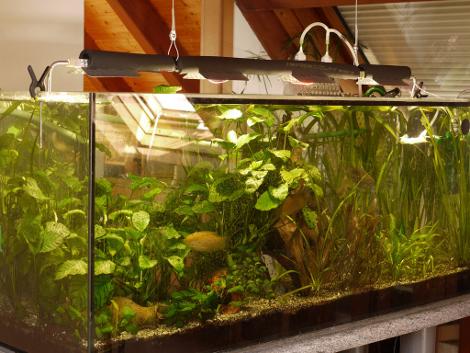
[Matthias] swapped out his twin-tube florescent aquarium lights for LEDs. By running tank water through the aluminum LED mounts he’s transferring excess heat into the water in the tank, in turn saving some of the electricity that would have been used to heat the tank. Couple this with roughly 35 Watts saved by moving away from fluorescent tubes and he’s got a great energy-saving hack. The LEDs used in the last aquarium light conversion were cooled by heat sinks and fans. We’d love to see this concept incorporated into that design.

Shiftbrite Coffee Table

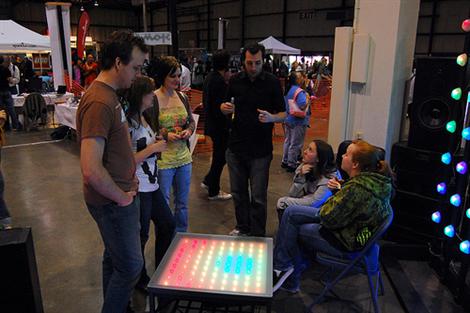
Here’s a project we’ve been wanting to do for a while. Over at macetech.com they’ve posted an LED coffee table that uses a 9×9 RGB LED grid. For the LEDs, they used the shiftbrite modules we’ve seen before. The table is capable of displaying pre written patterns as well as accepting patterns from a computer via bluetooth. They’ve set it up to connect to a twitter feed and display to a live cam on their site. Though we would love to reproduce this, we need a little more justification than “ooooh, shiny”  for the funds involved. Anyone want to donate 100 shiftbrights?

Controllable LEDs Spice Up The Living Room

[youtube=http://www.youtube.com/watch?v=YyjDcAzNJQ0]

[Sprite_tm] brings us another great hack by lighting up the living room. Unsatisfied with just replacing incandescent bulbs with an LED alternative he went with strips of LEDs to illuminate the length of a wall. Starting with a seven-meter strip of the lights, he cut it down to fourteen pieces in order to make the RGB devices individually controllable. [Sprite_tm] whipped up a design for controller boards using RS-485 to communicate with each, and sourcing an ATtiny2313 for the PWM necessary to generate any color. As you can see in the video above, the finished project is brilliant. Oh, and the Lounge Music as a background is nice too.