WiFi Menorah For Eight Nights Of Bandwidth

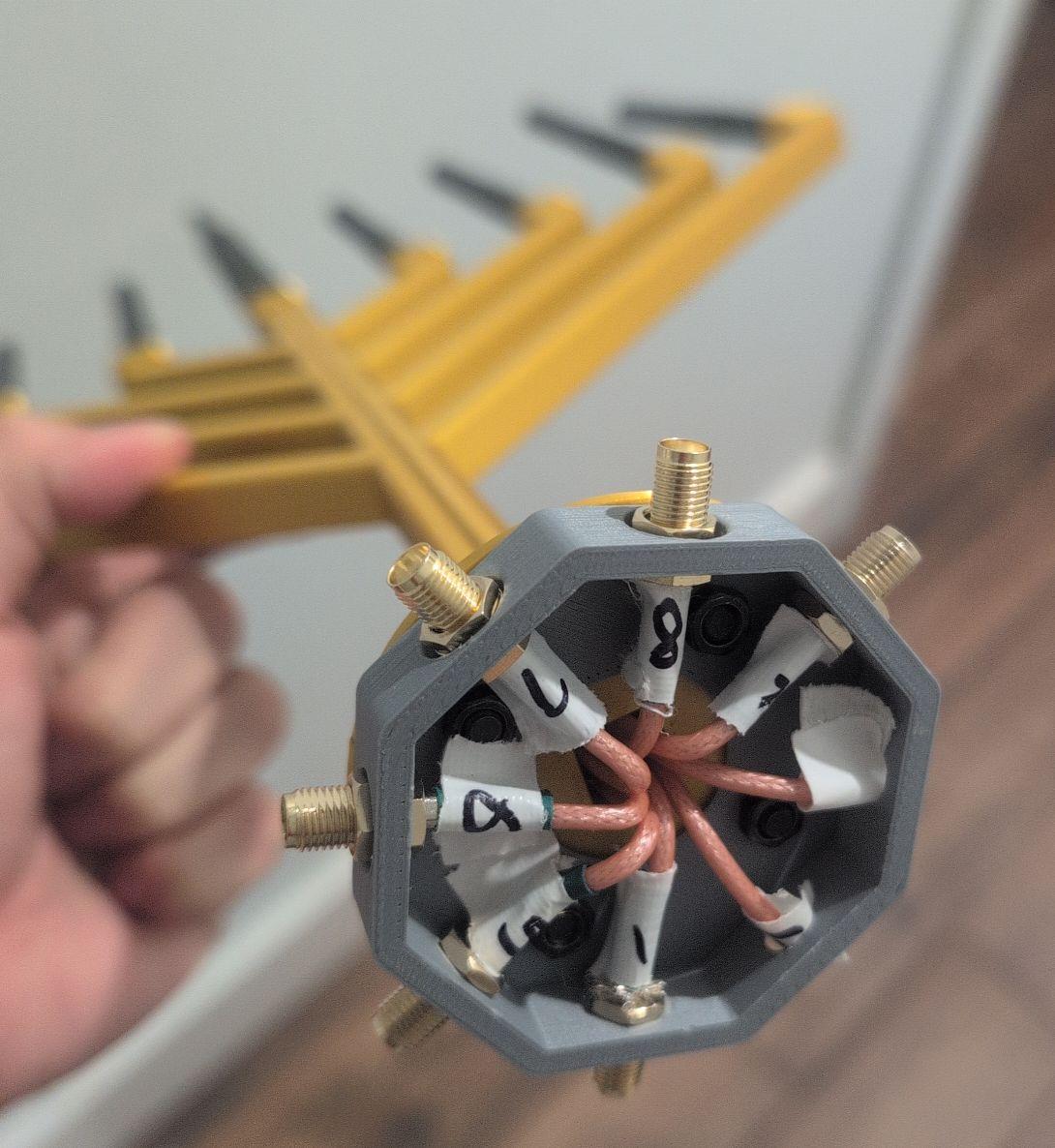
Hanukkah is upon us, and if that’s your jam [Brian] has you covered with this stylish WiFi menorah. While we can’t say if it’ll stretch your last gigabyte of connectivity into eight, it’s certainly going to provide awesome signal with all those antennae.
You could perhaps coax us to make one of these.

[Brian] was inspired by the enterprise version of the Hak5 “WiFi Pineapple”, a high-powered pentesting device. Seeing its plethora of antennae, he was struck with the idea of mounting them all onto a menorah, so he did. The menorah itself is 3D printed (of course) with lots of coax running through it down to the base, where presumably it would be connected to a Pineapple or high-powered router.

The project is presented as more of an art piece than a functional device, as there’s no evidence that [Brian] has actually hooked it up to anything yet. But consider the possibilities — along with the traditional candles, you could “light” one WiFi antenna each night, bringing the holiday glow to 2.4 GHz or 5 GHz. If you prefer more visible wavelengths, perhaps this LED menorah would be more to your tastes.

If you’ve got a hack for your culturally-relevant holiday festival, be it Christmas, Hanukkah, or Festivus, we’d love to see it. The tips line is open all year round.
A Menorah For The 21st Century

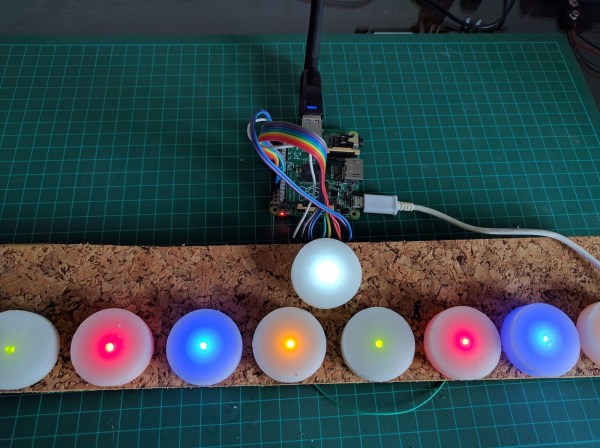
For those new and experienced, this time of year is a great chance for enterprising makers to apply their skills to create unique gifts and decorations for family and friends. [Mike Diamond] of What I Made Today built a phone controlled, light-up menorah. It’s a charming way to display some home automation know-how during the holidays.

Expanding on his previous project — a pocket-sized menorah — a Raspberry Pi Zero with a WiFi dongle, some LEDs, wire, and tea lights suffice for the materials, while setting-up Blynk on the Raspberry Pi and a phone to control the lights ties it together after mounting it in an old monitor housing.

Continue reading “A Menorah For The 21st Century”

Hackaday Links: December 1, 2013

hackaday-links-chain

Since our ‘ol buddy [Caleb] left Hackaday for EE Times, he’s been very busy. One of his latest projects is doing Antique Electronics Autopsies. This time around it’s a 1953 Heathkit Grid Dip Meter. It’s a beautiful piece of engineering with Point to Point wiring and metal gears.

We love microcontroller breakout boards, and so does [Tim] apparently. He built a breadboard friendly breakout for the NXP LPC812. It’s an ARM Cortex M0+ with 16kb of Flash and 4kb of SRAM. The entire breakout board is smaller than the through-hole DIP LPC1114. When are we going to see these on Tindie, [Tim]? Here’s the Git with the board files. You can also pick up a board at OSH Park – $3.30 for a set of three.

What do you do when you have the perfect idea for a Kickstarter, but don’t have the funds for the perfect sales pitch? The obvious solution is to start an Indiegogo campaign to raise funds for your Kickstarter. Unfortunately, this campaign has already been successfully funded, so it’s already too late to get in on the ground floor. Relevant xkcd.

We’ve seen this DIY cell phone before but now it’s just about ready for production. [David] at the MIT Media Lab has been working on a bare-bones, ATMega & GSM module phone for a while now, and now you can grab the firmware and board files. Make your own cell phone!

Here comes Hanukkah, so drink your gin and tonica. Here’s a pedal powered menorahica so put on your yarmulke, it’s time to celebrate Hanukkah.

Improved LED Menorah

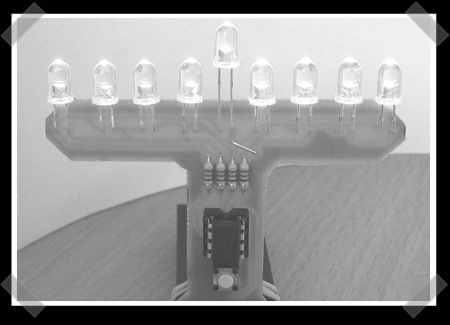
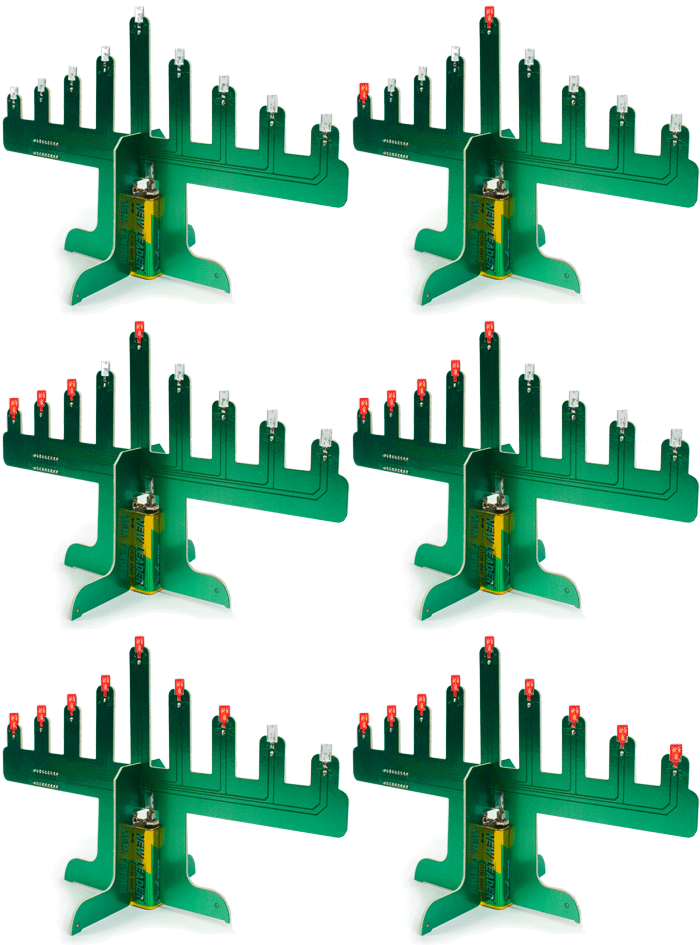
Reader [Mike] was not too impressed by design in a recent post we did on an LED menorahs. Doing what any self respecting hacker would do, he designed and built a better one then sent it in to us. He just happened to have an AVR ATtiny13 sitting around, so he used that for the brains. It has single button operation, is powered by 2 AA batteries, and even simulates the candles burning out. His custom PCB turned out quite nicely as well, the power plug connects to the batteries in a way that uses them as a base. Check out his site for detailed plans and source code. Great job [Mike].

LED Menorahs

We’re barely past Halloween and people are already working on their next LED based holiday decorations. For Hanukkah, Gizmodo pointed out the PCB menorah pictured above. It uses a set of DIP switches to control which LEDs are lit. A couple years ago, Evil Mad Scientist Laboratories put together a tutorial for building a more minimal LED menorah. Each of the nine LEDs are soldered directly to the legs of an ATtiny2313 microcontroller. Every time you power up the device an additional LED is lit. [Ori] liked the project and decided to take a slightly different approach. He used an LM3914 DIP18 LED bar driver. A potentiometer controls how many of the LEDs are illuminated.