Sustainability Hack: Wind Turbine Battery Charger

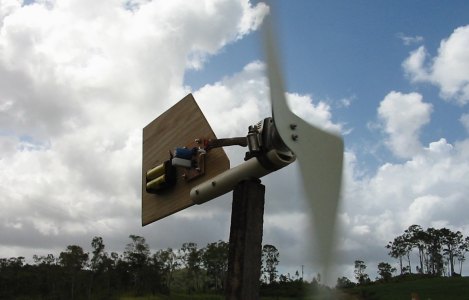
Hit your parts bin and set aside an afternoon to build a wind turbine that recharges batteries. You can see two AA batteries hanging off the side of this small generator. You only need a few parts to make this happen, and chances are you have them sitting in your junk bin already.

The generator itself is a small stepper motor which can be pulled from a floppy disk drive or a scanner. The blade is cut from a single piece of 3.5″ (90mm) PVC pipe, with another piece of smaller-diameter pipe serving as the body of the turbine. The tail-fin makes sure it’s always pointing into the wind and was made from some plywood. As the blade spins, a current is induced on the control pins of the stepper motor. By building a pair of bridge rectifiers and using an RC filter you’ll get the most out of the generated current.

This turbine can charge a pair of NiCad batteries in about 10 hours, but it might be worth developing some smart circuitry to manage charging. If it were able to choose between a dedicated storage battery and the on-board battery holder you could put all of the wind energy to good use.

[Thanks Michael]

PVC Boombox Is Not A Potato Cannon

After [Luke] built a suitcase mini-ITX rig for LAN parties he was left with one problem: he didn’t have any speakers and he didn’t want to use headphones. Not wanting to do something boring like a USB-powered speaker setup, he built a PVC Boombox.

Built around 3 inch PVC pipe, the boombox houses an off the shelf 15 W amplifier, bluetooth receiver, and charge controller. [Luke] found a deal on a dozen 1400mAh lithium ion batteries and despite the standard, “if you don’t know what you’re doing, don’t use lithium” trope commonly given as advice, he forged ahead anyway. [Luke] picked up a power converter that charges the batteries and provides some protection. The batteries are charged though wall power with a transformer and a huge cap scrounged from an ATX power supply.

[Luke] is pretty pleased with his boombox. Not only does it put out some decent quality sound, the battery life should be tremendous. It’s not a ground-up build, but we think it’s a pretty nice project. [Luke] will be taking the ‘boomtube’ to the Detroit Maker Faire next month, so if you see him make sure to say hi.

PC Case Using CNC Router And Home Building Products

[Reinventing Science] needed a project that he could use to test out his skills on a new CNC routing machine he recently acquire. He settled on building a PC case using easily obtained materials. What he ended up with is the clean-looking case seen above that was machined from materials you can pick up at the home store.

The bulk of the case is made from extruded PVC which is designed to perform like solid wood trim. He picked up one piece of the ‘lumber’ and cut out the front, back, top, bottom, and drive bay bezel. We expected the joints between the horizontal and vertical pieces to either be butt joints, or rabbits. But [Reinventing Science] wanted a cleaner look and managed to mill mortise and tenon joints. These are strong joints that leave a very nice finished look. Since the material is designed as a lumber replacement it shouldn’t be too surprising to see drywall screws used as the fasteners.

In addition to joinery, some other CNC tricks were used. The sides of the case were cut from clear acrylic, with a decorative bead milled in the surface. There’s also fan ports cut in the top and vents on the bottom, as well as some engraving with the name of the project just above the optical drive. The wood-grain embossing makes for an interesting final look; we’d like to see how this takes a few careful coats of paint.

If you’re interested in the CNC hardware used, take a look at the unboxing post that shares a few details.

Water-blob Launcher

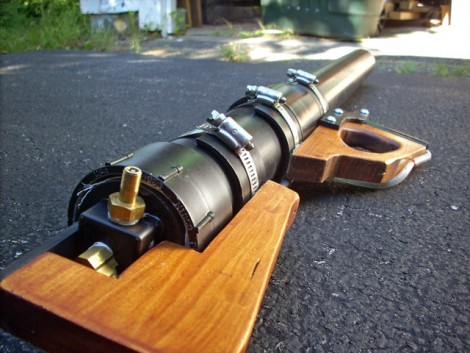
This rifle-shaped water cannon looks great and packs a big punch. We guess you could say that it’s a water balloon launcher, but the balloons are torn off and drop like the wad from a shotgun shell when fired. So we think this launches water blobs, or orbs, or something along those lines.

[Wolf] built it using PVC and some brass fittings that allow for the injection of compressed air. There’s a slick valve system that he developed which we don’t get a great look at in the build pictures. Fortunately, there’s an animated GIF that shows the various stages. Using his valve there’s no need for any electrical system like a lot of other pneumatic launcher systems use.

Just like the water-filled ping-pong gun, you’ve got to be careful with this thing. As you can see in the clip after the break there’s lethal force behind these projectiles. Especially when [Wolf] swaps out the water balloons for big steel darts.

Continue reading “Water-blob Launcher”

LEGO Ball Mill

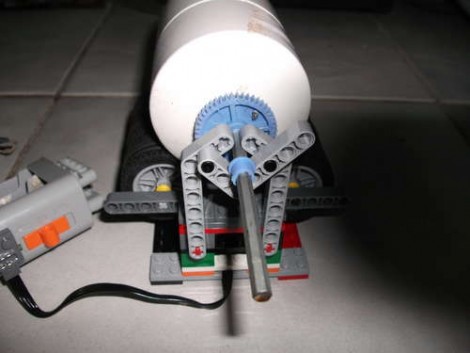
This is a ball mill used for refining materials into a fine powder. [Jpoopdog] built it in two parts, a base and the tumbler chamber. The base itself is build using LEGO wheels as rollers. The motor and controller from an NXT kit is used to drive the rotation, with programming to stop the mill every so often so that the raw material can cool down. That’s important because this can be used to make substances like aluminum powder, an explosive substance sometimes used in pyrotechnics. We don’t recommend producing your own explosives (or making your own propellant) but if that’s what you’re after [Jpoopdog] did build in a safety feature. The chamber,which is constructed from PVC, has a fail safe to prevent an explosion. A hole has been drilled in the end cap and plugged with hot glue. In the event the milling material starts to overheat the glue will melt and alleviate the built up pressure.

Photo Booth For A Wedding

[Joe Bain] built a portable photo booth for his wedding. We’ve looked in on photo booths before, both as a robust feature in your apartment and as a mobile option. But making it part of a wedding reception is the best reason we’ve found to build one. [Joe’s] electronics consist of a laptop, camera, screen, and a big pushbutton that interfaces via a serial cable and adapter. He found some software that was written for photo booths which takes care of almost everything including polling the “go” button.

The booth itself is a frame build from PVC pipe (another chance to use those fancy fittings) with fabric dividers hanging from it. This is fun for the wedding-goers and it produces a bit of nostalgia for your scrapbook.

PVC Pipe Fittings Just For Building Stuff

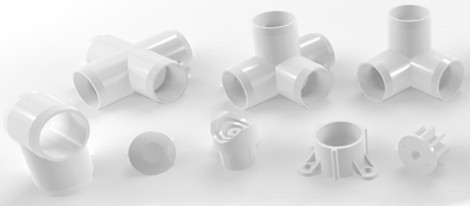
If you’ve used PVC as a building material in your projects you may have run into trouble finding a way to make three pipes joint at right angles to each other (like the corner of a box outline). That’s because there’s no need for that type of joint when plumbing, the intended purpose of the PVC pipes. But [John] tipped us off about FORMUFIT PVC Fittings designed for construction use instead of plumbing. There’s a lot of interesting options, such as the ninety degree connectors, rounded end caps for aesthetics, and end caps designed to receive casters. We also enjoyed seeing the T connector that slides onto a pipe and can function as a swivel. We haven’t tried them out ourselves, but we think they’d come in hand whether you’re building complicated moving structures or just making a desk.