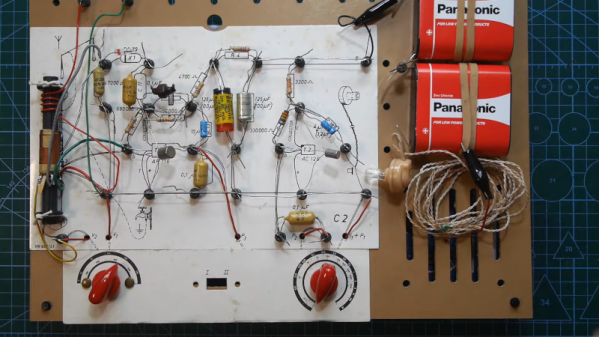
If you’ve ever built a crystal radio, there’s something magical about being able to pull voices and music from far away out of thin air. If you haven’t built one, maybe you should while there’s still something on the AM band. Of course, nowadays the equivalent might be an SDR. But barring a computer solution, there are not many ways to convert radio waves into intelligence. From a pocket radio to advanced RADAR to a satellite in orbit, receiving a radio wave is accomplished in pretty much the same way.
There are, however, many ways to modulate and demodulate that radio wave. Of course, an AM radio works differently than an FM radio. A satellite data downlink works differently, too. But the process of capturing the radio wave from the air and getting them into a form ready for further processing hasn’t changed much over the years.
In this article, I’ll talk about the most common radio receiver architectures you may have seen in years past, and next week I’ll talk about modern architectures. Either way, understanding receiver architectures will help you design new radios or troubleshoot them.
Continue reading “How Early Radio Receivers Worked” →