All Projections Suck, So Play Risk On A Globe Instead

The worst thing about the getting people together is when everyone starts fighting over their favourite map projection– maybe you like the Watterman Butterfly, but your cousin really digs Gall-Peters, and that one Uncle who insists on defending Mercator after a couple of beers. Over on Instructables [madkins9] has an answer to that problem that will still let you play a rousing game of Risk– which will surely not drag on into the night and cause further drama– skip the projection, and put the game on a globe. 
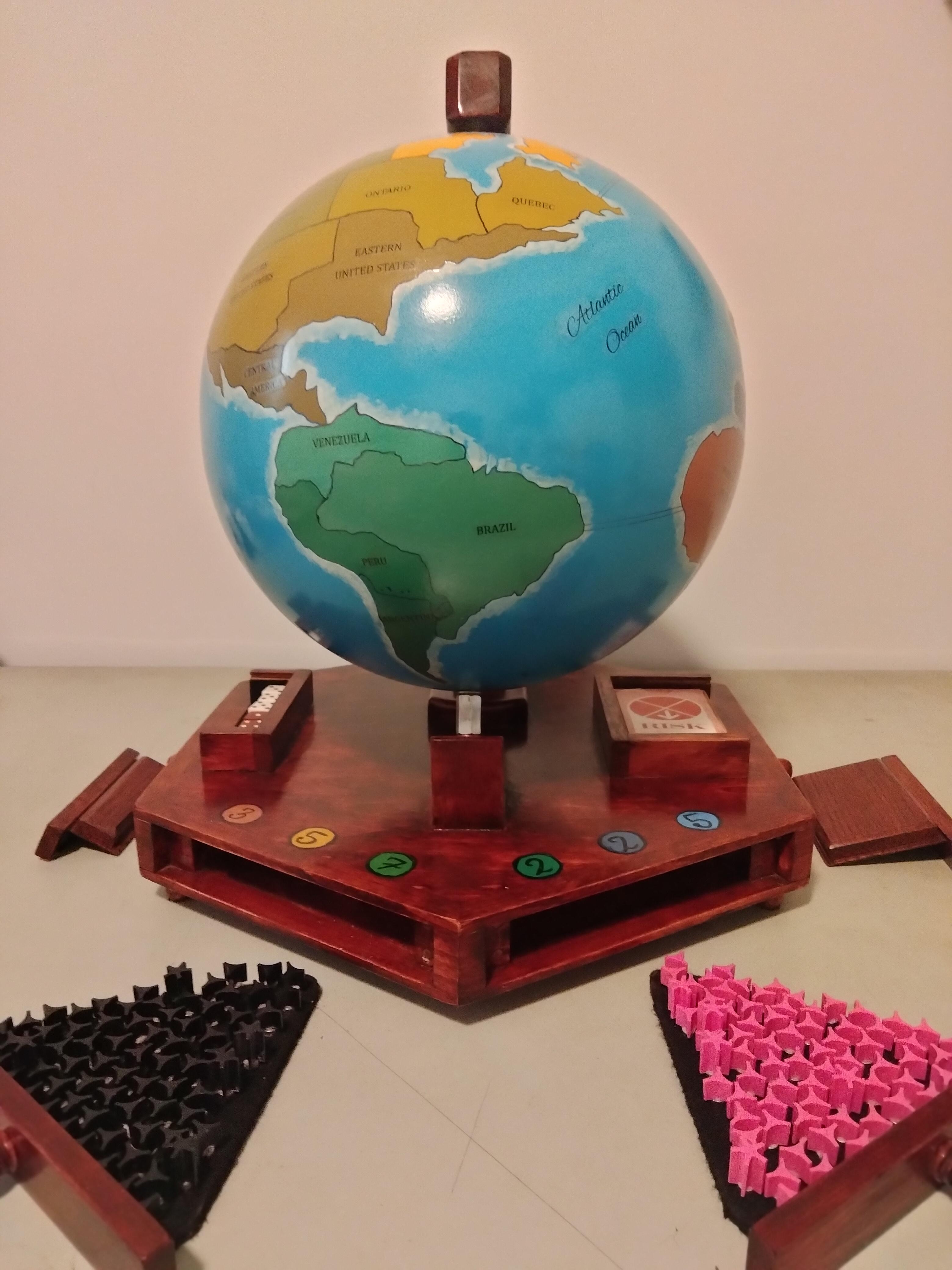
The pieces are from a 1960s version. The abstract tokens have a certain charm the modern ones lack.

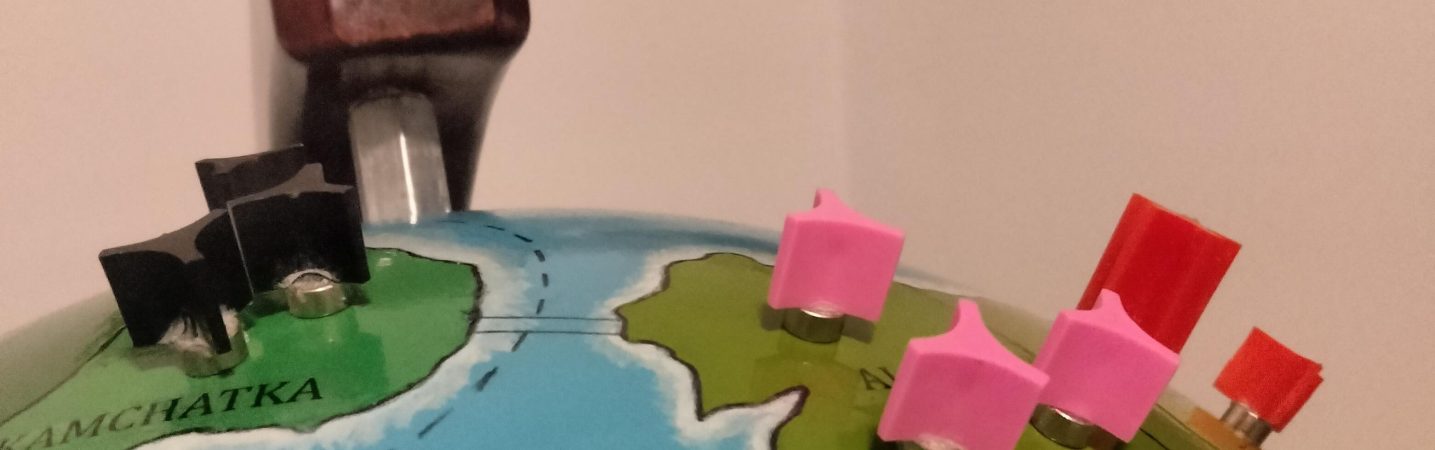
Most globes, being cardboard, aren’t amenable to having game pieces cling to them. [madkins9] thus fabricates a steel globe from a pair of pre-purchased hemispheres. Magnets firmly affixed to the bases of all game pieces allow them to stick firmly to the spherical play surface. In a “learn from my mistakes” moment, [madkins] suggests that if you use two pre-made hemispheres, as he did, you make sure they balance before welding and painting them.

While those of us with less artistic flair might be tempted to try something like a giant eggbot, [madkins] was able to transfer the Risk world map onto his globe by hand. Many coats of urethane mean it should be well protected from the clicking or sliding magnet pieces, no matter how long the game lasts. In another teachable moment, he suggests not using that sealer over sharpie. Good to know.

Once gameplay is finished, the wooden globe stand doubles as a handsome base to hold all the cards and pieces until the next time you want to end friendships over imaginary world domination. Perhaps try a friendly game of Settlers of Catan instead. 
SCADA Security Hack Chat

Join us on Wednesday, July 14 at noon Pacific for the SCADA Security Hack Chat with Éireann Leverett!

As a society, we’ve learned a lot of hard lessons over the last year and a half or so. But one of the strongest lessons we’ve faced is the true fragility of our infrastructure. The crumbling buildings and bridges and their tragic consequences are one thing, but along with attacks on the food and energy supply chains, it’s clear that our systems are at the most vulnerable as their complexity increases.

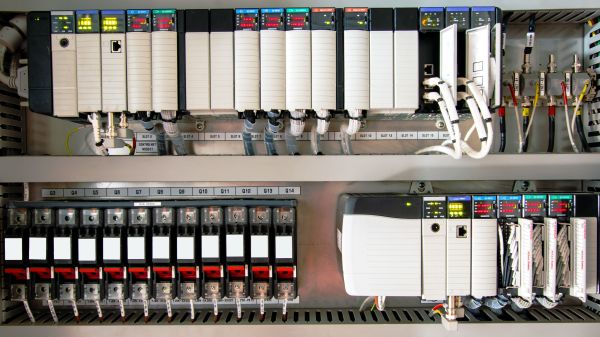
And boy are we good at making complex systems. In the United States alone, millions of miles of cables and pipelines stitch the country together from one coast to the other, much of it installed in remote and rugged places. Such far-flung systems require monitoring and control, which is the job of supervisory control and data acquisition, or SCADA, systems. These networks have grown along with the infrastructure, often in a somewhat ad hoc manner, and given their nature they can be tempting targets for threat actors.

Finding ways to secure such systems is very much on Éireann Leverett’s mind. As a Senior Risk Researcher at the University of Cambridge, he knows about the threats to our infrastructure and works to find ways to mitigate them. His book Solving Cyber Risk lays out a framework for protecting IT infrastructure in general. For this Hack Chat, Éireann will be addressing the special needs of SCADA systems, and how best to protect these networks. Drop by with your questions about infrastructure automation, mitigating cyber risks, and what it takes to protect the endless web of pipes and wires we all need to survive.

join-hack-chatOur Hack Chats are live community events in the Hackaday.io Hack Chat group messaging. This week we’ll be sitting down on Wednesday, July 14 at 12:00 PM Pacific time. If time zones have you tied up, we have a handy time zone converter.

Hackerspaces Are Hard: Insurance

Do you dream of opening a hackerspace, makerspace, or co-working space? Maybe it’s in the works and you’re already scoping out locations, intoxicated by visions of all the projects that will emerge from it. Here’s a sobering thought: makerspaces are a great big pile of risk. If the doors of your ‘space are already open, perhaps you’ve come to realize that the initial insurance policy you signed doesn’t really fit the needs of your particular creative paradise. Even if it does, the protection you need will change as you acquire new toys.

So why should you even get insurance? For one thing, your landlord will probably require it. If you own the building, you should insure it to protect yourself and anyone who uses the space. Do it for the same reason you’d insure a car, your house, or your collection of vintage pinball machines: to mitigate risk. It takes a lot of hard work to open a makerspace, perform the day-to-day operations, and keep it growing and getting better. Whenever the unthinkable happens, insurance will protect your investment as well as the people who make it a great place to be.

In researching this article, I contacted several well-established makerspaces in the United States as well as most of the major insurance providers to get both sides of the story. My intent was not to make a how-to guide, but to simply explore the topic and provide a view of the process and the struggle.

Continue reading “Hackerspaces Are Hard: Insurance”