This Week In Security: Flatpak Fixes, Android Malware, And SCADA Was IOT Before IOT Was Cool

Rowhammer attacks have been around since 2014, and mitigations are in place in most modern systems, but the team at gddr6.fail has found ways to apply the attack to current-generation GPUs.

Rowhammer attacks attach the electrical characteristics of RAM, using manipulation of the contents of RAM to cause changes in the contents of adjacent memory cells. Bit values are just voltage levels, after all, and if a little charge leaks across from one row to the next, you can potentially pull a bit high by writing repeatedly to its physical neighbors.

The attack was used to allow privilege escalation by manipulating the RAM defining the user data, and later, to allow reading and manipulation of any page in ram by modifying the system page table that maps memory and memory permissions. By 2015 researchers refined the attack to run in pure JavaScript against browsers, and in 2016 mobile devices were shown to be vulnerable. Mitigations have been put in place in physical memory design, CPU design, and in software. However, new attack vectors are still discovered regularly, with DDR4 and DDR5 RAM as well as AMD and RISC-V CPUs being vulnerable.

The GDDR6-Fail attack targets the video ram of modern graphics cards, and is able to trigger similar vulnerabilities in the graphics card itself, culminating in accessing and changing the memory of the PC via the PCI bus and bypassing protections.

For users who fear they are at risk — most likely larger AI customers or shared hosting environments where the code running on the GPU may belong to untrusted users — enabling error correcting (ECC) mode in the GPU reduces the amount of available RAM, but adds protection by performing checksums on the memory to detect corruption or bit flipping. For the average home user, your mileage may vary – there’s certainly easier ways to execute arbitrary code on your PC – like whatever application is running graphics in the first place!
Continue reading “This Week In Security: Flatpak Fixes, Android Malware, And SCADA Was IOT Before IOT Was Cool”

A Field Guide To The North American Substation

Drive along nearly any major road in the United States and it won’t be long before you see evidence of the electrical grid. Whether it’s wooden poles strung along the right of way or a line of transmission towers marching across the countryside in the distance, signs of the grid are never far from view but often go ignored, blending into the infrastructure background and becoming one with the noise of our built environment.

But there’s one part of the electrical grid that, despite being more widely distributed and often relegated to locations off the beaten path, is hard to ignore. It’s the electrical substation, more than 55,000 of which dot the landscape of the US alone. They’re part of a continent-spanning machine that operates as one to move electricity from where it’s produced to where it’s consumed, all within the same instant of time. These monuments of galvanized steel are filled with strange, humming equipment of inscrutable purpose, seemingly operating without direct human intervention. But if you look carefully, there’s a lot of fascinating engineering going on behind those chain-link fences with the forbidding signage, and the arrangement of equipment within them tells an interesting story about how the electrical grid works, and what the consequences are when it doesn’t.

Continue reading “A Field Guide To The North American Substation”

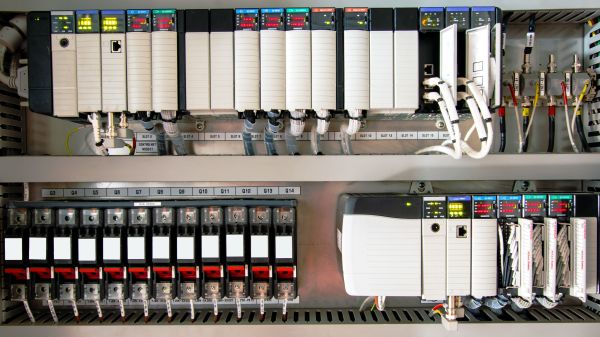
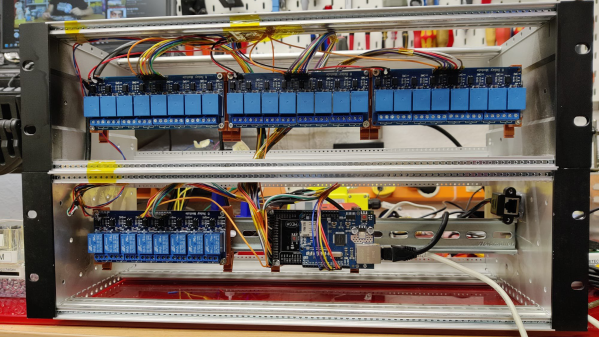
A DIY DIN rail mounted rack of PLC components for home automation

2024 Home Sweet Home Automation: A DIY SCADA Smart Home

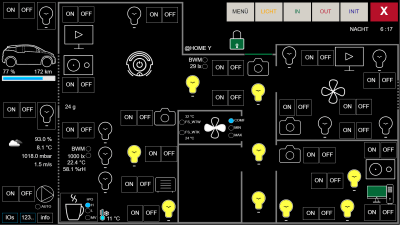
A SCADA-style display of icons and control buttons
Touch-screen control and monitoring

Supervisory control and data acquisition, or SCADA, systems sit in the background in industrial settings, performing all kinds of important jobs but in an ad-hoc setup, depending on the precise requirements of the installation. When we think about home automation systems, they’re pretty much the same deal: ad-hoc systems put together from off-the-shelf components and a few custom bits thrown in. [Stefan Schnitzer] clearly has significant knowledge of SCADA in an industrial setting and has carried this over into their home for their entry into the Hackaday 2024 Home Sweet Home Automation Contest. Continue reading “2024 Home Sweet Home Automation: A DIY SCADA Smart Home”

Hackaday Links Column Banner

Hackaday Links: August 6, 2023

“Have you tried turning it off and on again?” is a common tech support maneuver that everyone already seems to know and apply to just about all the wonky tech in their life. But would you tell someone to apply it to a reservoir? Someone did, and with disastrous results, at least according to a report on the lead-up to the collapse of a reservoir in the city of Lewiston, Idaho — just across the Snake River from Clarkston, Washington; get it? According to the report, operators at the reservoir had an issue crop up that required a contractor to log into the SCADA (supervisory control and data acquisition) system running the reservoir. The contractor’s quick log-in resulted in him issuing instructions to local staff to unplug the network cable on the SCADA controller and plug it back in. Somehow, that caused a variable in the SCADA system — the one storing the level of water in the reservoir — to get stuck at the current value. This made it appear that the water level was too low, which lead the SCADA system to keep adding water to the reservoir, which eventually collapsed.

Continue reading “Hackaday Links: August 6, 2023”

Serious Vulnerability In European Trunked Radio System

Trunked radio systems can be difficult to wrap one’s mind around, and that’s partially by design. They’re typically used by organizations like police, firefighters, and EMS to share a limited radio frequency band with a much larger number of users than would otherwise be able to operate. From a security standpoint, it also limits the effectiveness of scanners who might not know the control methods the trunked systems are using. But now a global standard for encrypted trunked radio systems, known as TETRA, has recently been found to have major security vulnerabilities, which could result in a lot more headache than disrupted voice communications.

One of the vulnerabilities in this radio system was a known backdoor, which seems to have been protected largely via a “security through obscurity” method. Since the system has been around for about 25 years now, it was only a matter of time before this became public knowledge. The backdoor could allow non-authorized users to snoop on encrypted radio traffic. A second serious vulnerability, unrelated to this backdoor, would further allow listening to encrypted voice traffic. There are a few other minor vulnerabilities recently uncovered by the same security researchers who found these two major ones, and the current recommendation is for anyone using a TETRA system to take a look to see if they are impacted by any of these issues.

Part of the reason this issue is so concerning is that these systems aren’t just used for encrypted voice among first responders. They also are used for critical infrastructure like power grids, rail networks, and other systems controlled by SCADA. This article from Wired goes into much more detail about this vulnerability as well, and we all know that most of our infrastructure already needs significant help when it comes to vulnerabilities to all kinds of failure modes.

Thanks to [cfacer] and [ToniSoft] who sent these tips!

Photo via Wikimedia Commons.

SCADA Security Hack Chat

Join us on Wednesday, July 14 at noon Pacific for the SCADA Security Hack Chat with Éireann Leverett!

As a society, we’ve learned a lot of hard lessons over the last year and a half or so. But one of the strongest lessons we’ve faced is the true fragility of our infrastructure. The crumbling buildings and bridges and their tragic consequences are one thing, but along with attacks on the food and energy supply chains, it’s clear that our systems are at the most vulnerable as their complexity increases.

And boy are we good at making complex systems. In the United States alone, millions of miles of cables and pipelines stitch the country together from one coast to the other, much of it installed in remote and rugged places. Such far-flung systems require monitoring and control, which is the job of supervisory control and data acquisition, or SCADA, systems. These networks have grown along with the infrastructure, often in a somewhat ad hoc manner, and given their nature they can be tempting targets for threat actors.

Finding ways to secure such systems is very much on Éireann Leverett’s mind. As a Senior Risk Researcher at the University of Cambridge, he knows about the threats to our infrastructure and works to find ways to mitigate them. His book Solving Cyber Risk lays out a framework for protecting IT infrastructure in general. For this Hack Chat, Éireann will be addressing the special needs of SCADA systems, and how best to protect these networks. Drop by with your questions about infrastructure automation, mitigating cyber risks, and what it takes to protect the endless web of pipes and wires we all need to survive.

join-hack-chatOur Hack Chats are live community events in the Hackaday.io Hack Chat group messaging. This week we’ll be sitting down on Wednesday, July 14 at 12:00 PM Pacific time. If time zones have you tied up, we have a handy time zone converter.

How Smart Is The Grid?

Marketing and advertising groups often have a tendency to capitalize on technological trends faster than engineers and users can settle into the technology itself. Perhaps it’s no surprise that it is difficult to hold back the motivation to get a product to market and profit. Right now the most glaring example is the practice of carelessly putting WiFi in appliances and toys and putting them on the Internet of Things, but there is a similar type of fiasco playing out in the electric power industry as well. Known as the “smart grid”, an effort is underway to modernize the electric power grid in much the same way that the Internet of Things seeks to modernize household appliances, but to much greater and immediate benefit.

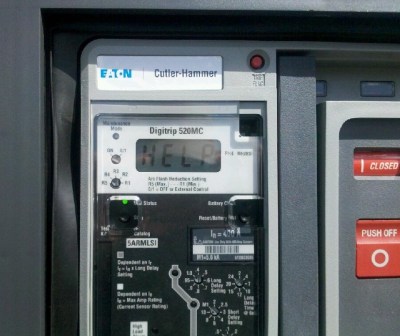
A Cutler-Hammer industrial breaker ominously predicts the coming confusion in the smart grid arena.
Photo by Bryan Cockfield

To that end, if there’s anything in need of modernization it’s the electric grid. Often still extensively using technology that was pioneered in the 1800s like synchronous generators and transformers (not to mention metering and billing techniques that were perfected before the invention of the transistor), there is a lot of opportunity to add oversight and connectivity to almost every part of the grid from the power plant to the customer. Additionally, most modern grids are aging rapidly at the same time that we are asking them to carry more and more electricity. Modernization can also help the aging infrastructure become more efficient at delivering energy.

While the term “smart grid” is as nebulous and as ill-defined as “Internet of Things” (even the US Government’s definition is muddied and vague), the smart grid actually has a unifying purpose behind it and, so far, has been an extremely useful way to bring needed improvements to the power grid despite the lack of a cohesive definition. While there’s no single thing that suddenly transforms a grid into a smart grid, there are a lot of things going on at once that each improve the grid’s performance and status reporting ability.

Continue reading “How Smart Is The Grid?”