The Only Snail You Want In Your Garden Is A Seed-Starting Hack

As temperatures warm up in the Northern Hemisphere, one’s mind naturally turns to the outdoors and the garden — even if some of our gardens are still snow-covered. One secret to good gardening is that many of the plants we love take too long to grow if started from seed outside, at least in relatively temperate climes. There are a myriad of ways to grow seedlings indoors, and this new hack highlighted by [GrowVeg] looks like a great way to get started.

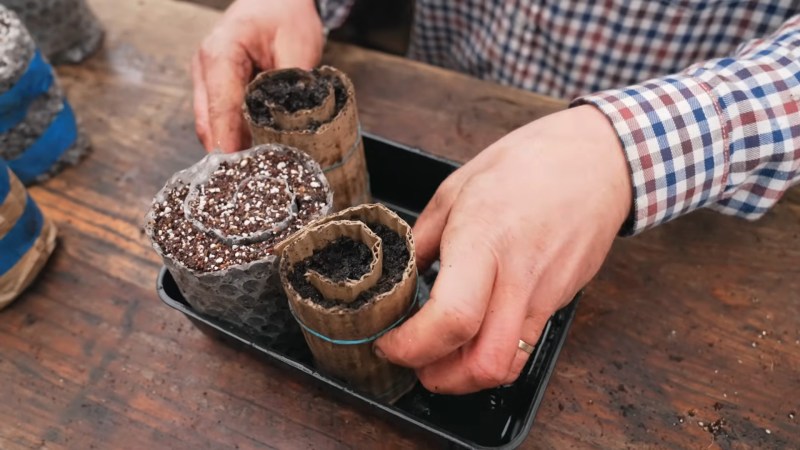
The idea apparently comes from the seedier side of Instagram, where [Farida Sober] has been popularizing it as a “seed snail”, a name they seem to have coined. The technique is very simple: take a sheet of something cheap that won’t disintegrate when moist like bubble wrap or cardboard, layer it with soil — up to 5 cm depending on your seed size — and you roll the whole thing up like a piece of sushi to produce the spiral shape that gives the hack its name. With a piece of tape to hold the roll, it’s just a matter of planting your seeds according to the packet directions. If that’s clear as mud, check out the video embedded below.

Once the seedlings have grown, it looks like it will be very easy to unroll the spiral and pluck them out to plant in the ground or bigger pots without overly traumatizing their roots, like we always do starting in flats. If it weren’t for those delicate roots, it certainly looks like the snail might save some space compared to, say, peat pots. Just remember that starting under the proper LEDs can make a huge difference to how quickly your seeds grow. No dirt? No problem — once sprouted, your plants can be made to grow hydroponically. For the really adventurous, there’s even aeroponics.

Continue reading “The Only Snail You Want In Your Garden Is A Seed-Starting Hack”
Sow Your Seed Efficiently With This Multi-Way Drop Seeder

Anyone who has ever had to propagate small plants from seed will know that efficiently sowing seed can be a difficult process. Getting a consistent number of seed in each point while achieving any sort of speed is almost impossible, and as a result it becomes a tedious process. If only there were some means by which it could be automated, perhaps a way to do a whole tray at once!

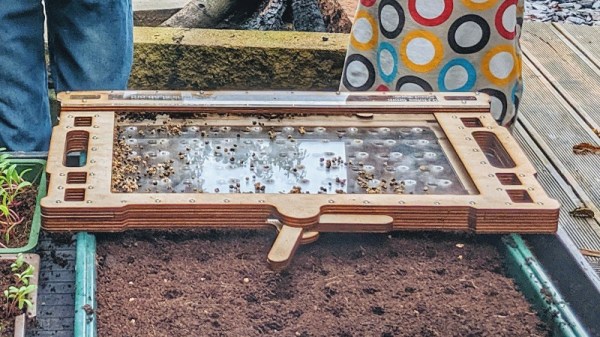
Fortunately [Michael Ratcliffe] is at hand, with his tray-sized drop seeder. It consists of two sheets of acrylic each with a grid of holes, offset from each other by able to be brought into alignment with a lever. Seed is shaken over the upper surface until all the holes contain some, and then the lever is operated allowing it to drop through into the soil below. There is a matching dibber if required to push the required grid of holes in the soil.

It’s a simple yet ingenious gadget that genuinely will make the lives of horticulturalists a lot easier, even though it might not be perfect for all types of seed. He’s created a video which we’ve placed below the break, and should you wish to create the dibber we’ve already covered it.

Continue reading “Sow Your Seed Efficiently With This Multi-Way Drop Seeder”

This Dibbling Plate Will Grow Your Love For Sowing

One of the best things about 3D printers and laser cutters is their ability to produce specialized tools that steal time back from tedious processes. Seed sowing is a great example of this. Even if you only want to sow one tray with two dozen or so seeds, you still have to fill the tray with soil, level it off, compress it evenly, and poke all the holes. When seed sowing is the kernel of your bread and butter, doing all of that manually will eat up a lot of time.

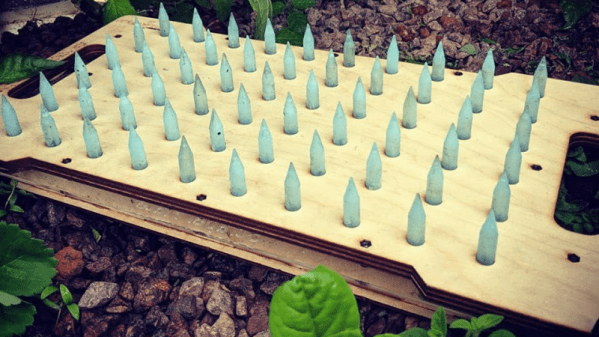
There are machines out there to do dibbling on a large scale, but [Michael Ratcliffe] has been dabbling in dibbling plates for the smaller-scale farm. He’s created an all-in-one tool that does everything but dump the soil in the tray. Once you’ve done that, you can use edge to level off the excess soil, compress it with the back side, and then flip to the bed-of-nails side to make all the holes at once. It comes apart easily, so anyone can replace broken or dulled dibblers.

[Michael] is selling these fairly cheaply, but you can find all the files and build instructions out there in the Thingiverse. We planted the demo video after the break.

More into micro-greens? 3D printing can feed that fixation, too.

Continue reading “This Dibbling Plate Will Grow Your Love For Sowing”