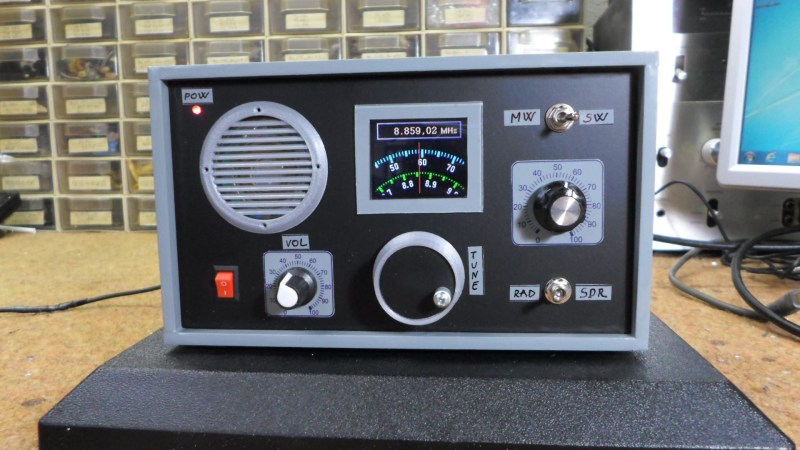
There are plenty of radios you can buy that pick up MW and SW bands if that’s what you’re into. Or, you can follow [mircemk]’s example, and whip one up yourself instead.
The build employs an ESP32 as the brains of the operation. It’s hooked up to a rotary encoder and a small colour TFT screen, which displays an old-school style tuning dial for choosing the desired frequency. This setup is paired with an Si5351—a capable clock generator chip that can deliver just about any frequency from <8KHz up to 150+ MHz on command. There’s naturally a bunch of supporting analog hardware for the radio end of things, plus a NE612 mixer IC and a PAM8403 class D audio amplifier board, hooked up to a small 0.25W speaker for audio output. [mircemk] has set up the rig to act as a simple radio set, or, with the flick of a switch, it can be configured for SDR use with an attached computer.
It’s a handsome build, and one that likely proves a pleasant way to browse the MW and SW bands on a rainy afternoon. We’ve looked at other hardware in this category before, too. Video after the break.
Continue reading “DIY SI5351 Radio Tunes In SW, MW, And More”