
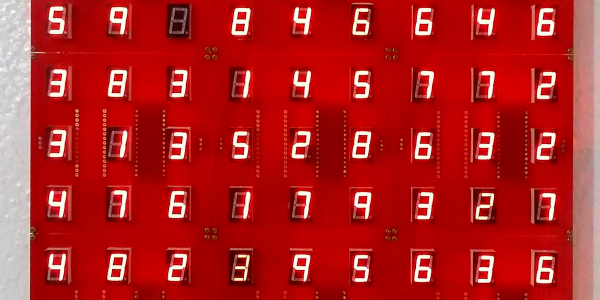
How old is the seven-segment display? Surely it is a product of the 1970s. After all, calculators started showing up, and the height of junior high humor was plugging 7734 into your calculator and showing it to someone upside down. Of course, for it to go mainstream, maybe they really originated in the 1960s, but no earlier than that, right? Actually, no. Sure, the LED seven-segment display had to wait for LEDs. But the actual idea is much older than that.
The concept of building numbers from a small set of reusable segments predates LED displays by decades. In fact, the basic idea appears in patents from the early 1900s and may have roots in even older mechanical signs and printing techniques.
The history isn’t entirely straightforward. Unlike vacuum tubes or transistors, segmented displays evolved gradually through a series of practical ideas rather than one defining invention.
Blacking out the Eight
While looking into the history of segmented displays, I was reminded of something I’d seen years ago in retail stores: reusable price tags printed with rows of eights.
Rather than printing every possible price, the clerk simply used a marker to black out portions of each figure, transforming an 8 into whatever digit was needed. Cover a few strokes, and the eight becomes a three. Remove a different set, and it becomes a zero or a five. It was, in essence, a manual segmented display.
Finding the exact origin of these price tags is akin to finding out where Romans bought sponges. They were inexpensive commercial supplies, not the sort of products that historians carefully documented. My recollection is from the middle of the twentieth century, but the underlying concept is almost certainly older.
Continue reading “A Brief History Of The Crazy Old 7-Segment Display”









