USB Host For Propeller Micros

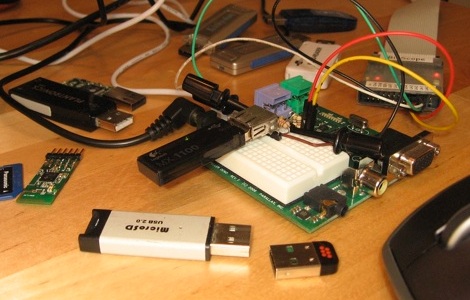
[Micah Dowty] has implemented full speed USB host control on a Propeller microcontroller. He’s motivated by the thought of using USB based WiFi and Bluetooth dongles in his projects as ready-made solutions.We’ve seen USB host control with the Arduino and it really opens up the flood gates for advancing your projects through storage, wireless connectivity, and user interface.

So far his work is fairly preliminary but the results seen from other participants in the Parallax forums are very positive. Check out his code from the subversion repository and lend a hand with the development.

[Thanks Stefan via Adafruit]
Add USB Playback To Some European LG Televisions

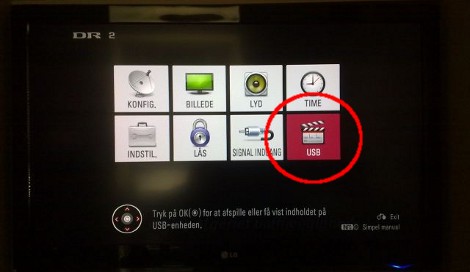
Here’s a pretty simple hack to enable playback from a USB drive on LG televisions. It only works on European hardware, the LH, LF, and some LU models. The hack consists of downgrading the firmware to version 3.15, then navigating through some service menus.

It’s not quite as hardcore as the Samsung firmware hacking, but the added functionality is really great.

[Thanks Jeton]

XBMC Hiding In An SNES Controller

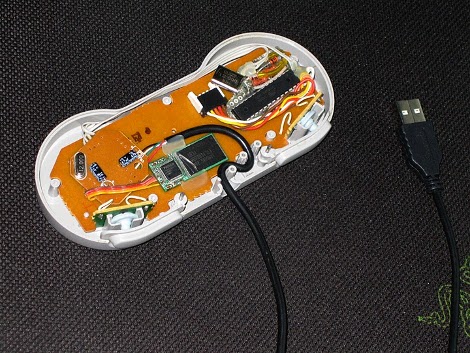
Here’s another SNES controller converted to house a USB system. The one we saw last time used a kit as an adapter for the controller but this version uses a home-built PCB and an ATmega8 microcontroller with the latest revision of an open source adapter for NES and SNES controllers. As you can see after the break, [Atarity] built the adapter, then added it along with a USB hub and thumb drive so that he could run a copy of XBMC from the controller. Now he’s got XBMC as a way to launch emulators for those classic games, as well as play traditional media.

You will be seeing more of this type of mod soon. We were tipped off that an in-depth tutorial for SNES controller hacking is on its way, although that is unrelated to [Atarity’s] work.

Continue reading “XBMC Hiding In An SNES Controller”

PIC Based USB Input Devices

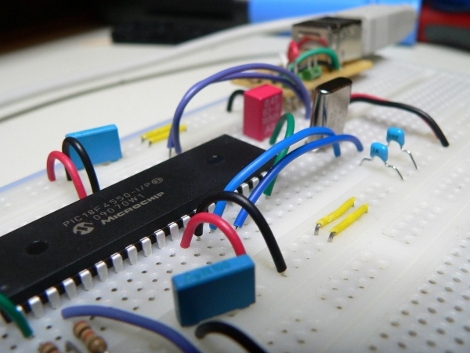
USB is convenient and that makes it desirable in many many projects. [Simon Inns] has the process down and is sharing it with his recent PIC based USB tutorial. Prompted by requests for help on the matter after having published a post about his Commodore 64 interface, he set out to detail the particulars when it comes to using the PIC 18F family as USB input devices. This example uses a PIC 18F4550 with the circuit built on a breadboard. There’s not much required here, an oscillator, a few passives, and a USB B connector. The magic really happens in the code. Take a look at this well-written guide and give it a try with your next project.

Don’t need USB? [Simon’s] game hack, the Ultimate Simon is always worth another look too.

USB Oscilloscope

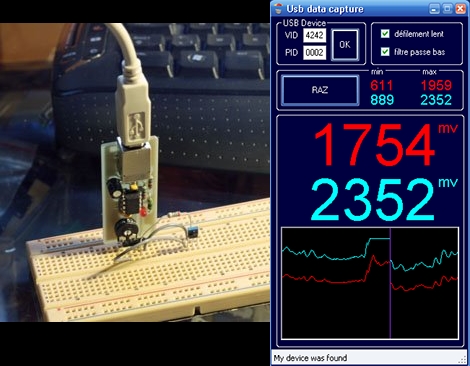
Here’s a USB oscilloscope project from a few years back. It’s easy to build on a single-sided PCB and very cheap because it uses just a handful of parts. At the center, an ATtiny45 microcontroller uses its ADC capabilities for the two traces and also handles the USB connectivity. The internal oscillator is used and trimmed up for accuracy by referencing the USB clock. On the PC side of things, a program written in C# displays the data coming over the serial bus. Quick, small, and useful; a schematic, board layout, firmware, and PC software sources are all available for download.

[Thanks Shri]

Automatic Telephone Recorder

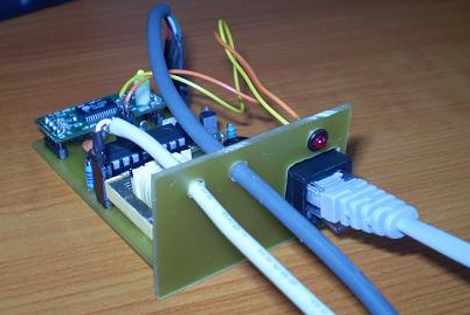
[James Bond] types and those suffering from a hefty dose of paranoia can now record all telephone conversations. [Trax] built this module that monitors the phone line and starts recording when a handset is picked up. A computer does the actual recording, triggered by the microcontroller via a USB connection.

We like the use of an old PCB for a faceplate, we’ve certainly got some duds of our own sitting around. The three cords are a bit confusing though. One for the phone line, one for the USB, but what does the third do? Is it an audio-out connection?

We’ve asked [Trax] to post a schematic and source code if possible so that might clear up the mystery.

Update: [Trax] let us know that there is a red button with white lettering at the bottom labeled “download”. This contains schematic, code, pcb layout, and PC software. We just missed it the first time around.

WRT54GL, Meet Alice

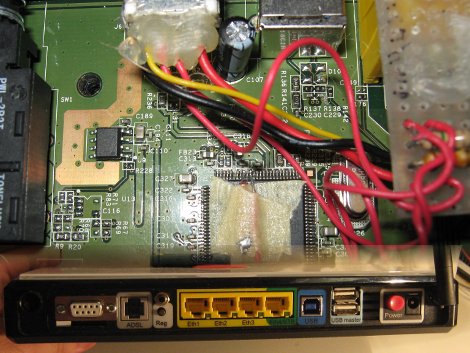
When it comes to routers, there is one that is hacker’s favorite, the WRT54GL. But a slightly lesser known company, Pirelli with their “Alice Gate2 plus Wi-Fi”, seems to be a popular choice among our Italian friends.

[Esteban] has done everything from installing serial and parallel ports, to unlocking firmware while installing Debian. Our personal favorite is the creative wiring of an additional USB port, where he had to custom create a power circuit to run his webcam and external drive.

[Thanks Marco]

[Update: It would appear Roleo, Beghiaro, and Zibri did the actual grunt work at ilpuntotecnicoeadsl and Esteban simply wrote the guides. Thanks for your hard work and hacking skills guys!]