Could Your Next House Be Built From Giant Lego By An Inchworm Robot?

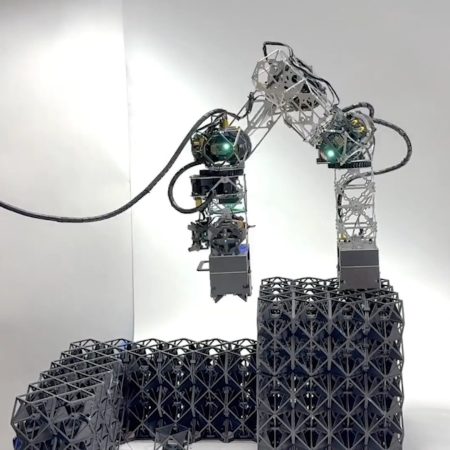
Well, it depends when you’re going to be househunting– if it’s anytime soon, Betteridge’s law applies, but if your time horizon is a ways further out, [Miana Smith] at MIT wants to make it happen. She’s got a paper out with an open-source inchworm robot designed to assemble structures from voxels– and what is a voxel but a giant, LEGO-esque brick?

There’s a demo video below, and it’s easier to understand the motion of this thing when you see it in action. The 5 degree-of-freedom MILAbot has actuators on both ends, and no traditional base– that’s the inchworm part. It grabs a brick while anchored to one part of the structure, then stays anchored to the new brick to keep building from that locale, so on and so on.

Note that we’re not talking about concrete bricks here, though conceivably you could use an inchworm-style actuator to assemble those. The ‘voxels’ in the study are engineered space-frame blocks which come together very easily, though admittedly would make for a very drafty home– you’d want to fill them with spray foam as a finishing step. So it’s more of a framing technique than a one-and-done thing. Still it is a technique that has something to recommend it compared to the 3D-printed concrete houses that get so much hype— and are already being torn down. 

For instance, the researchers find that weather the voxels are plywood, PLA, or metal, the resulting structure has less embodied energy than any concrete structure, with 3D printed concrete being worst option by that metric– though the balloon-frame stick-build we in North America consider “conventional” is still the lowest of all. On the other hand, that balloon-frame building takes a crew to put together, and labour is expensive compared to robots. At the moment, however, the study admits balloon-framing wins on price, but that doesn’t mean it always will, and it’s a fun hack regardless.

So while your next house might not be made of LEGO by a robot inchworm, we’re still grateful to [Miana] for the tip.

Most building hacks we see here are of the 3D printed variety, but don’t count out plain old dirt. For that matter, as long as someone is willing to live in it, anything can be a house– even an airliner. Continue reading “Could Your Next House Be Built From Giant Lego By An Inchworm Robot?”
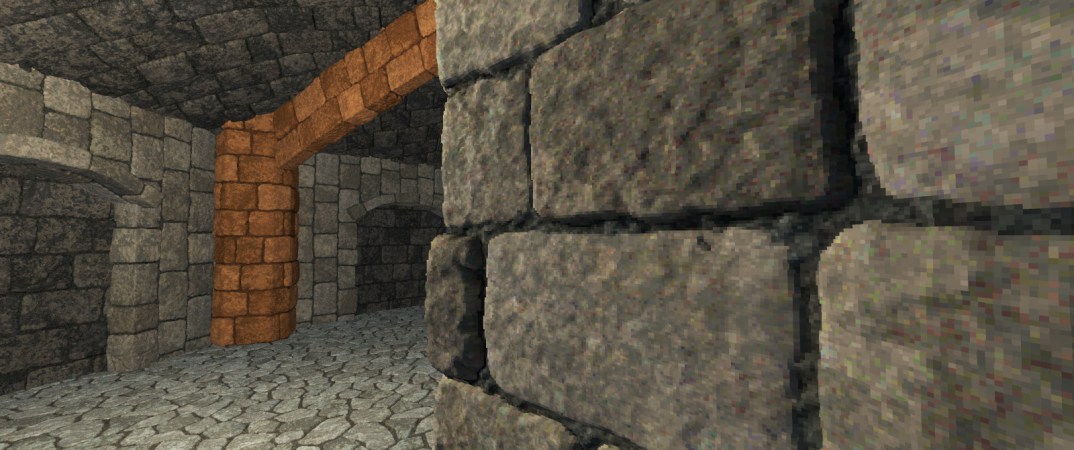
Easy Retro 3D Look With Voxel Displacement Renderer

Voxels are effectively like 3D pixels, and they form an integral part of what is commonly referred to as a ‘retro 3D’ look, with pixelated edges sharp enough to cut your retinas on. The problems with modeling a scene using voxels come in the form of creating the geometry and somehow making a physics engine work with voxels rather than conventional triangular (or quad) meshes.

The same scene in Blender (above) and in the voxel-based renderer (below). (Credit: Daniel Schroeder)

The approach demonstrated by [Daniel Schroeder] comes in the form of a Voxel Displacement Renderer implemented in C++ and using the Vulkan API. Best part of it? It only requires standard meshes along with albedo and displacement maps.

These inputs are processed by the C++-based tools, which generate the voxels that should be rendered and their properties, while the GLSL-based shader handles the GPU-based rendering step. The pre-processing steps required make it a good idea to bake these resources rather than try to process it in real-time. With that done, [Daniel]’s demo was able to sustain a solid 100+ FPS on a Radeon RX 5700 XT GPU at 1440p, and 60+ FPS on a Steam Deck OLED.

In a second blog post [Daniel] goes through his motivations for this project, with it originally having been intended as a showpiece for his resume, but he can imagine it being integrated into a game engine.

There are still questions to be resolved, such as how to integrate this technique for in-scene characters and other dynamic elements (i.e. non-static scenery), but in terms of easing voxel-based rendering by supporting a standard mesh-based workflow it’s an intriguing demonstration.

Continue reading “Easy Retro 3D Look With Voxel Displacement Renderer”

A Volumetric Display With A Star Wars Look And Feel

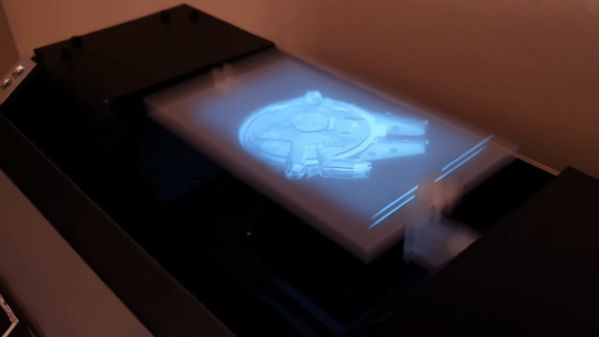
It may not exactly be what [Princess Leia] used to beg [Obi-Wan] for help, but this Star Wars-inspired volumetric display is still a pretty cool hack, and with plenty of extra points for style.

In some ways, [Maker Mac]’s design is a bit like a 3D printer for images, in that it displays slices of a solid model onto closely spaced planar surfaces. Sounds simple enough, but there are a lot of clever details in this build. The main component is a lightly modified LCD projector, a DLP-based machine with an RGB color wheel. By removing the color wheel from the projector’s optical path and hooking its sync sensor up to the control electronics, [Mac] is able to increase the framerate of the display, at the cost of color, of course. Other optical elements include a mirror to direct the projected images upwards, and a shutter harvested from an old pair of 3D TV glasses. Continue reading “A Volumetric Display With A Star Wars Look And Feel”

JOLED – A 3D Flip Dot Display

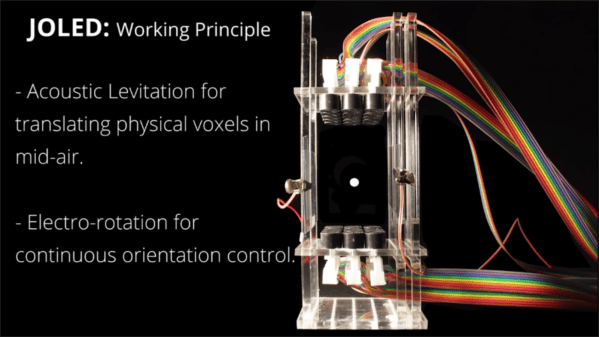
Flip-Dot displays are so awesome that they’re making a comeback. But awesome is nothing when you can have an insane flip-dot display that is three-dimensional with the dots floating in mid-air. Researchers at the Universities of Sussex and Bristol have built what they call JOLED, an array of floating pixels that can be controlled via a combination of ultrasonic standing waves and an electrostatic field. These “voxels” can be individually moved in space via ultrasonics, and can also be individually flipped or rotated through any angle, via the electrostatic field.

The key to the whole thing is something they call Janus Objects – hence JOLED. Janus particles have different features or chemistry on two opposite sides. A portion of each voxel is speckled with a small amount of titanium dioxide nano powder. This gives it a bipolar charge that makes it respond to the variable electrostatic field and hence capable of axial rotation. Half of each white voxel can then be covered with a contrasting color – red, blue, black – to achieve the flip dot effect. Each voxel appears to be a couple of millimeters in diameter. The ultrasonic actuators appear to be regular piezo transmitters found in every hacker’s parts bin. Transparent glass plates on opposite sides apply the variable electrostatic field.

While this is still experimental and confined to the research lab, future applications would be interesting. It would be like breaking e-ink displays out of their flat glass confines and giving them a third dimension. The short, two-minute video after the break does a good job of explaining what’s going on, so check it out. Now, who want’s to be the first to build a JOLED clock?

Thanks to [Garrow] for tipping us off about this.

Continue reading “JOLED – A 3D Flip Dot Display”

Turning Video Game Sprites Into 3D Objects

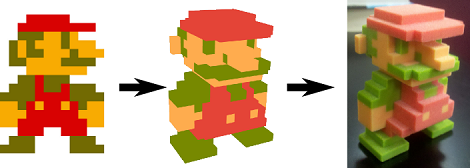
Anyone who has played Minecraftfor a good amount of time should have a good grasp on making 3D objects by placing voxels block by block. A giant voxel art dragon behind your base is cool, but what about the math behind your block based artwork? [mikolalysenko] put together a tutorial for making 3D objects out of video game sprites and covers a lot of the math involved in turning pixels into voxels.

The process of modeling a 3D object from a series of 2D images is a very well-studied computer vision problem called multiview stereo reconstruction. This process has been used to build 3D models of random objects with devices such as the Stanford spherical gantry. Unfortunately the math for this algorithm is a mess, but there is another way: using photo hulls (PDF warning) to find the largest possible object from a series of images showing the top, bottom, left, right, front, and back views.

[mikolaly] put together an algorithm to produce 3D images from a series of images and even went so far as to build a web-based shape carving editor. With this web app, it’s possible to make 3D objects simply by inputting a bunch of colored pixels onto six 2D grids.

Once the models were complete, [mikolaly] sent some of the 3D models off to Shapeways for 3D printing. He’s completed Meat boy, Mario, and Link 3D sprites, all available for sale.

Now the only thing left to do is build a script to turn these objects into Minecraft object schematics.