posted Nov 26th 2010 12:00pm by
Mike Szczys
filed under:
radio hacks

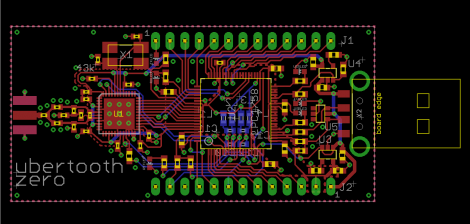
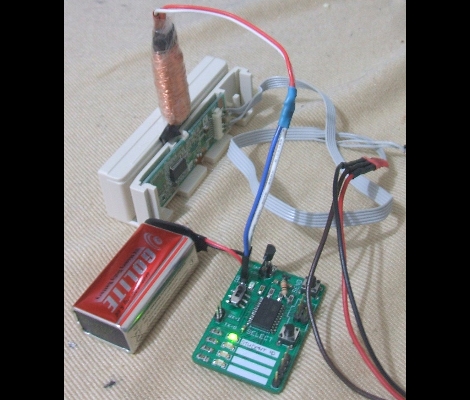
Ubertooth Zero is the first offering in [Michael Ossman's] quest for a Bluetooth sniffing and hacking hardware platform. We’ve seen some of his hacks in the past, like the build-in guitar tuner and some pink pager fiddling. The Ubertooth dongle is his original design based around an LPC1758 ARM Cortex-M3 processor paired with a Texas Instruments 595-CC2400-RTB1 to handle the 2.4 GHz RF communications. Looking at the bill of materials shows a very low cost for the components at just under $30 (if you can get your hands on a PCB to mount them on). He’s written firmware as well as host code to help you up start pulling Bluetooth packets out of the air as quickly as possible.
What can you do with this? That’s up to you, but whatever it is you accomplish, we’d like to hear about it.
posted Nov 26th 2010 11:00am by
Mike Szczys
filed under:
home hacks

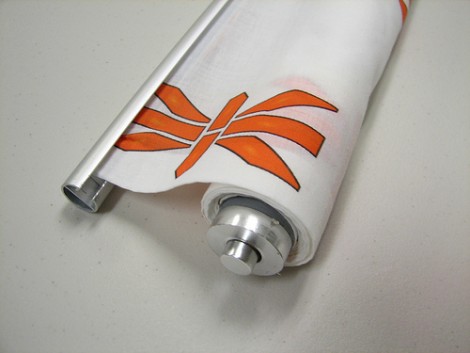
[Lenore] added a bit of customization to her office window hangings by fitting roller curtains with custom printed fabric. The treatment seen above is a $20 Enje roller blind from Ikea but that logo is all Evil Mad Science. The weight at the bottom of the fabric uses a friction-fit plastic insert that can be stapled onto new material. Some fusible tape was ironed onto the sides to finish those edges, and the roller at the top has strong adhesive that remains for a second use after peeling off the original material.
A fabric printer was used to produce this rendition of shades. But we’d like to see some conductive thread added for a fabric-based display that can be rolled up when not in use.
posted Nov 26th 2010 10:00am by
Mike Szczys
filed under:
robots hacks

Who doesn’t love a 12-legged robot, especially if you can ride it around work? You can watch this one running around the patio with rider perched atop it. The machine translation is a bit crude, but it seem this is based on the wicked walking sculptures of [Theo Jansen]. The rider can shift their center of gravity to control the walker, much like a Segway. We’d bet this makes for a rough ride on anything but a smooth level surface, but we’re fine with indoor use only. After all, you’ll need to be close to a charging station as this boasts 45 minutes of juice when transporting a 165 pound operator. See it scurry after the break.
Read the rest of this entry »
posted Nov 26th 2010 8:00am by
Mike Szczys
filed under:
security hacks

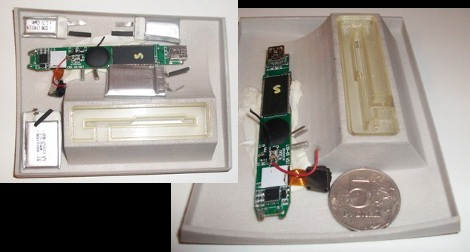
ATM information theft is nothing new. Neither is the use of skimmers to gain access to the data. But it’s a little surprising just how easy it has become to hack together the devices using audio equipment. The images above are samples of a skimmer for sale from an Eastern-European do-no-good. It is the magnetic stripe sniffer portion of the attack which captures card data as an audio recording. That is later turned into the binary code that was read from the card. We’re just speculating, but that looks an awful lot like the PCB from a pen recorder, something you can pick up for just a couple of bucks.
Of course this is used in conjunction with a camera to capture PIN data as the second part of the security protocol, but it really underscores the need for new ATM technology. Some skimmers don’t even require retrieval of the hardware, and you never know where the sketchy machines might pop up next.
[via Engadget and Slashdot]
posted Nov 25th 2010 2:00pm by
Joseph Thibodeau
filed under:
misc hacks,
security hacks

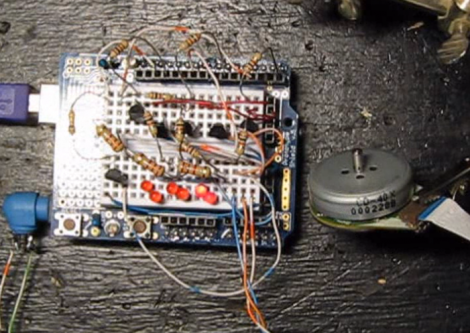
In the cold and mysterious wilderness of Norway, it pays to be ready for anything–especially heavy-walking trolls. The team at [nullohm] decided to prepare thoroughly for their trek into the woods to witness the Leonids meteor shower by putting together an Arduino-based “troll detector”.
The device is based on the superstition of hammering a steel spike into a tree to keep trolls away from camp. This goes one step further by including an accelerometer and LED indicators so that you can tell exactly what type of troll is just about to feast upon your tender human flesh.
When the detector is installed into a nearby tree, it takes an average seismic measurement and then looks for telltale footfalls. Even if you’re not concerned with perpetuating superstitions, you might find a use for the source code for simple seismic activity monitoring at home to supplement your miniature seismic reflector.
posted Nov 25th 2010 12:00pm by
Joseph Thibodeau
filed under:
robots hacks

It’s always nice to show our appreciation for our elders. Today’s young robots may be whippier, snappier, and go-gettier than their forbears but you have to admit that few of them have the moxie to dust themselves off after 45 years and have a walk around town (although it still wouldn’t qualify for a senior’s discount). George, a British humanoid robot made out of a WWII bomber, was resurrected by his inventor after decades in the garage–and all it took was a little bit of oil and some new batteries. Respect.
George is very impressive, but he’s not the oldest robot by any means. Ever-popular Buddha inspired a Japanese robot some 80 years ago that has recently been updated (pics here)–do robots meditate in solid state?
In a similar aesthetic vein to George, Chinese farmer Wu Yulu made a robotic rickshaw driver, one of his many eccentric projects since the 80s.
Here on hackaday we see a lot of modern robotics, but what about a return to the old school? Next time you have a scrap airplane on hand why not weld together a classic robot, and while you’re at it give your regards to old George.
posted Nov 25th 2010 10:00am by
Mike Szczys
filed under:
digital audio hacks

This is a second generation Manta, a touch-based controller with visual feedback made to use with Max/MSP. The hexagonal size and the patterns seen in the video after the break remind us of the arm-based computers the Predators sport in the movies. Like the previous generation, this controller can tell not only which of the 48 sensor you’re touching, but how much of your finger is touching it. The sky is the limit on extensibility with this type of data, but for now you can just try out the pre-built plugin and see how it goes. New with this rendition of the Manta is the use bi-color LEDs which adds another lay of interaction with the PC to which this is tethered.
If you don’t mind giving up the touch controllers for good old push buttons perhaps this Harmonic Keyboard is right up your alley. Read the rest of this entry »
posted Nov 25th 2010 8:00am by
Caleb Kraft
filed under:
news

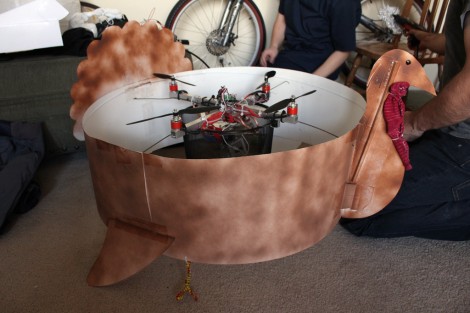
For those in the states, Happy Thanksgiving. Whether or not you celebrate the traditional holiday, you might still want to take a moment to think of what you are thankful for. We are thankful for our readers, who drive us to keep posting projects and challenge us to improve our skills. The Hackers, who supply us projects to write about, both simple and complicated. We are thankful for our bosses, who employ us to do this awesome stuff and only beat us occasionally. And we are thankful for thermite, which burns oh so bright and looks oh so pretty.
Join us after the break to see a turkey, roasted with thermite in slow motion.
[via Neatorama]
Read the rest of this entry »