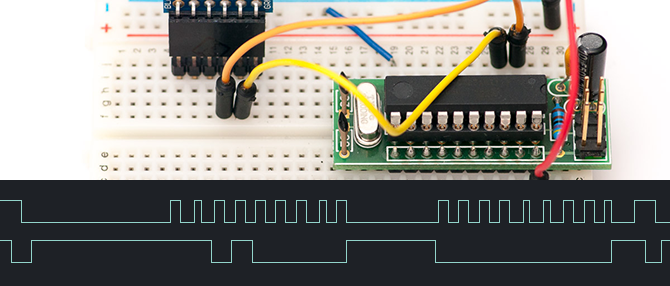
Roland 808 synced to MIDI

posted Sep 20th 2011 3:01pm by
filed under: musical hacks

Reading this week’s ATtiny-themed builds, [Thomas] was reminded one of his coolest builds. His midi808 project used an ATtiny2313 to sync a vintage Roland 808 drum machine to his Logic workstation.

Even though MIDI had been around for a few years when 808s were being made, the CPU in the 808 isn’t exactly up to the task of handling MIDI. Instead, the 808 used an interface known as DIN Sync that was designed to keep 808s, 707s, and 303s in time with each other. MIDI to DIN Sync boxes do did exist, but even the auxiliary equipment to use an 808 is getting hard to find.

The build takes a MIDI signal and passes it through an opto-isolator per the MIDI spec. The microcontroller reads the MIDI signal and passes it out through the DIN Sync port. The DIN Sync protocol is only 24 pulses per quarter note output with TTL voltages, and the project code is easy enough to follow. It’s a nice build for one of the greatest drum machines ever made. Listen to a track [Thomas] made with his new setup after the break.

Read the rest of this entry »

ATtiny hacks: 2313 driving a 4x4x4 LED cube

posted Sep 18th 2011 6:00am by
filed under: led hacks

ATtiny Hacks Theme Banner

[Kirill] wrote in to share his ATtiny hack, a 4x4x LED cube. The 64 LED display is a great choice to fully utilize the hardware he chose. It’s multiplexed by level. Each of the four levels are wired with common cathodes, switched by a 2N3904 transistor. The anodes are driven by two 595 shift registers, providing a total of 16 addressable pins which matches the 4×4 grid perfectly. All said and done it only takes seven of the ATtiny2313′s pins to drive the display. This is one pin more than the chip’s smaller cousins like the ATtiny85 can provide. But, this chip does include a UART which means the project could potentially be modified to receive animation instructions from a computer or other device.

You may have noticed the USB port in the image above. This is serving as a source for regulated power in lieu of having its own voltage regulation hardware and is not used for data at all. Check out the animations that [Kirill] uses on the display by watching the video after the break. You’ll find a link to the source code there as well.

Read the rest of this entry »


AVR HVSP on a tiny breadboard

posted Apr 6th 2011 11:30am by
filed under: Microcontrollers

AVR chips are convenient because you can program them in circuit at their operating voltage. That is, unless you screw up the fuse settings and they’ll no longer listen to an In System Programmer. If you find yourself facing this problem, just build this circuit on a breadboard and ‘unbrick’ by holding down the button.

The circuit seen above is a High Voltage Serial Programmer. This is one of two high voltage protocols used by AVR chips; HVSP is for chips that don’t have enough pins to use High Voltage Parallel Programming. This rendition uses a 12V power source, which is the level necessary for the high voltage method. A 7805 linear regulator joins the mix to provide operational voltage, along with one transistor, an ATtiny2313 to control the circuit, a four-digit 7-segment display for feedback, and one button for control.

Watch the video after the break to see an ATtiny13 programmed to disable the reset pin using a breadboarded programmer. That chip is then easily rescued, having been automatically recognized by using its device signature.

Read the rest of this entry »

Designing a controllable RGB LED driver board

posted Mar 30th 2011 8:59am by
filed under: led hacks

[Paul] wrote in to tell us about this LED driver board he’s been working on with a few friends. The collaborators had been unhappy with the Lumens per Watt ratings (or lack of a rating) on low powered LEDs and set out to find a better solution. They picked up the beefy ASMT-MT00 which houses all three diodes in one package, with all the pins on one side of the surface mount package, a heat dissipating tab on the other side, and pushed 30 Lumens per Watt. With that in hand they set out to design a host board for the blindingly bright light.

The board includes a heat sink on the underside. To drive the LEDs [Paul] sourced an LM3407 constant current driver. The manufacture recommends using one of these chips for each of the colors in the LED package. [Paul] built a circuit that allows him to route power around each LED, making the system work with just one low-side driver. From there, an ATtiny2313 provides addressable control via the RS485 protocol. Screw terminals on either end of the PCB allow this to be chained along with other modules, and they’ve already worked out a basic PureData program that will be able to address multiple boards once they finish manufacturing them.

MIDI input for the Kaossilator

posted Feb 4th 2011 10:31am by
filed under: musical hacks

This isn’t strictly a MIDI input hack; [Furrtek] pulled off an alternate input hack for the Kaossilator that he’s currently using with a MIDI connection. In its unhacked form the Kaossilator is a small touchpad-based sound manipulation tool. [Furrtek] sniffed out how the touchpad data is read and used on the little device. He then purposed an ATtiny2313 as the core of a circuit that spoofs those signals. The microcontroller now listens for incoming MIDI data, looks up the proper signal translations in a table, then outputs them to the Kaossilator.

In the video after the break you can see that it works perfectly, with no lag or noticeable problems. As we alluded to at the top, there could be so much more done with this. Since the ATtiny2313 is merely translating MIDI into touchpad signals, the input could be anything. The first thing that comes to mind is a dance floor that changes the music based on how many people are out there tearing it up. Read the rest of this entry »


Surprisingly simple magnetic card spoofer

posted Nov 27th 2010 8:00am by
filed under: security hacks

[Craig's] magnetic card spoofer is both simple and brilliant. There are two parts to spoofing these cards and he took care of both of them. The first part is getting the actual card data. He designed the spoofer board with a header that connects to a card reader for doing this. The second part is the spoofing itself, which is done with an electromagnet. As with past spoofers, he wrapped a shim with enamel-coated magnet wire. An old knife blade was picked for its thickness and ferromagnetism.  This magnet is driven by an ATtiny2313 which stores the data, and is protected by a transistor driving the coil. There were a few design flaws in his board, but [Craig] was able to get the same track data out of the spoof as the original card despite the LED being used as a protection diode and an ‘aftermarket’ resistor on the transistor base.

Halloween props: Pumpkin in standby-mode

posted Oct 22nd 2010 12:00pm by
filed under: home hacks

Evil Mad Scientist Laboratories is preparing for Halloween with this standby-mode pumpkin. Inside there’s an LED plugging a hole that is drilled just to the skin of the gourd-like vegetable. It fades in and out similar to a sleeping Mac, using what we think is a vastly over-powered circuit based on an ATtiny2313 (1k  of programming space for this?). But we still like the idea and we’d enjoy seeing it scaled up to a full LED matrix.

We’ve come to expect pumpkin hacks from EMSL and they don’t disappoint. Last year was a mechanized version, and the year before an LED schematic symbol. So what about your creation? With about one week left, take a look around and see if you can’t create something as wonderful as the Pie of Sauron.

Disco drumming with piezo sensitive lighting

posted Oct 1st 2010 10:00am by
filed under: led hacks, musical hacks

[Wilfred's] brother outfitted a snare drum with LEDs for Dutch Carnival. They faded through different colors randomly and were a nice addition to the normal looking instrument, but [Wilfred] suggested that the LEDs change color with each drum stroke. He set out to design a controller circuit to provide the functionality and ended with a small package based around an ATtiny2313 microcontroller. A piezo buzzer is used to detect the vibrations inside the drum, each hit triggering a different color combination. The LEDs fade to off after each impact as if dying along with the sound, and when not struck for 30 seconds the system defaults to a red heartbeat pattern. See for yourself after the break.

We’d love to see this feature added to each drum in one of those robotic drumsets. Read the rest of this entry »


Hack a Day serves up fresh hacks each day, every day from around the web as well as hacking related news.

Send us your hacks


Hacks

Resources