posted Aug 25th 2008 3:30pm by
Eliot Phillips
filed under:
downloads hacks,
security hacks
posted Aug 20th 2008 3:00am by
Eliot Phillips
filed under:
cons,
news

Long before we started reporting on [Dan Kaminsky]’s DNS chicanery, he contributed a guest post about one of our favorite sources of new technology: SIGGRAPH. The stars have aligned again and we’re happy to bring you his analysis of this year’s convention. [photo: Phong Nguyen]
So, last week, I had the pleasure of being stabbed, scanned, physically simulated, and synthetically defocused. Clearly, I must have been at SIGGRAPH 2008, the world’s biggest computer graphics conference. While it usually conflicts with Black Hat, this year I actually got to stop by, though a bit of a cold kept me from enjoying as much of it as I’d have liked. Still, I did get to walk the exhibition floor, and the papers (and videos) are all online, so I do get to write this (blissfully DNS and security unrelated) report.
Read the rest of this entry »
posted Aug 6th 2008 10:50pm by
Eliot Phillips
filed under:
cons,
security hacks
posted Aug 6th 2008 5:00pm by
fabienneserriere
filed under:
cons,
misc hacks,
news

[Dan Kaminsky]’s much anticipated talk on his DNS findings finally happened at Black Hat 2008 in Las Vegas today. [Dan] has already uploaded the complete slides from his talk as well as posted a short summary to his site. New information in the slides since our previous coverage includes “Forgot My Password” attacks and new attacks on internal network vulnerabilities as a side of effect of DNS cache poisoning. [Dan]’s talk today was over capacity; our shot of the conference room overflow is shown above.
posted Jul 31st 2008 8:50pm by
rossfairgrieve
filed under:
security hacks

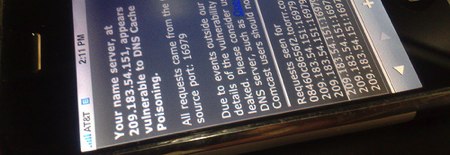
It’s been a few weeks since [Dan Kaminsky] announced the nature of the DNS vulnerability and allowed 30 days of non-disclosure for patches to be applied before details of the exploit went public. Unfortunately, the details were leaked early and it didn’t take long for a functional exploit to be released into the wild. Since then, many ISPs have taken steps to prevent their users from falling victim to the attack, and BIND, the widely-used DNS protocol implementation, was updated to minimize the threat. Even then, there were reports of a version of the attack being actively used on AT&T’s DNS servers.
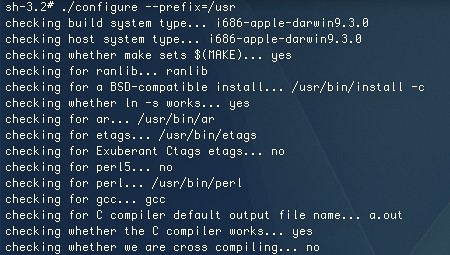
Mac OSX uses a BIND implementation but as of yet, Apple has not released a patch updating the system (Microsoft, on the other hand, patched this up on July 8). As a result, machines running OSX are at risk of being exploited. Individual users are less likely to be targeted, since the attacks are directed towards servers, but it’s not a smart idea to leave this vulnerability open. [Glenn Fleishman] has published a way to update BIND on OSX manually, rather than waiting on Apple to patch it themselves. It requires Xcode and a bit of terminal work, but it’s a relatively painless update. When we tried it, the “make test” step skipped a few tests and told us to run “bin/tests/system/ifconfig.sh up”. That allowed us to re-run the tests and continue the update without further interruption. [Fleischman] warns that people who manually update BIND may break the official update, but he will update his instructions when it happens with any possible workarounds. Unfortunately, this fix only works for 10.5 but alternative, yet less effective methods may work for 10.4 and earlier.
If you’d like to know if your preferred DNS servers are vulnerable or not, you can use the DNS checker tool from Doxpara. As an alternative to your ISP’s DNS servers, you can use OpenDNS, which many prefer for its security features and configuration options.
posted Jul 24th 2008 7:00pm by
Eliot Phillips
filed under:
news,
security hacks
posted Jul 23rd 2008 7:00pm by
Eliot Phillips
filed under:
news,
security hacks

We’ve been tracking Metasploit commits since Matasano’s premature publication of [Dan Kaminsky]’s DNS cache poisoning flaw on Monday knowing full well that a functional exploit would be coming soon. Only two hours ago [HD Moore] and [I)ruid] added a module to the Metasploit Project that will let anyone test the vulnerability (with comment: “ZOMG. What is this? >:-)“). [HD] told Threat Level that it doesn’t work yet for domains that are already cached by the DNS server, but it will automatically wait for the cached entry to expire and then complete the attack. You can read more about the bailiwicked_host.rb module in CAU’s advisory. For a more detailed description of how the attack works, see this mirror of Matason’s post. You can check if the DNS server you are using is vulnerable by using the tool on [Dan]’s site.
[photo: mattdork]
posted Jul 8th 2008 5:30pm by
Juan Aguilar
filed under:
news
posted Jun 12th 2008 2:50pm by
Juan Aguilar
filed under:
news

The Zlob trojan, also known as DNSChanger, has been around for a few years, but recent Zlob variants to appear in the wild attempt to log into routers using a list of default admin/password combos. If they succeed, they alter the DNS records on the router to reroute traffic through the attacker’s server.
Our friend [Dan Kaminisky] recently did a presentation warning against vulnerabilities in internet browser plugins that allow attackers to mount DNS rebinding attacks against routers with default passwords.. Though it achieves the same end, Zlob is different because it infects by the tried-and-true method of fooling users into downloading it inside a fake video codec. Once it is running on a client machine, it is free to attempt to use the default admin id and password of the router to log in and alter DNS settings. It even supports the DD-WRT firmware.
Even if a system is wiped clean of Zlob trojans, the router could still be compromised. The good news is that it is easy to fix and even easier to prevent. Fixing it takes no more than wiping all network clients clean, then resetting the router and restoring custom settings. Prevention is a simple matter of changing the router’s password.
[photo: fbz]
posted Oct 27th 2006 12:33am by
Eliot Phillips
filed under:
Uncategorized
Our buddy Dan Kaminsky gave an interesting talk at Toorcon. This is just one part where he talks about a novel way to help the user remember SSH keys by converting them to couples names. You can get it in high quality here. 17 minutes long. Thanks to Fabienne for shooting the video.