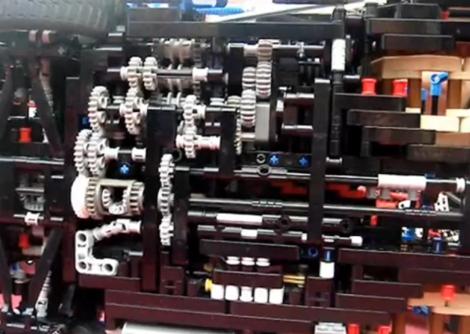
LEGO Gearbox – Seven Speed Plus Reverse

We know LEGO is a very versatile medium to build with but this is beyond what we considered possible. Seven speeds and a reverse gear were built into the gearbox for this LEGO vehicle. It’s not completely an original design, but adds to the five-speed design found in a ten-year-old LEGO set. See it demonstrated in the video after the break. The design uses a sequential gearbox; shifting is accomplished by clicking the stick up or down depending on how you want to shift. If you’ve got enough parts on hand you can build this using the assembly photos that [Sheepo] posted.

Can’t get enough of the gears? Check out this model of a double clutch transmission.

Continue reading “LEGO Gearbox – Seven Speed Plus Reverse”

Arduino Implemented On An FPGA

If you think that Arduinos are overkill in most projects we can do one better for you. [Jack Gassett] has a virtual Arduino running on a Field Programmable Gate Array. We checked in with [Jack] back in November to see his work with the AVR8 Soft Processor, an FPGA version of an AVR chip. Because the Arduino uses AVR it wasn’t too much of a leap to make this Arduino compatible. We’re lacking in imagination when hit comes to using this method productively, but we’re sure someone will find a way.

[Thanks Drone]

Intruder Alarm McDonald’s Toy Hacking

[malikaii] needed to set up some kind of tripwire style alarm system for his office. His bosses kept sneaking in to find him slacking. So, like any loyal hacker, instead of just working harder he built an alarm system. After a failed attempt to recreate an IR alarm circuit he found on the web and built from old appliance parts, he found the Hack a Day article about harvesting McDonald’s toys. The end result was a fully functional IR detecting alarm for the office doorway. This is pretty simple really, the best kind of hack.

The Trans-atlantic Battery Bunny Divide

This somewhat frightening armature is the base for the iconic energizer bunny. While we love seeing the guts of popular robotics, this brings up an interesting fact. In Europe, the bunny is the symbol for Duracell. There’s an interesting story where Duracell had used the bunny for years in europe, only to inspire Energizer to copy them stateside in 1989. This one will be available on ebay shortly.

Catch a Duracell battery after the break

Continue reading “The Trans-atlantic Battery Bunny Divide”

Project J.A.R.V.I.S.

[brightcove vid=76029544001&exp3=16977198001&surl=http://c.brightcove.com/services&pubid=245991542&w=470&h=325]

Project J.A.R.V.I.S. is an attempt to create a digital life assistant, or DLA. The name comes from the version in the movie Iron Man. While the details of the build are pretty slim, you can see that he’s using a mac mini for the base with an Arduino controlled RFID reader at his door. What is really interesting is how functional he has actually made it. Watch the video on the site to see a pretty good explanation of features.

[via Gizmodo]

Teletype Twitter Frontend

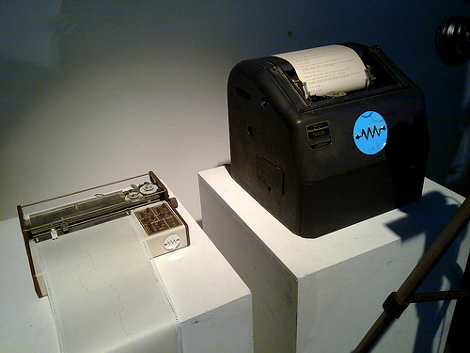
The folks from NYC Resistor got their hands on a teletype machine and hacked it to monitor Twitter. This eighty-year-old beast bangs out messages that it receives at 45.45 baud. This isn’t a project that turns something into a teletype, but rather finds a different way to feed the machine data. In this case, a python script parses Twitter and sends the data it finds to an Arduino board. The Arduino in turn formats the message into the serial format necessary to communicate with the device. To the left you can see a trend plotter, learn more about both in the video after the break.

Continue reading “Teletype Twitter Frontend”