USB Oscilloscope

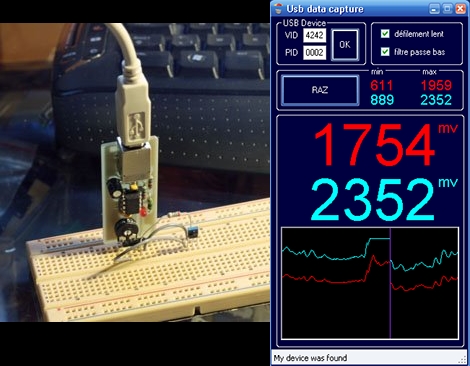
Here’s a USB oscilloscope project from a few years back. It’s easy to build on a single-sided PCB and very cheap because it uses just a handful of parts. At the center, an ATtiny45 microcontroller uses its ADC capabilities for the two traces and also handles the USB connectivity. The internal oscillator is used and trimmed up for accuracy by referencing the USB clock. On the PC side of things, a program written in C# displays the data coming over the serial bus. Quick, small, and useful; a schematic, board layout, firmware, and PC software sources are all available for download.

[Thanks Shri]
Space Invaders Clock 6 Years Ahead Of Pong Clock

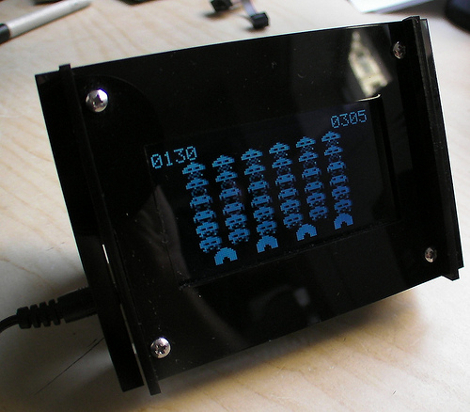
Space Invaders came out in 1978, six years after Pong. That means this Space Invaders clock uses newer technology, right? Nope, it’s the same hardware as the Adafruit Pong Clock with some updated firmware. Still, as you can see after the break, the effect is pretty nice. Pong was cool, but having a clock that scrolls through several classic games would be cooler.

[Dataman], the guy responsible for this firmware hack shared his code. It should be easy enough to alter it for any clock using a KS0108 graphic LCD screen. So what’s next? Can someone pull off a black and white Ms. Pac-Man that looks decent on the 128×64 display?

Continue reading “Space Invaders Clock 6 Years Ahead Of Pong Clock”

A VU Meter For Your PSP

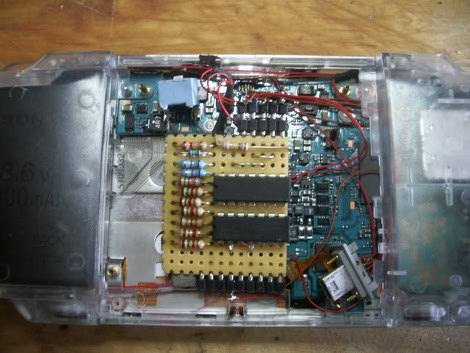
[Christian Doran] wanted some blinky goodness to go along with the tunes on his PSP. He built a VU meter circuit around a couple of LM324 op-amp chips and fit it into the UMD space on the back of the PSP. Using surface mount LEDs and some fine wire he lined up a string of indicator lights round the circle on the clear UMD cover. As you can see in the video after the break, the back of the case now pulses along with the music.

[Christian] notes that building the VU circuit around an LM3915 would have been much easier but he’s working with what he has on hand. Looks like he achieve the effect he was after. If you want to learn a bit more about how the op-amps work, take a look at the tutorial from our links post.

Continue reading “A VU Meter For Your PSP”

Google Your Home With A Roomba

[youtube=http://www.youtube.com/watch?v=bKRH6uQwOgg]

Meet GåågleBot. GåågleBot is a modified roomba that will not only vacuum your home, but collect data while it does it. While it is carrying out its normal duties as a floor cleaner, it will take pictures, collecting and analyzing all the data for later searches.  With built in OCR, you can actually search for things using text strings.

Aside from just carrying out its normal job, you can also remote control it via the web. You can even control theirs!

[via Boing Boing]

Is GEK A Modern-day Mr. Fusion?

[Nanomonkey] spent the weekend building generators that run off of syngas. All Powers Lab produces Gasifier Experimenter Kits to convert raw material to energy. The kits use Gasification to make a “natural gas like” fuel from materials such as wood chips, walnut shells, construction debris or agricultural waste.

So is this the Mr. Fusion that powered the DeLorean? This Honda fitted with a GEK sure makes it look that way. But all joking aside, this looks like a great way to turn waste in heat or electricity. There’s tons of info on the site to dig through. The controllers are open source which would make it easier to interface with the Google PowerMeter when the system is used as a generator.

Google Unveils API To PowerMeter

Google’s tentacles continue to wrap around every portion of our lives with the addition of an API for their PowerMeter software. The PowerMeter tool works with smart electricity meters to monitor and display power usage in the home. This will allow manufacturers (and hackers alike) to design new devices with the Google interface in mind.

We’ve got an old-fashioned power meter with a spinning dial and no blinking LED. This means we can’t monitor that blink to add our own PowerMeter interface. But if you do have an easy way to grab data from your meter you can design a home system that takes full advantage of Google’s tools.

Ok, who’s going to be the first to have their Google PowerMeter-compatible hack featured on Hackaday?

[Thanks Juan]