Kinetic Space: Software For Your Kinect Projects

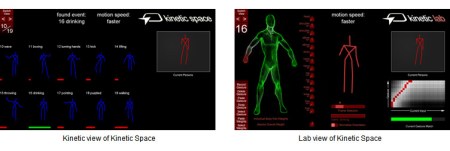
For all of you that  found yourselves wanting to use Kinect to control something but had no idea what to do with it, or how to get the data from it, you’re in luck. Kineticspace is a tool available for Linux/mac/windows that gives you the tools necessary to set up gesture controls quickly and easily. As you can see in the video below, it is fairly simple to set up. You do you action, set the amount of influence from each body part (basically telling it what to ignore), and save the gesture. This system has already been used for tons of projects and has now hit version 2.0.

Continue reading “Kinetic Space: Software For Your Kinect Projects”
Using A Router As A Wireless Embedded Platform

If you’re going to make your next project wireless, you don’t need an XBee, WiFi shield, or even a Bluetooth module. Turning old hardware into a dev board is extremely easy, as [Taikson] shows us by adding an I2C bus to a Fonera router. (Spanish, here’s the Google translation)

To add an I2C bus, [Taikson] took two pins that originally went to a router status pin and soldered on a pair of wires. [Taikson]’s router is running OpenWrt, so adding support for I2C devices is just a matter of changing a few kernel settings.

As for what you can do with a router development platform, the sky’s the limit. Last year, [Taikson] controlled a quadcopter from within a web browser with a similarly modified I2C-enabled router. It’s a clever hack, and with a little bit of work it should be possible to add a few sensors or even a camera to his quadcopter.

The First Step To Running IPhone Apps In Linux

[Christina] has been working on a project she calls Magenta to put Darwin/BSD on top of Linux. What does that mean? Well, hopefully it’s the first step towards running iPhone/iPad apps on a Linux machine.

Before you get too excited, there are a few caveats; Magenta only works on ARMv7 platforms, none of the fancy iOS frameworks are included, and it’s currently impossible to run iOS apps with this build. Think of this project as a very, very early version of Wine. If you’d like to take Magenta for a spin, [Christina] put the source up here.

Although [Christina]’s project is entirely useless for anyone wanting Siri on their Android phone, it’s possible to add all those fancy iOS frameworks to Magenta and create an open source OS able to run iPhone apps.

We really have to admire [Christina]’s work on this. It’s an amazingly impressive project, and her final goal of recreating the iOS stack would be a boon to the jailbreaking scene. Cue the sound of millions of iPhone clones marching out of China…

via [OleRazzleDazzle] on the reddits

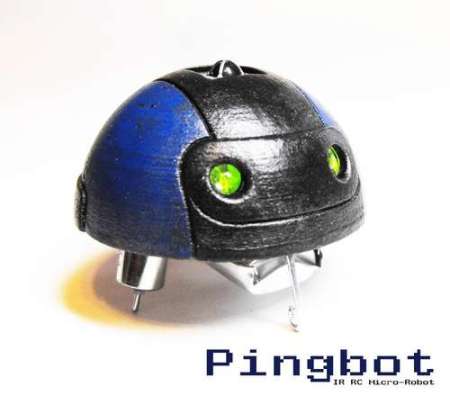
Pingbot: Adorable And Fully Documented

After building many functional but somewhat unfinished looking bots, [Tomdf] really wanted to produce something that felt “complete”.  Pingbot is the result and here’s how [Tomdf] describes it:

Pingbot is a very small (38mm diameter), usb rechargeable, programmable, musical, remote control robot designed for maximum fun and danceability.

Though I wasn’t inclined to dance I did find myself smiling watching the video. Pingbot does look finished and has quite a bit of personality too. The brains inside the Pingbot are a Picaxe 08m2. With a 110mAh Li-Po battery, Pingbot can dance happily for a quite a while too. When juice is running low, just plug into your USB port for a recharge. You can find all the info and schematics on the instructible as well as the files to print your own Pingbot shell.

Continue reading “Pingbot: Adorable And Fully Documented”

Batbot: Building A Functionally Correct Bat Wing Robot

Batbot is a project wherein the researchers are attempting to mimic the biological structure of a bat wing for flight. The desire is to attain the maneuverability and agility you see in bat flight due to the ever changing shape of their wings. Also, bats look really cool.  In attempting to mimic the structure, they have decided to use SMA based artificial muscles and steel tendons as opposed to the typical cam linkage you would see in most ornithopters.

Unfortunately, there’s no video of this bot attempting to fly. There is a video (below) of a presentation on the project that explains in detail what they are doing, and how they are doing it. It also has some really cool slow motion footage of real bats doing what they do.

[via Adafruit]

Continue reading “Batbot: Building A Functionally Correct Bat Wing Robot”

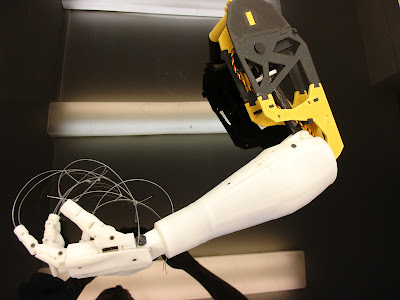
InMoov: A 3d Printed Animatronic Hand You Can Download

[Hairygael] has been hard at work designing and building this robot structure that can be completely 3d printed. He’s admittedly not a big electronics person, so most of his focus has been on the design and construction of the bot frame. So far, he as a fully 3d printable (and available for download) hand that you can see in action after the break. Once printed, you’ll have to drill it for your own servos and add your own control system.

You can see the action is quite nice and sturdy in the video. [Hairygael] laments his lack of electronics knowledge when you see him hit roadblocks like multiple finger control. But, just as he points out in the video, we’re positive that some of you who are more familiar with that end of things will undoubtedly make this work well.

[via HackedGadgets]

Continue reading “InMoov: A 3d Printed Animatronic Hand You Can Download”

Free Linux Computer From A Printer’s WiFi Card

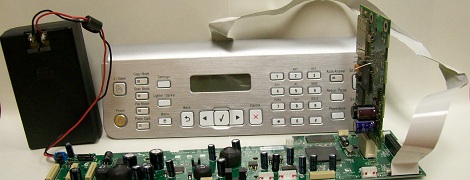
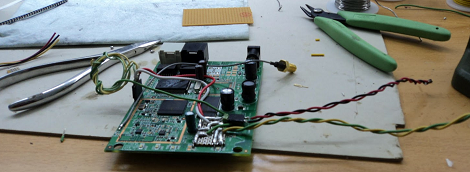
Whether it’s building a 3D scanning system with a Kinect, or using a USB TV tuner dongle for software defined radio, there are a lot of interesting off-schedule uses for commodity hardware. The latest comes from the fruitful mind of [sjMoquin] and a Lexmark N2050 WiFi card that runs Linux.

This build started off with a Lexmark X6570 all-in-one printer available for about $100 USD on eBay. This printer comes packaged with a Lexmark N2050 WiFi card running BusyBox. After soldering a few wires to the USB/UART pins on the N2050, [sjMoquin] had a very cheap but highly useful single board computer running Linux.

There is still a little more work to be done – the WiFi and USB on the N2050 aren’t currently supported. [sjMoquin] and [Julia Longtin] are working on that, so a fully functional embedded Linux board based on a printer’s WiFi card should be available soon. It might be time to hit up eBay for a few of these cards, you know.