Kansas City MakerFaire: Greentechweekly’s Coverage

We hadn’t been at the MakerFaire long when we ran into a couple hackaday fans lugging around camera equipment and microphones. I agreed to a quick interview for their show greentechweekly.tv which was fairly painless, then we all went our separate ways. [EcoGeeco] later sent me the footage and I couldn’t help but think… these guys did a better job than I did!  They asked some great questions, got some great footage, somehow managed to get decent audio too!

Continue reading “Kansas City MakerFaire: Greentechweekly’s Coverage”

The Most Surprising Game Of Simon You’ve Every Played

How does one take a game of Simon and make it extremely awesome? The folks at the North Street Labs — a Hackerspace in Portsmouth, Virginia — have found the secret and it’s all in the execution. They turned this chair-desk into a coin-operated Simon game that hides a huge surprise.

We suppose you should be able to guess the secret. Most coin-operated sidewalk attractions are rides, and so is this. As their Red Bull Creation entry the team built a base for the desk around a 2000 Watt floor buffer. These are the kind of things that you’d see a janitor in the 1980’s using to polish the tiles of your middle-school.  This one just happens to shake the bejesus out of a player who makes a mistake. To help suck you into the game this won’t happen right away. You have to make it past at least four rounds before making the mistake.

The rest of the game is as expected. The playing area is nicely milled from a piece of wood with acrylic windows serving as the buttons. Apparently the biggest problem with that part of the build is finding a way to hold everything together despite the intense vibrations. See for yourself in the clip after the break.

Continue reading “The Most Surprising Game Of Simon You’ve Every Played”

Ask Hackaday: Who Wants To Build A Function Generator?

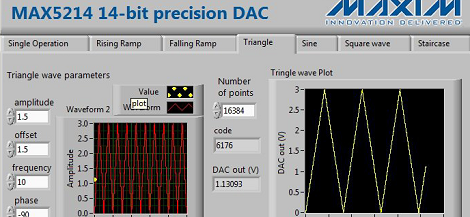
[tari] sent in a tip about a MAX5214 DAC evaluation board AVNET is giving away this summer.  The MAX5214 / MAX5216 is a neat little chip providing a 14 or 16 bit DAC with a serial interface in a tiny 8-pin package. [tari] thinks this eval board could be hacked into a function generator, and we’ve got to agree. Now, who wants to build one?

It’s entirely possible to take the MAX5214 chip and put it in a circuit with a small ARM uC, a display, and a few knobs, but that seems like a waste of time given function generators of this caliber are already available for about $60. It seems the most efficient hack of this dev board will be simply adding an amplifier to this board’s output and possibly programming a better interface than the current LabView software available.

If you want to tinker around with some free hardware and make something useful in the process, have a go at making a function generator out of this dev board. Be sure to send it in when you’re done.

MakerFaire K.C.: Power Wheels Racing

[vimeo=44644726]

This section of the MakerFaire almost deserves an entire event of its own. I know I would happily attend a monthly match of the power racing series in my home town. To compete, you must have a modded Power Wheel. Yes, those electric kids vehicles that go really slowly across your lawn, those power wheels. You tear it apart, soup it up, and race it.

Continue reading “MakerFaire K.C.: Power Wheels Racing”

Wireless Bullduino Belt Buckle Sets The Stage For Romance, Schtick

redbull-romance-pants

As the Red Bull Creation Contest gets underway, we’re seeing a ton of great entries, including this one put together by [Team Instructables]. While we are pretty partial to our own spectacular Red Bull Cannon, it’s hard to deny that there is some stiff competition out there.

Instructables’ “Romance Pants” are a creation that would undoubtedly fit perfectly as a prop piece for any of the Naked Gun movies. The basic premise behind the pants is that when unzipped, the Bullduino belt buckle wirelessly signals the lights in the room to dim, the music to turn up, and candles to light – setting the mood for romance.

Some might argue that anyone wearing a Red Bull-themed Arduino as a belt buckle would have a snowball’s chance in hell of encountering a potential mate – We can’t really argue with you there. That said, their concept is pretty amusing.

Stick around to see the Romance Pants in action, as well as a behind the scenes look at how they work.

[Thanks, Bill!]

Continue reading “Wireless Bullduino Belt Buckle Sets The Stage For Romance, Schtick”

[RobB’s] House Has No Light Switches

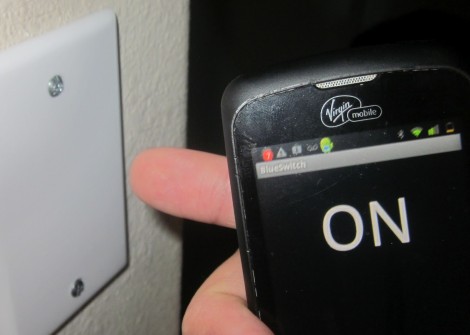
So [RobB] wanted to take out all the light switches in his house. His plan was to replace them with a system that could be operated from his smart phone. But his wife insisted that there still must be some way to control the lighting directly — we have to agree with her on that one. The solution was to develop a system that switches the lights via a touch sensor or by Bluetooth.

The touch part of the project is pretty easy. He coated the back of a blank outlet plate with tin foil and hooked it to a microcontroller with a couple of resistors. He’s using an ATtiny85, which can be programmed using Arduino sketches, so the software side is made easy by the CapSense Library. The chip also uses the software serial library to communicate with a Bluetooth module. You can see the result of both in the demo video after the break.

Of course you need to throw a relay in there to switch mains, and find a way to power the uC and Bluetooth module. [RobB] went with a tiny plug-in USB power converter and managed to fit everything in a single-gang switch.

Continue reading “[RobB’s] House Has No Light Switches”

The Excitement Of Ice Fishing Now From Anywhere In The World

Now you can experience the excitement felt for centuries by ice fisherman thanks to this cellular-capable tip-up.

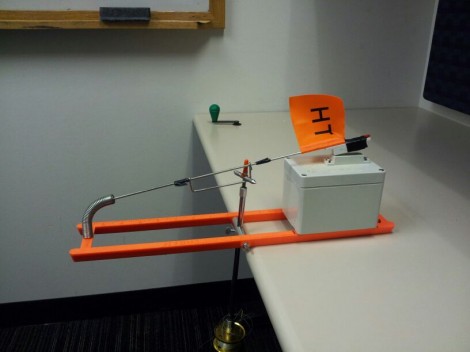
For the uninitiated a little ice fishing primer may be in order. The majority of what you see above is a standard tip-up rig for ice fishing. Basically it lets you set many baited lines and just watch for a flag to pop up when one of them hooks a fish. Just drill a hole in the ice and drop the line through — the orange frame rests on the surface of the ice.

The add-on here is the grey box which is hiding an Xbee device. A magnet and reed switch (which can be found at the local hardware store) complete a circuit when the flag is down. But if the flag pops up the reed switch opens (or closes, we’re not sure which) and the Xbee sends an alert to a base station, which then converts that to a text message to push to your phone. As you guessed, there’s a video after the break.

Fun and convoluted. But not entirely useless. We’d suggest swapping the Xbee/cellular hardware for a cheap microcontroller/Bluetooth setup. This way you can knock back a few cold ones in the ice house while waiting for the wireless network to alert you via an SL4A script.

Continue reading “The Excitement Of Ice Fishing Now From Anywhere In The World”