Gyroscopically Stabilized Car/motorcycle Thing

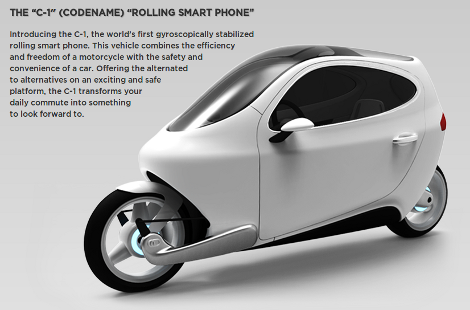
So yeah, this thing exists. Well, at least some pretty interesting looking prototypes of it do. It’s the C-1 from Lit Motors (anyone else think that’s a reference which belongs in /r/trees?). The idea here is that the small form-factor of a motorcycle is very efficient and easily maneuverable. But the cage protecting the passenger from harm, and the canopy keeping the elements out give it some of the desirable traits of a car.

Design aside, check out the video after the break. The prototype uses two horizontally positioned gyroscopes placed beneath the passenger seat, just in front of the rear wheel. The builders take it out on a hockey rink and give it a few kicks and slide a few tires into it. Sure, it reacts to the impact but it doesn’t fall over.

Want to see some fast-motion welding of the C-1? Right now there’s a one-minute clip up on the company’s main page.

Continue reading “Gyroscopically Stabilized Car/motorcycle Thing”
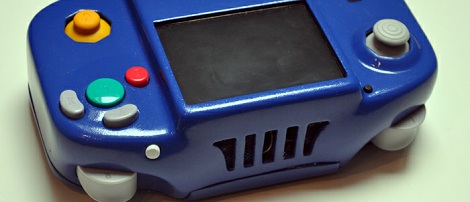
The Most Portable GameCube Ever

Here’s the smallest GameCube we’ve seen, straight from the fruitful workbench of [lyberty5] over on the ModRetro forums. Even though we’ve seen disc-less GameCubes before, [lyberty5] puts this project together so well it wouldn’t look out-of-place in the Nintendo product lineup.

Unlike most of the other portable GameCubes we’ve seen, [lyberty5]’s build doesn’t have a disk drive. The games are loaded off an SD card with the help of a Wiikey Fusion, a small FPGA’d device that replaces the CD drive in GameCubes and Wiis with an SD card.

The enclosure was constructed out of vacuum formed plastic with the always popular ‘dremeling and bondoing a controller for proper button placement’ method. Inside the enclosure is the hacked up GameCube, a 3.5 inch screen capable of displaying NTSC video at 640×480 resolution and enough battery power to get two or three hours of playtime from a single charge.

After the break you can check out [lyberty5] fast-paced demo video that really sets the bar for portablized console presentation.

Continue reading “The Most Portable GameCube Ever”

Update: Using Your Forearms As A UI

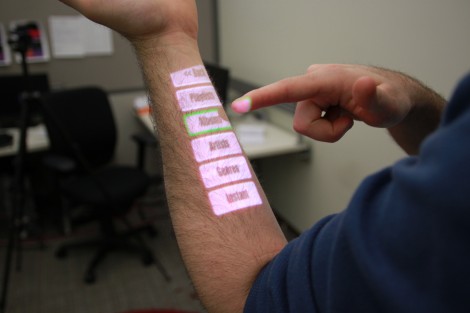
This image should look familiar to regular readers. It’s a concept that [Chris Harrison] has been working on for a while, and this hardware upgrade uses equipment which which we’re all familiar.

The newest rendition, which is named the Omnitouch, uses a shoulder-mounted system for both input and output. The functionality is the same as his Skinput project, but the goal is achieved in a different way. That used an arm cuff to electrically sense when and where you were touching your arm or hand. This uses a depth camera to do the sensing. In both cases, a pico projector provides the interactive feedback.

There’s a couple of really neat things about this upgrade. First, it has a pretty accurate multitouch capability. Second, it allows more surfaces to be used than just your arm. In fact, it can track moving surfaces and adjust accordingly. This is shown in the clip after the break when a printed document is edited in real time. Pretty neat stuff!

Continue reading “Update: Using Your Forearms As A UI”

Automatic Capacitor Charger Lets You Have Fun With Sparks

[GranTotem] is delighted by the sparks put out when a capacitor is rapidly discharged. But he’s not impressed at the relatively slow process of connecting them to a power supply for a recharge. So he built this auto-charging station for his capacitors that provides a shockingly good time almost continuously. Check out the video to see what we mean.

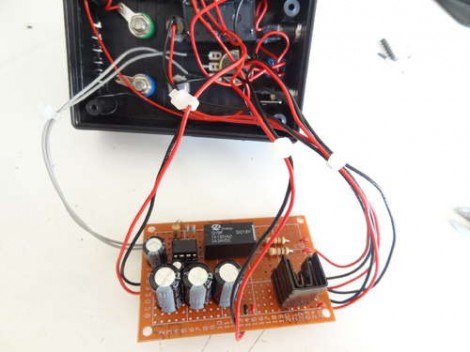
We always like to see the guts of the project, and that’s why we chose this image for the feature. But when everything is properly seated in the project box [GranTotem] has managed to achieve a really clean look. There are two barrel jack connectors on the end, one for 16V and the other for 20V inputs. The lid of the enclosure hosts an on/off switch, adjustment knob, and two banana connector terminals. Once switched on, a relay connects and disconnects the capacitor from the power supply at regular intervals which are adjusted by the knob. Just connect a couple of probes to those banana terminals and let the sparks reign down.

Continue reading “Automatic Capacitor Charger Lets You Have Fun With Sparks”

3D Printed Circuit Boards Using Conductive Ink

The thought of using a 3D printer to fabricate PCBs is tantalizing and the good news is that it’s a reality. This project shows that it’s possible to use a special printer head to apply traces to an extruded substrate.

This is similar to the point-to-point 3D printer circuits with one big upgrade. Now the traces can be printed directly onto the ABS using conductive ink. The process starts with the design files, which are used to model a substrate that has a trench for each trace. A Makerbot then prints out this model. Once complete, the ABS extruder head is swapped for a special ink head. Each trace is then filled with the conductive fluid, which is kept in place by the trench walls until it can dry. We think this improves on the trace printing techniques we’ve seen before because it doesn’t require your printer heat to use molten metals.

The circuit above uses printed traces for the high and low side of an LED circuit. It’s a bit rough at the edges, but it shows a lot of promise. Don’t miss the demo video embedded after the jump.

Continue reading “3D Printed Circuit Boards Using Conductive Ink”

Macetech’s LED Glasses Prototype

While there was no mention of it on their blog, [Garret] from mace tech was spied wearing some pretty cool looking LED glasses at MakerFaire last weekend. This morning, we noticed a Lytro gallery of the glasses and they look pretty cool (as a toy, not a fashion accessory). For those who haven’t played with Lytro, you can click around and refocus the image. Neat right? Back to the glasses.

Someone who we’re guessing is [Garret] spoke up on Reddit this morning explaining some tech specs and dropping a video of them in action.

The shades are a 20×6 matrix (with some pixel missing of course) driven by SPI from an integrated Arduino-compatible in the right temple. There is a Lithium-Polymer battery on the left temple. You can charge the glasses through USB, and download new code to it over the same connection. A button on the right temple allows switching between modes or auto cycling animated patterns.

Win $40,000 For Squirting Plastic Out Of A Nozzle

3D printers such as the RepRap and Makerbot turn spools of plastic filament into just about any object imaginable. There’s a problem though: this filament costs about $40 a kilogram, and raw plastic pellets cost about 1/10th of that. Obviously, there’s a lot of room for improvement. The folks at Inventables are throwing $40,000 at the problem in a contest to build a machine that takes plastic pellets and turns it into usable plastic filament.

The object is simple: build a device that takes ABS or PLA pellets and turns them into a 1.75mm filament. The machine has to cost less than $250, be able to add colorant to the plastic, and be usable in a 3D printer. The winner gets $40,000, a laser cutter, a 3D printer, and a CNC milling machine courtesy of Inventables. Sign up on the official contest website and don’t be shy about sending your progress into the Hackaday tip line

If you’d like to get started, here’s a great page that goes over the basics of plastic extrusion, and a few attempts (1, 2) from [Adrian Bowyer] and [Forrest Higgs] that show exactly how hard this is. There’s also the Filabot that had a successful Kickstarter, but there’s apparently been no (or very limited) progress in the four months since the Kickstarter. I’ve even given this idea a go, but am currently stuck at manufacturing a proper auger. To put this in perspective, this is the moonshot of the current crop of 3D printers; a simple device to lower the barrier of entry to 3D printing is desperately needed, and we’ve got to give props to the Inventables crew for putting this contest together.