10,000 Posts

According to our CMS calculations (we use WordPress), this is Hackaday’s ten-thousandth published posts. We meant to build a confetti cannon, but we were too busy looking for interesting projects to feature multiple times per day.

We’d like to thank everyone who documents their projects to share what they’ve been up to in basements, garages, or hackerspaces with the ecosystem of hackers around the world. We hope that every time you publish a build log or project summary you think about sending us a link. We’re also grateful for those who find intriguing blog or forum posts and send in a tip even though it’s not their project (we wholeheartedly encourage it).

Our contributors and editors deserve kudos. Over the years a growing band of Hackaday alumni have helped keep the front page of Hackday a place you can count on for interesting uses for otherwise everyday things. You’ve heard many of their names, like [Philip Torrone], [Eliot Phillips], and [Caleb Kraft]. But most of what you see on the front page is the result of the writers sifting through tips and scanning a laundry list of RSS feeds to find new and interesting projects and project ideas. Their contribution is what keeps the front page fresh and new, but we continue to use the royal ‘we’ in our posts because it’s the project being featured that is paramount.

And finally we thank the regular readers, whose participation keeps the lights on, and whose comments build a community. Many started out as lurkers, inspired by the projects featured here until the point that they take the plunge and blink their first LED. The threads in the comments section of each post are the evolutionary ooze that often leads to the next amazing build. Keep reading, keep commenting constructively, and we’ll see you all back here for our 16,383rd post when we fill up these digits with ones.

Thank you.

The RC Transmitter That Does Everything

[Demetris] sent in a project he’s been working on over the last year. It’s called the Open Source Radio Control, and promises to be a modular platform for every imaginable remote control transmitter need. If you’d like to control a bipedal android or a 3D aerobatic model plane, the OSRC can do it while transmitting video from the cockpit down to your hands.

Last summer, we caught wind of the OSRC project to build an extensible and open source remote control radio that would do anything; from displaying video from the cockpit to serving as the brain of a UAV rig, the OSRC promised to do everything.

A fully decked out OSRC can be had for about $1400, putting it in the upper echelon of remote control radios. For that price, though, you get a fully customizable radio with your choice of shoulder buttons and a 4.8 inch LCD that receives a video feed from the cockpit of your favorite model. The base unit starts out around $700; still very expensive for a remote control radio, but reasonable when you consider all the possible upgrades.

[Demetris] and the rest of the team put together an outrageously long yet surprisingly beautiful video showing off a few features of the OSRC. You can check that out after the break.

Continue reading “The RC Transmitter That Does Everything”

Display Made Out Of Hundreds Of Seven Segment LEDs

While huge LED panels are a relatively common project du jour for people wanting to flex their engineering muscle, we’re taken aback by the sheer beauty of [Skot9000]’s huge LED display made of seven-segment displays. He calls the build DigitGrid, and it’s a wondrous display the likes of which we’ve never seen.

To build a display based on seven-segment LEDs, [Skot] went with a modular approach in designing the DigitGrid. To power and control all these seven-segment displays, [Skot] used a Texas Instruments TLC5920 to run four 4-digit displays as a single module. Four of these modules connect together to form a row of 32×2 digits, and eight rows of digits come together to make a 512-digit display. With seven LEDs for each digit, that works out to 3,584 4,096 individual LEDs for the entire panel.

To power and control this gigantic array of LED displays, each row uses a PIC16F microcontroller which, in turn, is controlled by an FPGA. After several hours of writing Verilog, [Skot] had a reasonably good hunk of software that allowed him to send frames from his computer to the display. The results, quite simply, are amazing. [Skot] managed to put up a short film showing off the animation capabilities of his new display, and it’s a wonder to behold. You can check that video out after the break.

Continue reading “Display Made Out Of Hundreds Of Seven Segment LEDs”

Building A Combination Lock With Logic Chips

The component gods must have smiled on [Darrell], because he recently ran into a cabinet full of 7400-series logic chips for sale at his local college surplus. All the regulars were there – flip-flops, logic gates, and SRAMs – in DIP packages. the 7400-series of logic chips gets very esoteric as the numbers increased, so when [Darrell] found a 74ALS679 address comparator, he didn’t quite realize what he had. After a quick review of the relevant datasheet he had a fairly good idea of the actual function of this chip and decided to make a combination lock.

From the datasheet, [Darrell] figured out how this small logic chip can compare two 12-bit addresses with only 20 pins: each of the 12 address pins are hardwired to match a single four-bit value. If the four-bit ‘key’ is set to 0110, the first six address pins are tied low, and pins 7-12 are tied high. After wiring up his address comparator to a trio of Hex dip switches, [Darrell] had a combination lock that used the word ‘FAB’ as a key.

In the 7400-series of logic chips, there are some oddballs; the 7447 seven-segment display driver is useful, but the 74881 ALU and 74361 bubble memory timing generator aren’t exactly something you would find in a random component stash. If you’ve got a weird logic chip build (there’s a 300-baud modem, you know), send it on in. You can check out an animated gif of [Darrell]’s lock after the break.

Continue reading “Building A Combination Lock With Logic Chips”

Grabbing Data From A Rigol ‘scope With Python

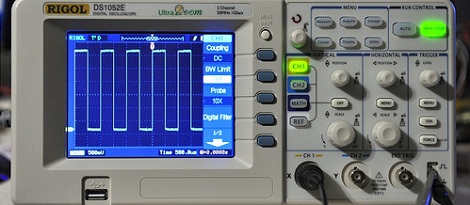
While a fancy Rigol 1052E oscilloscope is a great tool and a wonderful portable oscilloscope we heartily recommend, sometimes you just need to use the more ‘advanced’ functions of an oscilloscope. Luckily, [cibomahto] figured out how to use a Rigol scope with Python, allowing for easy remote viewing and control of a Rigol 1052E ‘scope on any desktop computer.

[cibomahto]’s Python script grabs the screen and can send commands to the oscilloscope, effectively obviating the need for the slightly-terrible Rigol Ultrascope software. Not only that, controlling the 1052E is possible under OS X and Linux because of the portable Python nature of [cibomahto]’s work.

The Rigol DS1052E has become the de facto standard oscilloscope to grace the workbenches of makers and hackers around the globe. With a small price tag, the ability to double the bandwidth, and an active homebrew development scene, we doubt [cibomahto]’s work of grabbing data over USB will be the last hack we’ll see for this fine machine.

Thanks to [Markus] for sending this one in.

Working Software-defined Radio With A TV Tuner Card.

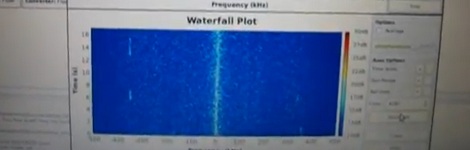
[Balint Seeber] just sent in a small yet timely project he’s been working on: a software radio source block for the Realtek RTL2832U. Now with a cheap USB TV tuner card, you can jump right into the world of software-defined radio.

[Balint]’s code comes just a week after hackaday and other outlets posted stories about using a $20 USB TV capture dongle for software defined radio. At the time, these capture cards could only write data directly to a file. With [Balint]’s work, anyone can use a cheap tv tuner dongle with HDSDR, Winrad, or GNU Radio. If you’ve ever thought about trying out software-defined radio, now might be the time.

Elsewhere on the Internet, a surprisingly active RTL-SDR subreddit popped up dedicated to using the Realtek RTL2832U tuner for software defined radio. There’s an awesome compatibility chart listing compatible USB dongles. The cheapest (so far, and subject to change) is the Unikoo UK001T available for $11 on eBay.

With his source block, [Balint] can listen to anything on the radio between 64-1700 MHz. The sample depth is 8 bits and the sample rate can be anything up to 3.2 MHz. You can watch [Balint] testing out his $20 GNU Radio rig after the break.

Continue reading “Working Software-defined Radio With A TV Tuner Card.”

Quieting An Inexpensive Bench Power Supply

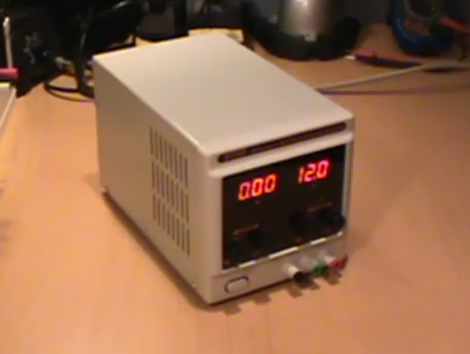
[Mike] just purchased this Atten APS3005S bench power supply for around $80. It does the job, but boy is it noisy! We were pretty surprised to hear it fire up in the video after the break. To make matters worse, the noise is persistent since the fan never shuts off. Having worked with other bench supplies he knew that a common feature included in many models is temperature controlled case fans. He set out to quiet the fan and implement a temperature switch.

For this project [Mike] had the benefit of looking at a nearly identical model that does have temperature switching. He discovered that the board on this one has a through-hole zero ohm resistor populated in place of a thermostat switch. That switch closes the connection at or above 45 degree Celsius, thereby turning on the cooling fan. Bridging the traces with a zero ohm resistor to save on production costs is what caused the fan to run continuously. After replacing the resistor with a KSD-01F and swapping out the stock fan for a high-quality version [Mike] has takes a noise maker and turned it into a device that’s kind to the ears.

Continue reading “Quieting An Inexpensive Bench Power Supply”