Sony Google TV Devices Running Unsigned Kernels

The proud cry of “I am root” rings true once again, this time on Sony Google TV devices. Although a low-level exploit was found on previous firmware versions, a downgrade process lets you run unsigned kernels on updated TV or Bluray models of the Internet streaming devices.

These systems are Android-based, which currently run version 3.1 Honeycomb. This version patches the previous exploit, but with three different USB sticks you can downgrade, exploit, and upgrade to an altered and unsigned hack of the most recent kernel. This gives you the root access you may have been longing for, but other than the features discussed in the forum thread there’s not a whole lot of changes rolled into the exploit yet.

We’re always looking out for open source projects running on living-room devices and hope that someday we’ll see a branch of XBMC for the GTV. Until then we’ll just have to keep our fingers crossed for the viability of a RaspberryPI XBMC.
512k SRAM Board For Your Next Prototyping Run

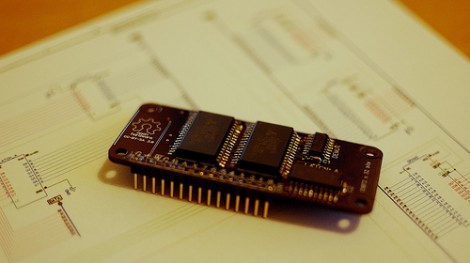
Find you’re running out of memory and paying for more expensive chips just to plug this feature gap? Many of the upper offering of chips have the option of adding SRAM thanks to an on-chip hardware feature, but if you don’t have that this 512k SRAM add-on board can be used with any chip that has 13 extra I/O pins available.

That use of pins may sound crippling if you usually use low pin count chips. But thanks to a write protected state option with the memory chips, nine of those thirteen pins can serve a dual use when not reading or writing from the memory. Speaking of, the address scheme is designed to access the memory in 32-bit blocks but individual bytes are accessible too if need be. [Wardy] has been testing his design using a Propeller chip running at 75 MHz so we know it’s built for speed, but he also mentions there’s no minimum clock speed for the board to function either. He used the Open Hardware guidelines when sharing his work, and if you want one for yourself you could always give the DorkBot PDX service he used for the prototypes to get your own boards too.

[via Dangerous Prototypes]

Robot Overlords Require Chores In Return For Technological Access

Looks like you might not be fully immersed in the digital world if you didn’t complete your chores. The members of the LVL1 Hackerspace have put together a lot of automation for their lair, but nothing drives home the utility of the system they call MOTHER like the shenanigan-preventing trash removal system. Or in layman’s turns, being nagged by MOTHER until you empty the trash can.

So here’s a bit of background first. Remember that sensor array that just had way too many environmental sensors on it? That is just one way that the automation system (MOTHER) measures its surroundings. It seems the hackerspace has been building a pile of scripts to interface with just about every aspect of the community.

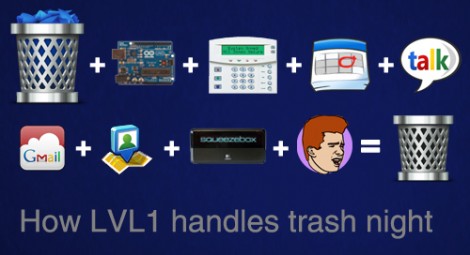
For instance, the night before trash colletion the system starts by letting members know it’s trash night and someone needs to empty the garbage. There’s a pressure sensor under the can which alerts MOTHER to the fact that it has been moved. But what if nobody moves the can? Say goodbye to Google. Yep, it’ll block all Google searches until the chore is done. And that’s just one punishments in its bag of tricks.

So what if you just move the can and don’t take it out? No dice. MOTHER is also monitoring the garage door which needs to be open to get the extra-large can out to the dumpster. You’ve got five minutes to do that before she starts getting nasty.

[Thanks Jonathan]

[Dick Tracy]’s Watch Gets Night Vision

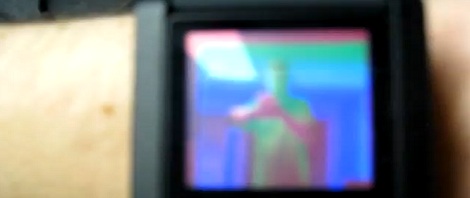
After getting his hands on an Android-enabled wristwatch, [Paul] wanted to test the limits of his new hardware. We’ll assume he’s happy with his purchase because his finished build sends data from a Microsoft Kinect to his wristwatch, making it a night vision spy watch.

[Paul]’s new toy is a WIMM One Android wristwatch that comes complete with wi-fi and a copy of Android 2.1. To get night vision onto his watch, a Kinect on [Paul]’s desk streams depth data to his watch using OpenCV. The result is a camera that gathers depth data in the dark and sends it to [Paul]’s watch.

Whenever the movement of an intruder is detected, [Paul]’s watch vibrates and displays the depth image taken from the Kinect. If the intruder gets close to the Kinect, the face is picked up and also sent to the watch. To get the intruder out of the room, [Paul] can tap the face of his watch to turn on a remote alarm and sound an intruder alert. It’s a very neat project that would have been unimaginable a few years ago.

Handheld CNC Fabrication

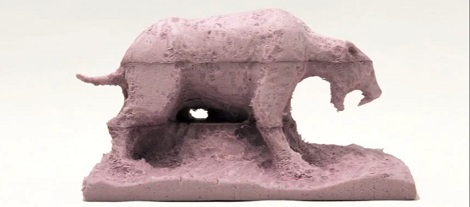
While loading a 3D model into a CNC program and letting a machine go to town on a piece of stock is awesome, there’s a lot to be said about the artistry, craftsmanship and tactile feedback of carving a project by hand. [Amit Zoran] and [Joe Paradiso] created a nice bridge between these two approaches with their hand-held, but still digitally controlled milling device they call The Free D.

The Free D looks like your run-of-the-mill handheld Dremel tool with an engraving attachment and a few extra servos attached for good measure. These extra parts serve a purpose: the tool actually keeps track of its own orientation in 3D space. With the help of a few magnets underneath the work piece, the Free D sends its orientation back to a computer running a CNC program. When the computer detects the engraving attachment is getting too close to the desired shape, the Free D automatically retracts its own tool head.

Given the insanity or expense in building our buying a mill with six degrees of freedom, the Free D looks like it could be a useful tool in a few model maker’s toolboxes. Check out the demo video of the Free D after the break.

Continue reading “Handheld CNC Fabrication”

Bringing The Stars To Your Baby

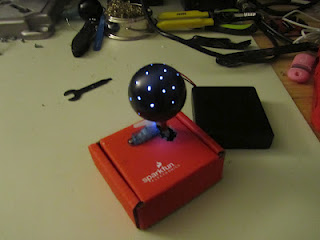
[Zach] saw a stuffed animal that projected some simple stars on the ceiling. This gave him an idea that he could build a tiny star projector for his 3 month old daughter’s room.  The idea is to put an LED inside a ping pong ball with tiny holes and rotate it slowly.

The electronics are fairly strait forward. He’s using an MSP430 to control the servo and LED, allowing him to set different speeds and turn the whole thing off after a certain amount of time.  The ball took a little bit of trial and error though. He first started by drilling some holes, but found this to give poor results. The holes were just too big. He finally ended up heating up a  sewing needle and melting tiny holes in the ping pong ball. That worked perfect.

After the break you can see a video of it moving. The servo is pretty loud, which might actually be a good distraction for a 3month old, but might be something to address in the future.

Continue reading “Bringing The Stars To Your Baby”

Hackaday Links: February 19, 2012

Industrial control robot band

Remember Animusic, a series of videos featuring computer-generated, highly  implausible instruments? Intel made their own to demo their industrial control tech. From the looks of things, we’re putting money on a bunch of MIDI triggers bolted onto plastic panels; now it’s slightly less impressive and the reason we’re looking at xylophones on eBay right now.

Quadrocopters everywhere

[Jouni] sent in his quadrocopter build that was inspired by the Japanese spherebot we caught earlier this year. [Jouni] used a carbon fiber frame to  prevent the copter from bumping into things. Other things bumping into it are another story entirely.

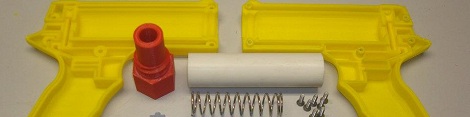
This is my gun. There are none like it, because I printed it.

[Landru] printed a Nerf gun on his 3D printer. The only non-printed parts are a few screws, springs and an o-ring. [Landru] promised to put the files up on Thingiverse, but we can’t find them.

Media center auto power on circuit

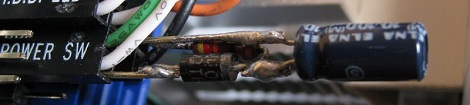
[Dizzy]’s media server doesn’t have an ‘AC power loss reset’ feature in its BIOS, and he can’t jumpstart the thing by shorting pins on the ATX power socket. He came up with a very clean, minimal solution to starting his server after a power loss. Nice job, [Diz].

Better run, better run, outrun my soldering gun

Alright, circuit board shoes probably aren’t that comfortable, or useful, but we did find a like to the works of [Steven Rodrig], an artist who works in the medium of PCBs. The recycled circuits don’t do anything, and that’s giving us a few ideas on how to improve a digital banana.