Take A Picture Of A Bang With A Camera Sound Trigger

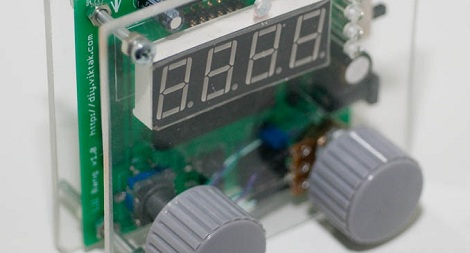
We’ve featured dozens of digital camera triggers over the years. Very rarely do we come across one as well designed as [Viktor]’s ‘lil bang sound trigger that snaps a picture whenever a microphone picks up a loud noise.

[Viktor]’s build is based around a PIC16F microcontroller with an LM386 amp connected to a microphone. On the front of the device, the right knob controls the sensitivity of the microphone and the left knob sets the delay between detection and the trigger.

The ‘lil bang trigger connects to the camera through an opto-isolated 3.5 mm jack that is compatible with all the fancy Canon and Nikon DSLRs. The delay between sound detection can be changed from 0 to 255 ms, allowing for precise control over a high-speed photography rig.

All this work comes after the  light-activated trigger [Viktor] built for taking pictures of lightning. The sound-activated version wouldn’t work for lightning pics, but he thinks it could be useful for collision or explosion photographic studies. Check out the video of [Viktor]’s ‘lil Bang in action after the break.

Continue reading “Take A Picture Of A Bang With A Camera Sound Trigger”

Tears From Your Lonely Heart Will Activate A Comforting Tune

If you’re forever alone we’d guess you’ve long since stopped crying about it. But if you’re still prone to shed a tear on a dateless Valentine’s day this project’s for you. [Mikeasaurus] spruced up this pillow to play a tune when it senses your lonely soul. It’s got a moisture sensor which triggers an audio greeting card just when your weeping really starts to get soggy.

If you look closely at the top portion of the white fabric in the picture you can see there are rows of stitching. These hold a matrix of conductive wire mesh fabric on the inside of the pillow case. There are two buses made up of alternating rows (think of the tines of two forks pointed together) which make up the probes. When the gap is bridged by moisture a transistor circuit triggers the audio bits from a greeting card to play a song. Check out the demo after the break. We’re not satisfied that [Mikeasaurs’] couldn’t even bring himself to cry real tears for the clip, but maybe years of solder fumes have clogged up those tear ducts.

Continue reading “Tears From Your Lonely Heart Will Activate A Comforting Tune”

Share A Light-up LED Heart With Your Valentine

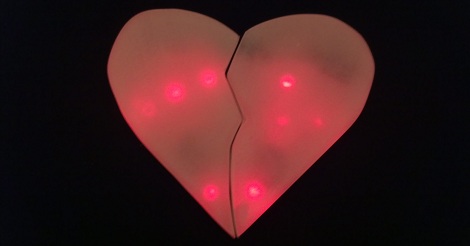
It’s not roses or jewelry, but we hope [Erik]’s light-up USB heart will be appreciated by his significant other. When the two heart pieces come in contact with each other, each side lights up.

[Erik] started his build by cutting two half-heart shaped pieces out of polycarbonate. After drilling a few holes for LEDs and wires, magnets and reed switches were installed along the ‘broken’ side of the heart. Whenever the hearts come in contact with each other, the magnets trip the reed switches and light up both sides of the heart.

There is USB flash drive embedded in each heart half is loaded with a portable Dropbox. When the USB drive is plugged into a computer, the dropbox steps into action and synchronizes the photo album stored in each heart half. No matter how far apart they are, [Erik] and his SO can share pictures through their glowing LED hearts. Not to come off as a hopeless romantic, but this sounds like something we’d like for Valentine’s day. We’re hoping [Erik]’s SO thinks that as well.

Passive Filters, Data Transmission And Equalization Oh My!

[Shahriar] is back with a new “The Signal Path” video. It has been a few months but it is okay because his videos are always packed full of good information. Some new equipment has been added to his lab and as an added bonus a quick tour of the equipment is included at the start, which is great if you like drooling over sweet machines.

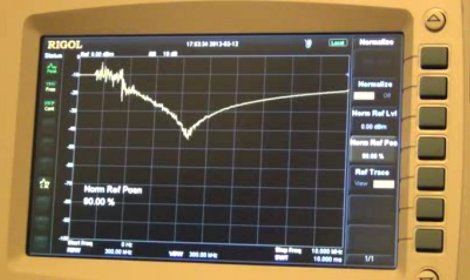
The real focus of the video is high speed data communications, getting up into the GHz per second range. [Shahriar] covers filtering techniques from simple RC low pass filters to pretty complex microwave filters. Explaining frequency and time domain measurements of a 1.5Gbps signal through a low bandwidth channel. He also shows how equalization can be used to overcome low bandwidth limitations.

It is an hour long video jam packed with information, so you might want to set aside some time and have a pencil on hand before going in. It is well worth it though, so join us after the break.

Continue reading “Passive Filters, Data Transmission And Equalization Oh My!”

AltSoftSerial Looks To Speed Up Arduino Software UART

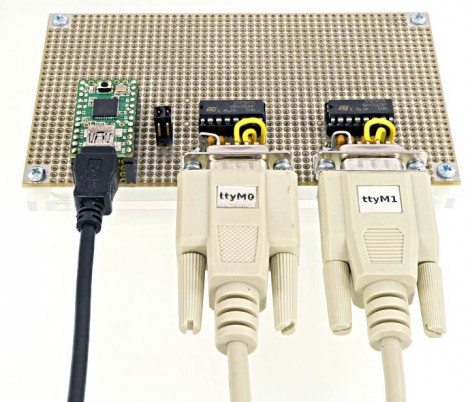
So let’s say your using an Arduino in your project. You already have the hardware-based serial interface working with one portion of the project and need a second serial port for unrelated hardware. The obvious solution is to write one in software. But this is a place where working in the Arduino environment gets really hairy. Since there’s a layer of abstraction between the code and the hardware interrupts, it can be difficult to know if you are going to have timing problems. But there’s a new library available which seeks to reduce the latency of software-based serial communications so that you don’t have to worry about it.

It’s named AltSoftSerial because it is a software-based serial library that is an alternative to the NewSoftSerial package. The former can function with just  2-3 microseconds of latency, while the latter has as much as a 174 microsecond hit. If it functions as advertised that’s quite an improvement. It’s not hard to put together a hardware test platform, and the example program is only about a dozen lines of code (which is the beauty of working in this environment) so give it a try if you have a free hour here or there.

Connecting A Dumb Scale To Your Smartphone

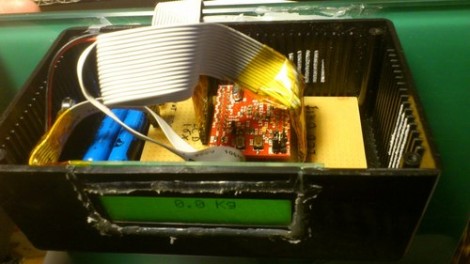
[Casainho] wanted to track his body weight using an app on his Android phone. He just needed a way to get the weight readings onto the device automatically. He ended up adding Bluetooth to a bathroom scale and hacking the app to grab data from it.

The scale which he hacked is a digital model, which makes it possible to read the weight data if you know what you’re doing. [Casainho] already completed a weight logging scale hack which stored the data on an SD card. So this was a recreation of that project but with a Bluetooth module for the output rather than the card for storage.

Now you can buy WiFi enabled scales, but that’s not nearly as fun as a hack like this. Plus one of those will cost you around $200 and the hardware for this version came it at only $75. It includes an LPC2103 dev board, $6 Bluetooth module, character display, batteries, and misc. supplies. The software end of the hack was helped greatly by the fact that the Android apps which [Casainho] is using are both open source.

Fill In The Bass On Your PSP

[Michael Chen] felt the sound his PSP was putting out needed more dimension. Some would have grabbed themselves a nice set of headphones, but he grabbed his soldering iron instead and found some space where he could add a bigger speaker.

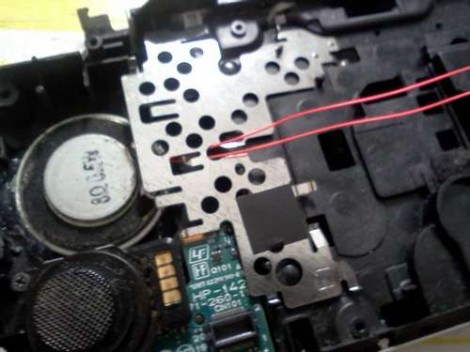
Mobile devices tend to cram as much into the small form factor as possible so we’re surprised he managed make room. But apparently if you cut away a bit from the inside of the case there is space beneath the memory card. [Michael] cautions that you need to choose a speaker rated for 8 ohms or greater  in order to use it as a drop-in replacement for one of the two original speakers. But he also touches on a method to use both stock speakers as well as the new one. He suggests grabbing an LM386 op-amp and a capacitor and hooking them up. Yep, there’s room for that too if you mount it dead-bug-style. We wonder how the battery life will be affected by this hack?