Fictional Moon: Reality TV And SciFi Don’t Mix

It is a safe bet that nearly all Hackaday readers like to at least imagine what it would be like to build and live in an orbital station, on the moon, or on another planet. Moon bases and colonies show up all the time in fictional writing and movies, too. For the Hackaday crowd, some of these are plausible, and others are — well — a bit fanciful. However, there’s one fictional moonbase that we think might have been too realistic: Moonbase 3.

View of the base from above.

If that didn’t ring a bell, we aren’t surprised. The six-episode series was a co-production between Twentieth Century Fox and the BBC that aired in 1973. To make matters worse, after the initial airings in the UK, Australia, and New Zealand, the video master tapes were wiped out. Until 1993, there were no known copies of the show, but then one turned up in a US television station.

The show had many links to Dr. Who and, in fact, if you think the spacesuits look familiar, they made later appearances in two Dr. Who episodes.

Continue reading “Fictional Moon: Reality TV And SciFi Don’t Mix”
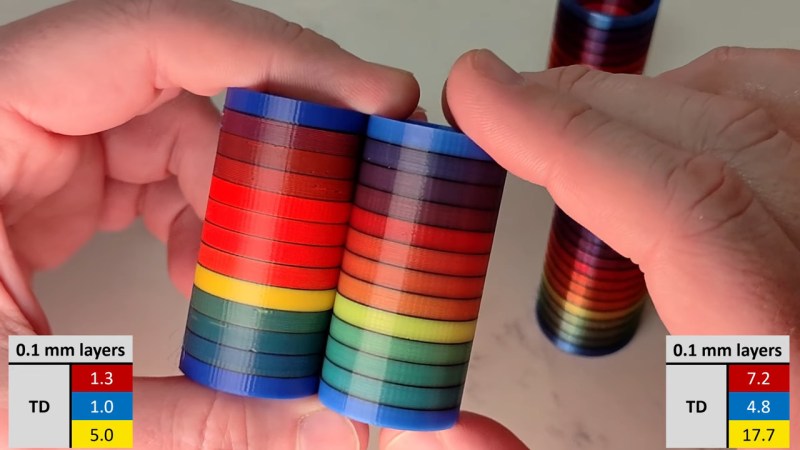
Two test towers, showing the palette potential of three (R, B, Y) filaments.

FullSpectrum Is Like HueForge For 3D Models, But Bring Your Toolchanger

Full-color 3D printing is something of a holy grail, if nothing else, just because of how much it impresses the normies. We’ve seen a lot of multi-material units in the past few years, and with Snapmaker’s U1 and the Prusa XL, it looks like tool changers are coming back into vogue. Just in time, [Ratdoux] has a fork of OrcaSlicer called FullSpectrum that brings HueForge-like color mixing to tool-changing printers.

The hook behind FullSpectrum is very simple: stacking thin layers of colors, preferably with semi-translucent filament, allows for a surprising degree of mixing. The towers in the image above have only three colors: red, blue, and yellow. It’s not literally full-spectrum, but you can generate surprisingly large palettes this way. You aren’t limited to single-layer mixes, either: A-A-B repeats, and even arbitrary patterns of four colors are possible, assuming you have a four-head tool-changing printer like the Snapmaker U1 this is being developed for.

FullSpectrum is, in fact, a fork of Snapmaker’s fork of OrcaSlicer, which is itself forked from Bambu Slicer, which forked off of PrusaSlicer, which originated as a fork of Slic3r. Some complain about the open-source chaos of endless forking, but you can see in that chain how much innovation it gets us — including this technique of color mixing by alternating layers.

Continue reading “FullSpectrum Is Like HueForge For 3D Models, But Bring Your Toolchanger”

Polyphonic Tunes On The Sharp PC-E500

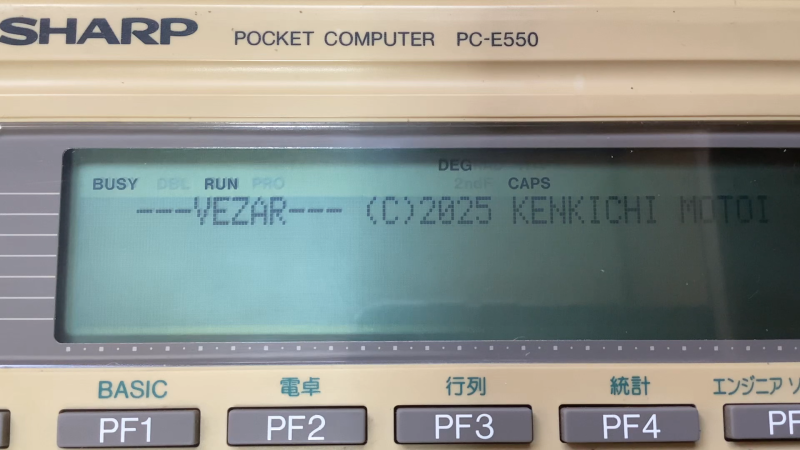
If you’re a diehard fan of the chiptune scene, you’ve probably heard endless beautiful compositions on the Nintendo Game Boy, Commodore 64, and a few phat FM tracks from Segas of years later. What the scene is yet to see is a breakout artist ripping hot tracks on the Sharp PC-E500. If you wanted to, though, you’d probably find use in this 3-voice music driver for the ancient 1993 mini-PC. 

This comes to us from [gikonekos], who dug up the “PLAY3” code from the Japanese magazine “Pocket Computer Journal” published in November 1993. Over on GitHub, the original articles have been scanned, and the assembly source code for the PLAY3 driver has been reconstructed. There’s also documentation of how the driver actually works, along with verification against RAM dumps from actual Sharp PC-E500 hardware. The driver itself runs as a machine code extension to the BASIC interpreter on the machine. The “PLAY” command can then be used to specify a string of notes to play at a given tempo and octave. Polyphony is simulated using time-division sound generation, with output via the device’s rather pathetic single piezo buzzer.

It’s very cool to see this code preserved for the future. That said, don’t expect to see it on stage at the next Boston Bitdown or anything—as this example video shows, it’s not exactly the punchiest chiptune monster out there. We’ll probably stick to our luscious fake-bit creations for now, while Nintendo hardware will still remain the bedrock of the movement.

Continue reading “Polyphonic Tunes On The Sharp PC-E500”