

This Week In Security: Another Linux Exploit, Ubuntu Knocked Offline, Finals Interrupted, And Backdoored Tools

After the CopyFail vulnerability gave root access from any user on almost all distributions last week, this week we’ve got DirtyFrag. This chains the vulnerability in CopyFail (xfrm-ESP) and a new vulnerability in a RPC function which allows similar overwriting of the page cache.

Both vulnerabilities manipulate the Linux page cache where data from disk is stored for rapid access. The kernel will always prefer the cached version of a file, which means that anything that is able to manipulate the contents of the cache can effectively replace the contents of the file. Both of the vulnerabilities leverage a similar mechanism – picking a binary which is flagged to run as root, such as su, and replacing the contents that would prompt for the users password with a launcher to immediately run a shell.

Like CopyFail, DirtyFrag requires the ability to execute code on the target in the first place, but turning almost any code or command execution vulnerability in any network service into root raises the impact significantly, allowing an attacker to break out of containers and privilege environments, or establish a persistent presence in the system when the original vulnerabilities are discovered and closed.

The previous mitigations to block specific kernel modules related to CopyFail are not sufficient to block the new vulnerabilities. At the time of writing this, there are no available patches from the distributions, however the vulnerable kernel modules can be temporarily disabled.

CopyFail added to KEV

CISA (the United States cyber security agency) has added CopyFail to the KEV, or Known Exploited Vulnerabilities list. Attacks on the KEV have been observed under active exploitation, which in the case of CopyFail is hardly a surprise.

The KEV is designed as a tool to allow security teams in government and commercial industry to prioritize the highest risk vulnerabilities – or at least give another source of data to point at when you say “we really need to patch this now”.

Prolonged Ubuntu DDOS

On the heels of the CopyFail vulnerability impacting almost all distributions, Ubuntu has had to face a prolonged distributed denial-of-service (DDoS) attack against the main infrastructure. Ars Technica reported at the beginning of the attack, and after several days, services appear to be restored. In the meantime, core services such as package updates, core repositories, and even the Ubuntu and Canonical websites were largely unreachable.

An Iraqi group claims responsibility for the attack, but it is unclear if they were the actual perpetrators – or why. The timing with the CopyFail vulnerability seems like an opportune moment to cause chaos by taking the update mechanisms of a major distribution offline, but in the era of modern Internet behavior, it could also just have been a Tuesday.
Continue reading “This Week In Security: Another Linux Exploit, Ubuntu Knocked Offline, Finals Interrupted, And Backdoored Tools”

The ESP8266 Gets An OS, And It’s Familiar

A couple weeks back we brought you news of KernelUNO, a command line shell and very simple operating system for the Arduino Uno. It’s a neat idea, so it’s hardly surprising to see someone port it to another microcontroller and add more features.

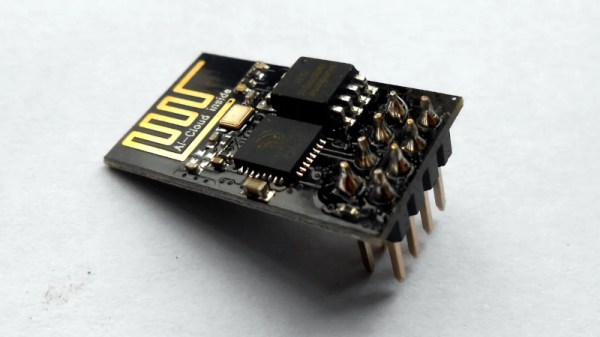
Here’s [hery-torrado], with KernelESP for the ESP8266, which takes the original idea and adds a web console, scheduled jobs, sensor rules, scripting, NTP, and a JSON API. The networking using the ESP’s built-in WiFi takes the original and makes it significantly more useful.

It’s worth suggesting that the ability to call URLs with GET data to pass things to APIs would be useful on a networked processor too, but this is already so well featured it seems rude to ask for more. Yet again though, this project has given a new life to an old chip, and we think it has a way further to go. Perhaps a port to the ESP32 would allow it to reach its full potential, or maybe for a ridiculously cheap and powerful platform, the CH32 series of chips. We look forward to see what more will come from KernelUNO.

Our original coverage can be read here.

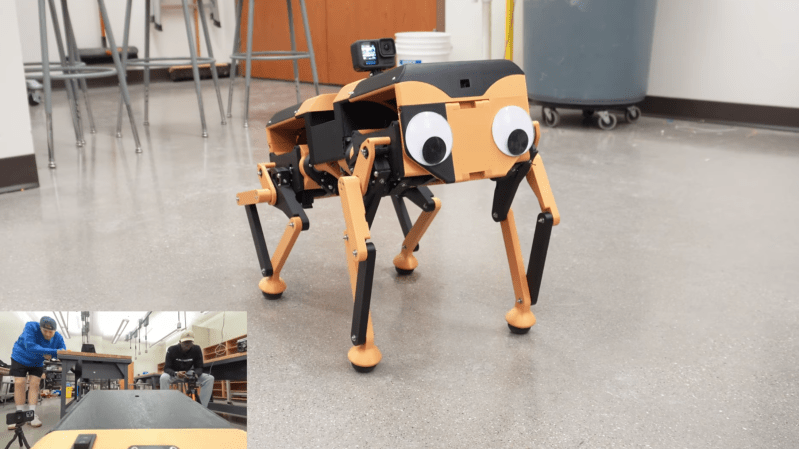
A black and yellow robot dog stands in the middle of the floor, with a GoPro camera mounted on its back. A picture-in-picture view in the bottom left corner shows the view from the camera.

An Improved Robot Dog For Senior Design

[Aaed Musa] has been building robot dogs for a long time now, so it was only natural that he would make one for the senior design project of his mechanical engineering degree. Since this meant working with potential customers, the requirements were somewhat more stringent than for previous dogs, but [Aaed] and his team were able to deliver CARA 2.0, their most agile, versatile robot yet.

Based on conversations with potential customers, [Aaed] and his team aimed for a price around $1,000 USD, a weight under 20 pounds, and a durable design. Like the original CARA, this used capstan drives to actuate the joints, which reduced costs. The drives were printed in resin and powered by brushless drone motors. These motors were designed for speed, not torque, so the team had to rewind them with more wire, an ordeal which paid off by roughly tripling the torque. As far as durability, one joint motor was tested by running it continuously back and forth, and it lasted for over 1,000 hours without obvious damage.

Since the joints don’t contain any absolute encoders, each motor has to home on startup by extending to its limit, as detected by a rise in motor current. As a happy side effect, this creates a lifelike stretching motion on startup. Compared to the earlier iteration, CARA 2.0 takes shorter, quicker steps, and thanks to angled step movements can turn much more quickly. In testing, it originally skewed to the left, which turned out to be due to an asymmetric leg design. Once corrected, CARA 2.0 could walk in straight lines, walk sideways, turn in place, crouch, jump, and keep its balance on an inclined surface. It didn’t quite make the price goal, but $1,450 is still cheap for such a capable robot dog, and it reached every other customer requirement. Most importantly, all the team graduated.

For another take on a capstan-powered robot dog, check out Stanley. We’ve also taken a look at TOPS, one of [Aaed]’s earlier designs.

Continue reading “An Improved Robot Dog For Senior Design”









