The Dark Side Of Unitree Robot Dogs

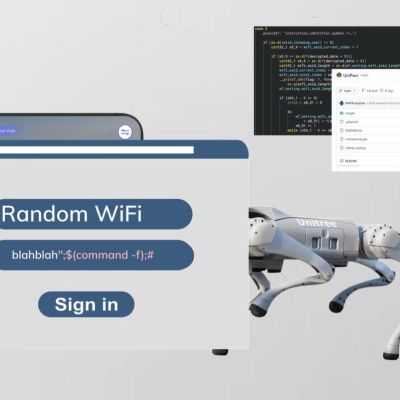
Arbitrary command execution with the Wi-Fi password. (Credit: Benn Jordan)

Continuing on his quest to expose the dark underbelly of modern technology, [Benn Jordan] recently did a deep-dive into the rise of so-called robot dogs. Although their most striking resemblance with biological dogs is that they also have four legs and generally follow commands, [Benn] found many issues with them that range from safety issues due to limited sensory capabilities, to basic security vulnerabilities, all the way to suspicious network traffic from Unitree’s robot dog firmware.

Although not the only seller of this type of quadruped robot, Unitree Robotics has made a name for itself by offering very capable and yet very cheap products. Their basic quadruped robot costs only a few thousand clams and features Lidar and heaps of processing power, all of which should make it a pretty useful device.

Despite this, [Benn] found that the original task that he’d envisioned for the robot, as in protecting his chickens from uninvited visitors, wouldn’t quite work as the robot is rather blind. The reason for this is the placement of the Lidar below the head, which obscures most of what’s behind and around the robot. Rather than risk trampled chickens and chicks, this plan was thus abandoned.

When digging further into the robot, he found an easy to exploit arbitrary command execution flaw via the Wi-Fi password entry field, a year-old CVE-2025-2894 exploit, as well as highly suspicious traffic to Chinese servers whenever the robot’s software figured that it was not being watched.

Although much of this can be circumvented with hacks, issues like the sensory limitations and general distrust of firmware updates makes using these robots a rather daunting and often ill-advised proposition.

Continue reading “The Dark Side Of Unitree Robot Dogs”

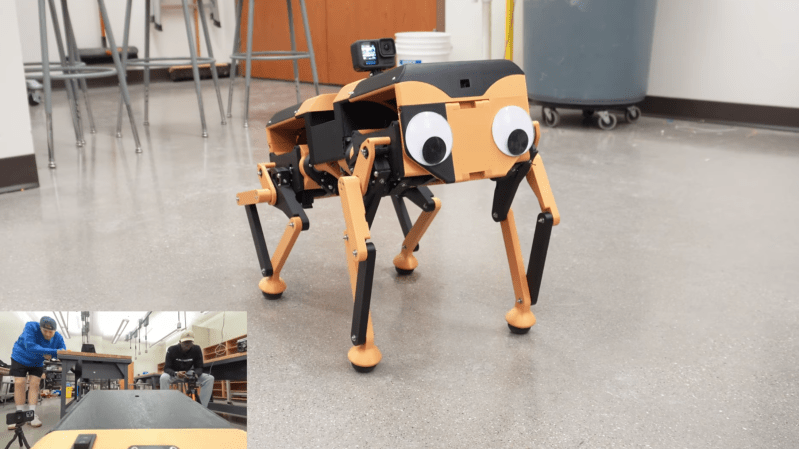
A black and yellow robot dog stands in the middle of the floor, with a GoPro camera mounted on its back. A picture-in-picture view in the bottom left corner shows the view from the camera.

An Improved Robot Dog For Senior Design

[Aaed Musa] has been building robot dogs for a long time now, so it was only natural that he would make one for the senior design project of his mechanical engineering degree. Since this meant working with potential customers, the requirements were somewhat more stringent than for previous dogs, but [Aaed] and his team were able to deliver CARA 2.0, their most agile, versatile robot yet.

Based on conversations with potential customers, [Aaed] and his team aimed for a price around $1,000 USD, a weight under 20 pounds, and a durable design. Like the original CARA, this used capstan drives to actuate the joints, which reduced costs. The drives were printed in resin and powered by brushless drone motors. These motors were designed for speed, not torque, so the team had to rewind them with more wire, an ordeal which paid off by roughly tripling the torque. As far as durability, one joint motor was tested by running it continuously back and forth, and it lasted for over 1,000 hours without obvious damage.

Since the joints don’t contain any absolute encoders, each motor has to home on startup by extending to its limit, as detected by a rise in motor current. As a happy side effect, this creates a lifelike stretching motion on startup. Compared to the earlier iteration, CARA 2.0 takes shorter, quicker steps, and thanks to angled step movements can turn much more quickly. In testing, it originally skewed to the left, which turned out to be due to an asymmetric leg design. Once corrected, CARA 2.0 could walk in straight lines, walk sideways, turn in place, crouch, jump, and keep its balance on an inclined surface. It didn’t quite make the price goal, but $1,450 is still cheap for such a capable robot dog, and it reached every other customer requirement. Most importantly, all the team graduated.

For another take on a capstan-powered robot dog, check out Stanley. We’ve also taken a look at TOPS, one of [Aaed]’s earlier designs.

Continue reading “An Improved Robot Dog For Senior Design”

Hackaday Links Column Banner

Hackaday Links: October 24, 2021

It seems that the engineers of NASA’s Lucy spacecraft have some ‘splaining to do. The $981M asteroid-seeking mission launched without a hitch, but when the two solar panels unfolded, one of them failed to latch into place. Lucy’s two large solar arrays combine to an impressive 51 square meters. Both are critical to this 12-year mission as it will travel farther from the Sun than any previous spacecraft, and be gone for longer. The problem is that Lucy is on an escape route, and so they can’t just sidle up to her with a repair craft. Even so, NASA and Lockheed are “pretty optimistic” that they can fix the problem somehow. On the bright side, both solar arrays are providing power and charging batteries inside the cockpit.

It’s kind of hard to believe, but KDE is turning 25 this year! Well, the actual anniversary date (October 14th) has already passed, but the festivities continue through the 25th when KDE founder Matthias Ettrich delivers a fireside chat at 17:00 UTC. Registration begins here.

EnergyStar, purveyors of appliance efficiency ratings and big yellow stickers, will no longer recommend gas-powered water heaters, furnaces, and clothes dryers on their yearly Most Efficient list. They will continue to give them ratings, however. This move was prompted by several environmentalist groups who pointed out that continuing to recommend gas appliances would not put America on track to reach Biden’s 2050 net-zero carbon emissions goal, since they produce greenhouse gases. We totally understand the shift away from gas, but not so much the nitty gritty of this move, which the article presents as exclusive of any appliance that doesn’t run on 100% clean energy. You can’t prove that a user’s electricity is renewable. For example, this consumer is well aware that the energy company in her town still burns coal for the most part. Anyway, here’s the memo. And a PDF warning.

Sure, you can trawl eBay for space rocks, but how do you know for sure that you’re getting a real meteorite? You could play the 1 in 100 billion or so odds that one will just fall in your lap. Just a few weeks ago, a meteorite crashed through a British Columbia woman’s ceiling and landed between two decorative pillows on her bed, narrowly missing her sleeping head. Ruth Hamilton awoke to the sound of an explosion, unaware of what happened until she saw the drywall dust on her face and looked back at the bed. The 2.8 pound rock was the size of a large man’s fist and was one of two meteorites to hit Golden, BC that evening. The other one landed safely in a field.

Hackaday alum Jeremy Cook wrote in to give us a heads up that his newest build, the JC Pro Macro 2, is currently available through Kickstarter. It’s exactly what it sounds like — a Pro Micro-powered macro pad. But this version is packed with extra keyswitches, blinkenlights, and most importantly for the Hackaday universe, broken out GPIO pins. Do what you will with the eight switches, rotary encoder, and optional OLED screen, and do it with Arduino or QMK. Jeremy is offering a variety of reward levels, from bare boards with SMT LEDs soldered on to complete kits, or fully assembled and ready to go.