
The word “restomod” is a bit nebulous, but it’s normally used in the automotive world to describe taking an old car and making it better-than-new with all the technological improvements the original builders would have used, had they been available. We think the word applies to [Alnwlsn]’s MIDI-actuated player piano, because what are those punched rolls of paper, but the MIDI of the 19th century?
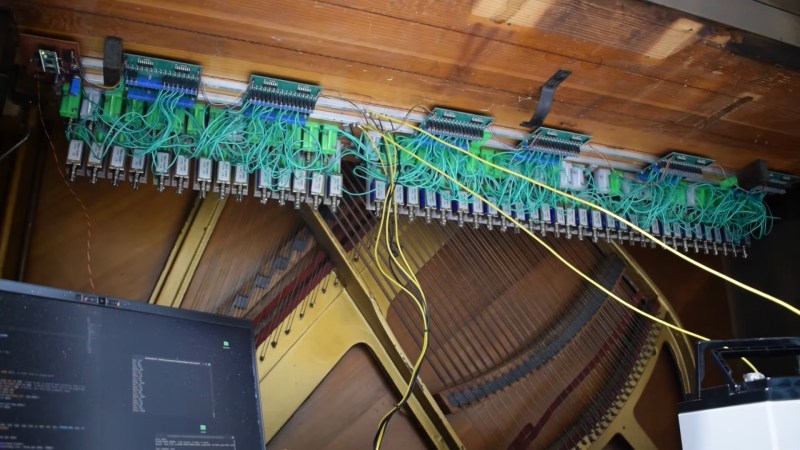
Unlike a lot of automotive restomods though, this one is mostly reversible. He did drill few holes and slots in the original wood, but nowhere that it would alter the integrity or original operation of the player piano mechanism. The MIDI-controlled solenoids just poke the same key paddles from below that the pneumatic mechanism used. From the listener or operator’s perspective, unless the doors that reveal the music scroll or lack thereof are open, the piano behaves exactly the same. Except now it has access to the whole wide array of tracks that exist in MIDI form, rather than a paltry selection of hard-to-find piano rolls.
Each of the relays is driven by a MOSFET via shift registers to get 88 outputs out of the single Pi Pico in charge, with a level shifter involved to get the RP2040 speaking 5 V logic. If you’re wondering how that gets volume control, no, the piano isn’t smacking keys at full volume all the time. He’s using the RP2040’s powerful PIO to create a sort of PWM signal to soften the solenoid blows when needed. To save his power supply, he’s also got it set up to stagger the pulses, so multiple relays aren’t pulsed at the same time when the MIDI file calls for chords.
There was actually more overlap between player pianos and MIDI than you might think, given this presentation of an Apple ][ being used to create the piano rolls.












Oh hey, I didn’t expect to see me here today. There is a site where you can submit midis to be played, but I’m not sure yet when I’ll get to play them. House has to be pretty quiet for that. Maybe on the weekend or next week? I put this up last week when I was on vacation, and people already played 17 hours worth of music on it!
And how many renditions of “Crazy Frog” or “Never Gonna Give You Up” or “Louie, Louie” did kindly Internet strangers request? 🙂
Seriously, though – great job, this is really impressive. Next project for you – converting a Jacquard loom (related technology to the player piano) to similar computer control, perhaps?
This is really cool. The article doesn’t do it justice; you should check out his website.
Twist the 2 wires to each coil, it will be twice as neat. One commercial outfit does this, I’ve installed them and I twisted the wires before they did it on their own. Probably cuts down on RFI too.
Would be cool for DOS or Windows 3.1 games with “generic” MIDI support (=piano channel).
Because, that thing likely isn’t MT-32, MT-540 or GM/GS MIDI compatible.
Something like “Dare to Dream” might sound not that bad on this piano, I guess.