
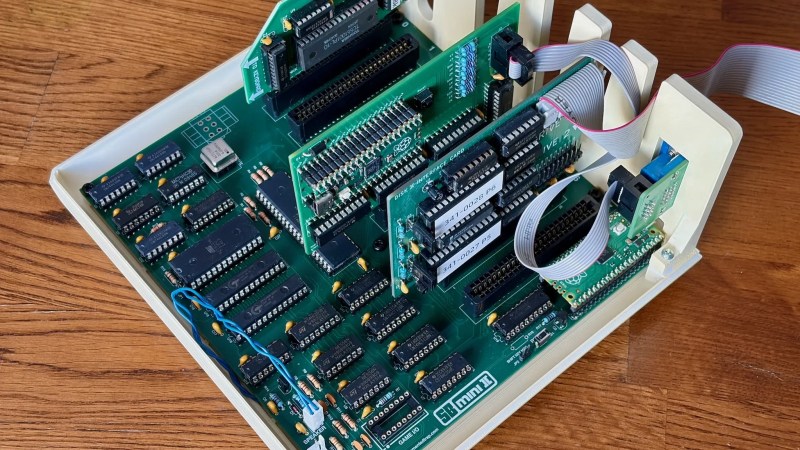
On the one hand, the original Apple II has been copied over and over again since at least the early 80s, so maybe this hack is old hat to the greybeards around here. On the other hand, this is the year 2026. When Apple released it back in 1977, who could have predicted people would still be building these things nearly five decades later?
In that sense, a homebrew Apple II in the current year is pretty remarkable. It’s a really well done project by [simonboak], nicely open sourced with a case to match, so is worth looking at on its own merits.
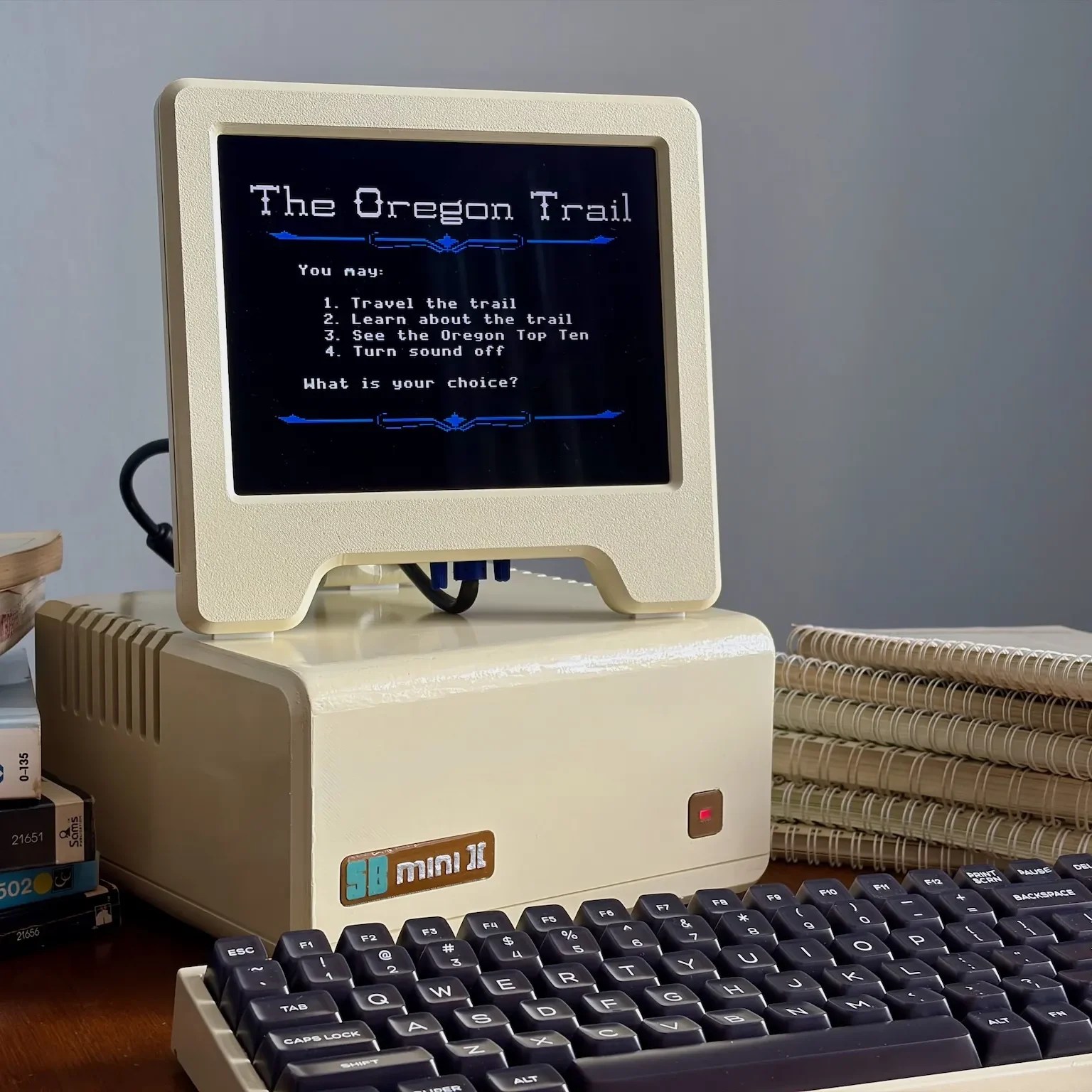
Unlike the later models, the original Apple II only used commercially available ICs, making it an easy target for recreation. No FPGAs required, just good old-fashioned DIPs. OK, these are modern CMOS versions of the chips, but other than that, the biggest concession to modernity is space on the board for a Raspberry Pi Pico to allow for connecting a USB keyboard.
The accompanying blog post lists some other differences from 1977’s favorite home computer: SRAM vs DRAM — because you know the Woz would have used it if he could — and omitting the composite video circuitry in favor a late-model VGA card. There’s no need for the composite output since he’s eschewing the period-appropriate CRT for a retro-styled LCD monitor, which is also 3D printed and available on Printables. It’s crazy to think that the Apple II family lived long enough not only to see the dawn of VGA but also well into its sunset.
If a homebuilt Apple ][ doesn’t impress, what about a PC-compatible circa 1995?












There are emulators that will duplicate the Apple II on a Pi Pico.
The keyboard interface is a more powerful computer than the entire Apple II clone.
I feel like this is missing the point.
It’s about building this from actual components rather than emulating it. The $4 pico is just there to provide a keyboard interface because it’s impractical to purchase a period correct keyboard for this.
Personally, I love this! It’s also beautiful!
A replica of a period-correct keyboard would be really neat, though! 😃
It would make the whole experience feel much more real, less PC-like.
i think you hit a real distinction but imo this is not a question of emulation vs reality, more a question of how much to emulate. in this case, the cpu and ram seem to be fairly authentic but all of the i/o seems to be emulated. since cycle-accurate cpu emulation seems to be plausible these days (at least for something as slow & simple as a 6502), tbh i think it’s a distinction without a difference.
but we all know the real thing i want out of an apple ii is that feeling i had in 1989 when i was one of the few 4th graders who was granted permission by the school librarian to handle the 5.25″ floppy disks myself. to have that feeling again!
That’s a great point. Let me counter that argument:
My brother and I restored my dad’s old Amiga 500 – our pride and joy. It’s great to play our original games on it!
But because I live nowhere near him, I built an open source Amiga floppy drive adapter (plans are out there somewhere), pulled backups of all our degrading floppies into adf files on my laptop, even pulled the original bios ROM from our Amiga to make it feel more real and more connected to the past experience… and yet it fails to give me the feelings you described yourself. Only the real thing feels… real. So period correct hardware makes a difference at least to me. Everyone can throw an emulator on some PC or even micro controller together but few ppl go to this length to rebuild with actual DIP parts and make some almost mandatory upgrades/compromises to allow everyone else to follow along without just going straight to FPGA. :)
Hate to break it to you, but the keyboard encoder ICs were full blown microcontrollers too.
There was more RAM in the two IBM XT keyboard chips than the original computer came with.
Your Amiga 500 keyboard controller was a MOS 6570, a full 6502 processor and internal mask rom, the entire thing more powerful than an apple2/2+
Maybe you don’t get that old past experience with an emulator on your ghz pc is because you need another 1thz-cpu 2tb-ram PC to act as your keyboard :P
^Wait, didn’t the PC/AT introduce the keyboard interface as we know it (8042) ?
I’m no PC or PC/XT expert, but I think that the mainboard didn’t have an intelligent keyboard controller yet.
It rather was some i/o chip and the keyboard was provided via CPU/BIOS.
Not sure on the keyboard side, however. On PC/AT, the keyboard was intelligent, too. Maybe even used same chip as PC/AT.
Some AT compatible keyboard models had a PC/AT switch on underside, while some had auto-detect.
I also vaguely remember that later PC BIOS revisions could detect AT keyboards and change scan codes, if needed.
heh i don’t think you’re as cynical as i am :)
i believe i could go back to my elementary school, find the library miraculously preserved, with the little table and the computer and the stack of 5.25″ floppies just where i left them 37 years ago, in full working order, and i would still not feel even a shadow of the same wonder :(
a lot of how i feel about emulation / restoration projects on hackaday comes from a realization i had a few years ago…i passed by a distinctive and rare spring ephemeral flower, and i remembered smelling the same flower from my childhood. and i noticed i was more overcome with the memory of smelling it as a child than the reality of smelling it in the moment.
Could have done a external USB -> PS/2 adaptor though (the commercial ones are all PS/2 -> USB).
I can’t complain. 🙂
The only thing that I miss in general is proper color CRT emulation, still.
I hope that by 2050 it will be possible to emulate the CRT of a Commodore 1702/1702, 1084S or an early IBM PS/2 monitor (say Model 8513 or 8514).
People really don’t know what they miss out on. Sigh. 😟
No offense, early monochrome video monitors already were hi-res and pixel-perfect (no screen mask).
– Except for b/w TV sets with soft CRTs (-matter of settings, focus etc-) that had RF input (common ZX81 display setup).
So they’re generally fine for devices using monochrome video (VBS was the RGB of the monochrome world).
However, domestic color TV sets and consumer grade color video monitors (-not Sony PVMs-)
had a CRT with a dot pitch of, say, ~0.4 to ~0.64mm (Commodore 1702; it had shadow mask).
A good VGA CRT from the mid-90s had 0.24mm dot pitch, by comparison.
These are worlds apart of each other! The latter is very LCD/TFT like, already. Like CAD/CAM grade CRTs .
And the difference is notable with graphics that use low-resolution but high-color (say 320×240 and 32+ colors).
Except, of course, for very blocky graphics that not even a crude CRT can hide (pong console, Philips Videopac G7000, Fairchild Channel F etc). ;)
This guy spends all this time building an amazing project and your first thought is to complain and point out that someone else Ported an emulator?
Hackaday meets many diverse needs, including the need to tear down someone else’s miracle.
Human nature is what it is…
ideal for 2014, I need this!
When I was stationed in Korea in 1980 the local electronics bazaar sold the parts and pieces to make the Krapple. In Japan it was the Japple.
Wrt the original keyboard, IIRC they were an Intel 8051, so closer to an Arduino Uno than anything more powerful.
Overall, however, this article, and in particular the commentary, absolutely demonstrates the truth of
https://hackaday.com/2026/07/04/yesterdays-technology-re-engineered-today/
We each have different opinions on How It Should Be Done, but the great thing about being Makers is that we can choose how we make things. This one, though maybe different than how I would do, is damn clever and elegant, and should be congratulated for such.
This is a comment I can respect!
“Making” is not “Made it for others”. “I am a maker” means I’m making something to my exact personal taste and liking and if someone else thinks otherwise they are free to make one to their liking, too! Which is also why we don’t call it patenting :D
+1