

This Week In Security: AI Is A Mess, Hacking Car Chargers, An OpenSSL DoS, And Factories Under Attack

[Ayush Paul] posts about extracting data from Claude agents while it accesses web data to fulfill user requests.

But it wasn’t that easy. [Ayush] discovered that Anthropic anticipated many of the attacks, and set up guardrails in an attempt to keep the agent from accessing arbitrary web sites. For Claude to access a website, the user has to specify it, it must be the results of a web search, or it must be referenced by a website previously specified by the user or returned in a search.

To convince the Claude agent to navigate a malicious site designed to extract data, Ayush formed a false warning that Cloudflare was blocking the agent for authentication purposes, and asked it to spell out the name of the agents owner by clicking a list of alphabetical links. Of course Claude trusts Cloudflare and wants to be helpful, so it cheerfully completed the task.

Once the agent is trapped in the false authentication loop, it can be interrogated for all sorts of information it knows about the owner: Ayush was able to convince it to disclose employer, and even data about the user that could be linked to security questions, like their home town.

Since Claude can be detected by the user agent (the field attached to web requests that tells the web server what sort of browser is requesting the page) custom information can be fed to the bot while users see a normal website; clicking a link looks completely normal, but asking an agent to summarize the site triggers fooling the bot into spilling the beans.

After reporting the issue, Ayush was told that Anthropic had already identified the issue internally, and eventually prevented the attack for now by preventing the agent from following links on external pages.

Grok sends entire codebases

Cereblab discovered that the Grok coding agent uploaded the entire content of the codebase it’s working with – and all Git history – to xAI servers, almost immediately. Even when told to never upload a file, the agent would reply “OK”, and then begin uploading the code bundle anyway.

If uploading your code to a remote server isn’t bad enough, and this could be extremely bad in some situations involving sensitive company code, including the entire Git history means that previously deleted files, like accidentally committed secrets or authentication credentials and tokens, were also leaked. Attempting to opt out by disabling options to improve the model by uploading code had no effect.

After gaining attention, Grok has added a privacy option to opt out of data retention. xAI has committed to deleting the retained uploaded code, but it is unclear if users will be told when their data has been removed. To actually prevent the agent from uploading local files to the xAI servers, even temporarily, a global flag “disable_codebase_upload” is required. Watch out, the privacy retention flags are only per-session!

Continue reading “This Week In Security: AI Is A Mess, Hacking Car Chargers, An OpenSSL DoS, And Factories Under Attack”

Exploring Hidden JPEG Features

The lossy compression algorithm used by JPEG was useful for those on the early Internet not only because it enabled pictures to be shared easier, but because it allows a low-resolution version of the image to load first. This meant that users could make out the gist of an image before it finished downloading. This was a great feature for those on slow connections, but it hides some other capabilities of this image format as well.

Rather than effectively splitting up the image into chunks, each with successive amounts of detail, [maurycyz]’s project shows that this can be exploited to load more than one picture. The first is loaded into this lower-resolution area, with a second unrelated picture showing up once the higher-resolution information is available. Essentially this makes a one-way .gif of sorts. Though this method is only capable of loading about nine frames, which is not enough for much animation. Further limiting things is that there’s no way to encode timing data, so on fast computers with fast connections the animation could load faster than a user could see.

Still, it’s an interesting quirk of this older image standard, one which still is in widespread use today. And it’s also true that it’s hard to say in what ways various technologies will be used in the future. JPEG images have also been the subject of some artistic projects that might not have been possible without the JPEG standard itself, and even as other formats have tried to supplant it, it still maintains its firm grip on the images on the Internet. More JPEG, please!

A New Blood Hack For An Old Game

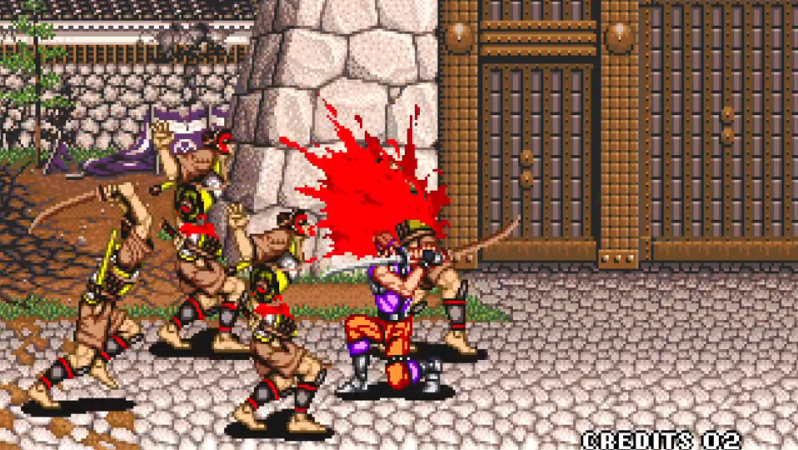
Even before 3D graphics and advanced shaders became common in the gaming world, there were concerns that virtual violence looked too realistic. Fighting games in the 1990s were routinely toned-down by having gratuitous displays of blood removed, which was often seen as disappointing by dedicated fans. [Raphaël Boichot] has been working to right this wrong in one obscure case, by rectifying the lack of blood in Sengoku 2.

Sengoku 2 was a title released in 1993 for the Neo Geo AES/MVS and the Neo Geo CD. It hit the market with relatively tame graphics that didn’t reflect the realistic amount of blood that should be released when an enemy was chopped in half with a sword. Noting that there was no simple DIP switch configuration or bit to flip to enable a more adult version of the game, [Raphaël] decided to create a custom blood hack the hard way. What ensued was a heavy-duty reverse engineering effort, swapping out palettes, and carefully editing tilesets in order to turn the censored graphics into something more lurid. A lot of artistic decisions had to be made to manipulate things just so in order to create a pleasing effect that didn’t mess up other aspects of the graphics at the same time.

If you’re a big Sengoku 2 fan, or you just want to learn more about reverse engineering and hacking on an obscure platform, dive into the project and enjoy the learnings. Otherwise, dive into the entirely different sorts of blood-related hacks we’ve featured over the years.

Continue reading “A New Blood Hack For An Old Game”









