This Week In Security: BugTraq, AI Hacks, And Being Dumb On Planes

After a multi-year hiatus, the venerable BugTraq mailing list is back!

For decades, BugTraq was the place where vulnerabilities were disclosed, from the early days when nearly all vendors viewed all security research as a hostile force, through to the modern era of working with vendors to coordinate disclosing bugs. With the rise of bug bounty programs and other social changes, the mailing list slowly died: what started in 1993 ended in 2021 is returning. The new maintainer, Jonathan Brossard, says in his announcement “The mission is unchanged: full disclosure, researcher-first, no corporate filter.”

Don’t Be Dumb on Planes

In the unlikely event anyone here needs to be told: Don’t do dumb things on planes.

It seems that someone coming home from from the DEF CON hacker conference in Las Vegas decided to mess with the in-plane WiFi, and is likely now in the “find out” phase of doing something dumb. There hasn’t been any public followup beyond the original reports: a passenger on a Delta flight leaving Las Vegas brought up a fake WiFi hotspot named “Delta WiFi FAST” to trick other passengers into connecting, and attempted to disable the in-flight WiFi using a denial of service attack.

Continue reading “This Week In Security: BugTraq, AI Hacks, And Being Dumb On Planes”

ShieldFont: Bludgeoning AI Scrapers That Disrespect Robots.txt

In the more innocent days of the World Wide Web you could simply put a robots.txt file in the root of your website that search engine indexing bots and similar would consult for the indexing wishes of the site owner. In this brave new world of LLM training data indexing such pleasantries are however rarely respected, leaving site owners to resort to increasingly more involved ways to bludgeon so-called AI scrapers, with ShieldFont being one of the most recent methods.

Its basic functioning is detailed in the white paper, explaining their use of ligatures. These are normally used to join multiple graphemes or letters into a single glyph which are rendered in the final text. By substituting about a quarter of the words in a text with such ligature-based versions in an intelligent, dictionary-based manner, the HTML version – as typically parsed by a scraper – will read as grammatically valid but nonsensical text, while the rendered font version will look normal.

Naturally, there are some disadvantages to this, such as screen readers for the visually impaired needing to also use the rendered font version, and it’s just as effective on legitimate search engine indexing bots. That said, if you apply this to static, archived content, or content marked as ‘do not follow’ in said robots.txt, then it might just be one way to make ChatGPT and friends spit out really funny output in the future now that the novelty of wood glue on pizza and eating rocks has somewhat worn off.

While LLM scrapers can adapt to this by also parsing the rendered text, this makes the scraping effort significantly more expensive. Together with maze traps like Nepenthes and Cloudflare’s offerings that seek to keep these scrapers busy scraping dynamically generated content through infinite linked pages, the tools available to combat the menace of these scrapers keep developing.

Mauchly And Eckert’s Other Computers

If you ask a random person who [John Mauchly] or [J. Presper Eckert] were, you’d probably get a blank stare. Ask a Hackaday reader, and you have a better shot. People who know will tell you that the two were behind the famous ENIAC, which may or may not have been the first computer, but was certainly influential in kicking off the modern computer era. They worked at Penn, and now [Holly Mengel] of Penn’s Kislak Center for Special Collections, Rare Books, and Manuscripts wants to introduce us to the other computers they worked on after ENIAC.

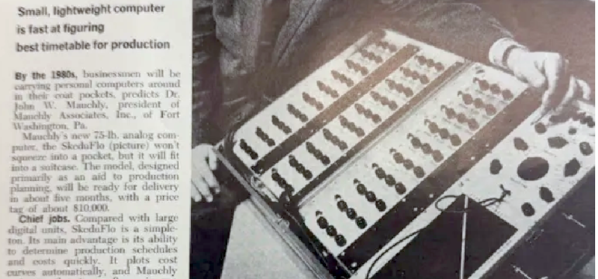
We will admit that we knew about EDVAC and UNIVAC. But we’ll also confess we didn’t know about BINAC or Skeduflo, a computer in a rather large suitcase. BINAC can claim to be the first digital computer that was commercialized, although you could argue that since it was fairly limited and, reportedly, never worked after it was delivered. Supposedly, the customer disassembled it, shipped it to a secure facility, and hired a freshly graduated engineer to rebuild it, which didn’t go very well.

We couldn’t find much about Skeduflo, other than that it was a 75-pound analog computer made for critical path method (CPM) analysis. You set up the problem with a patchboard and potentiometers, and the result came out on an analog plotter. Those details are from a PMI interview with [Morgan Walker] and [Jim Kelley].

It makes sense that these inventors didn’t just finish off ENIAC and retire to a tropical island. While UNIVAC had a good bit of success and EDVAC was very influential, the others are arguably fairly obscure. UNIVAC even has a Disney connection.