Hackaday Links Column Banner

Hackaday Links: September 10, 2017

Hackaday is 13! We’re going through a bit of a rebellious phase. There’s hair where there wasn’t hair before. Thirteen years ago (Sept. 5, 2004), [Phil Torrone] published the first Hackaday Post. [Phil] posted a great writeup of the history of Hackaday over on the Adafruit blog — we were saved from the AOL borg because of the word ‘hack’ — and interviewed the former and current editors of your favorite DIY website. Here’s to 13 more years and to [Phil] finding a copy of the first version of the Jolly Wrencher designed in Macromedia Flash.

Hackaday is having an unconference in the UK! Tickets for next weekend’s event went fast, but don’t worry — we’re hosting a Bring A Hack the day before.

Hurricanes are an awesome force of nature. As we learned from Harvey a week ago, livestreamed footage from the eyewall of a hurricane is fascinating. [Jeff Piotrowski] seems to be the streamer of choice. If you’re looking for something to gawk at, here you go.

Another burn is over, and I still have no idea how they moved the fuselage of a 747 from Palmdale to the playa.

You know we’re doing this whole Hackaday Prize thing where we’re giving a ton of money to people for creating cool hardware, right? We’re almost done with that. The last round of The Hackaday Prize is going on right now. The theme is anything goes, or rather there is no theme. The goal of this round is to build cool stuff. This round ends on October 16th, and yes, we’ll have the results for the Assistive Technologies round out shortly.

[Prusa] makes a lot of printers, and that means he needs to make a lot of parts to make a lot of printers. Obviously, a PTFE-cutting robot is the solution to this problem

October 5th is the Open Source Hardware Summit in Denver. Hackaday and Tindie are going, and it’s going to be a blast.  The location has moved in the last week — now it’s about half a mile away from the old venue. The speaker schedule is up, board nominations are open, and somewhere, someone is organizing a Lulzbot/Sparkfun booze cruise the day after the summit. I should be getting a van to add capacity to this trip, so if you’re interested leave a note in the comments.

Sparkfun’s Alternate Reality Hardware

SparkFun has a new wing of hardware mischief. It’s SparkX, the brainchild of SparkFun’s founder [Nate Seidle]. Over the past few months, SparkX has released breakout boards for weird sensors, and built a safe cracking robot that got all the hacker cred at DEF CON. Now, SparkX is going off on an even weirder tangent: they have released The Prototype. That’s actually the name of the product. What is it? It’s a HARP, a hardware alternate reality game. It’s gaming, puzzlecraft, and crypto all wrapped up in a weird electronic board.

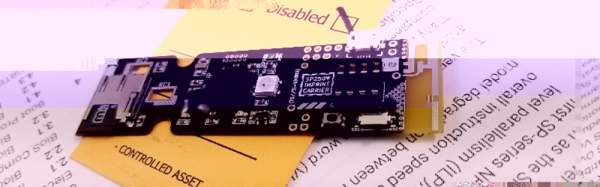
The product page for The Prototype is exactly as illuminating as you would expect for a piece of puzzle electronics. There is literally zero information on the product page, but from the one clear picture, we can see a few bits and bobs that might be relevant. The Prototype features a microSD card socket, an LED that might be a WS2812, a DIP-8 socket, a USB port, what could be a power switch, a PCB antenna, and a strange black cylinder. Mysteries abound. There is good news: the only thing you need to decrypt The Prototype is a computer and an open mind. We’re assuming that means a serial terminal.

The Prototype hasn’t been out for long, and very few people have one in hand. That said, the idea of a piece of hardware sold as a puzzle is something we haven’t seen outside of conference badges. The more relaxed distribution of The Prototype is rather appealing, and we’re looking forward to a few communities popping up around HARP games.

Hackaday Prize Entry: Smart Electric Bike Controller

One of the more interesting yet underrated technological advances of the last decade or so is big brushless motors and high-capacity batteries. This has brought us everything from quadcopters to good electric cars, usable cordless power tools, and of course electric bicycles. For his Hackaday Prize project, [marcus] is working on a very powerful electric bicycle controller. It can deliver 1000 Watts, it’s got Bluetooth, and there’s even an Android app for some neat diagnostics.

The specs for this eBike controller are pretty much what you would expect. It’s able to deliver a whole Kilowatt, can use 48 V batteries, has regenerative braking, Hall sensors, and has a nifty Android app for settings, displaying speed, voltage and power consumption, diagnostics, and GPS integration.

How is the project progressing? [marcus] has successfully failed a doping test. He lives on the French Riviera, and the Col de la Madonne is a famous road cycling road and favorite test drive of [Lance Armstrong]. The trip from Nice to Italy was beautiful and ended up being a great test of the eBike controller.

3D Printed Ribs For Not 3D Printed Planes

A few months ago, [Tom] built a few RC planes. The first was completely 3D printed, but the resulting print — and plane — came in a bit overweight, making it a terrible plane. The second plane was a VTOL tilt rotor, using aluminum box section for the wing spar. This plane was a lot of fun to fly, but again, a bit overweight and the airfoil was never quite right.

Obviously, there are improvements to be made in the field of 3D printed aeronautics, and [Tom]’s recent experiments with 3D printed ribs hit it out of the park.

If you’re unfamiliar, a wing spar is a very long member that goes from wingtip to wingtip, or from the fuselage to each wingtip, and effectively supports the entire weight of the plane. The ribs run perpendicular to the spar and provide support for the wing covering, whether it’s aluminum, foam board, or monokote.

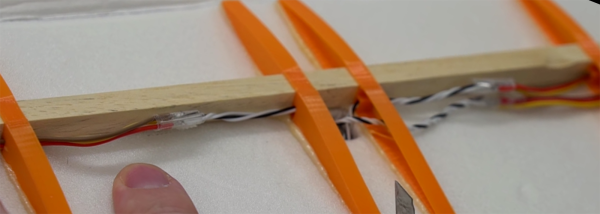
For this build, [Tom] is relying on the old standby, a square piece of balsa. The ribs, though, are 3D printed. They’re basically a single-wall vase in the shape of a wing rib, and are attached to the covering (foam board) with Gorilla glue.

Did the 3D printed ribs work? Yes, of course, you can strap a motor to a toaster and get it to fly. What’s interesting here is how good the resulting wing looked. It’s not quite up to the quality of fancy fiberglass wings, but it’s on par with any other foam board construction.

The takeaway, though, is how much lighter this construction was when compared to the completely 3D printed plane. With similar electronics, the plane with the 3D printed ribs weighed in at 312 grams. The completely 3D printed plane was a hefty 468 grams. That’s a lot of weight saved, and that translates into more flying time.

You can check out the build video below.

Continue reading “3D Printed Ribs For Not 3D Printed Planes”

It’s Time For Anything Goes In The Hackaday Prize

We’re challenging you to make the best whatever. It’s time for the Anything Goes round of the Hackaday Prize. This is your final chance to enter and we’re looking for just about anything! Twenty entries from Anything Goes will receive a $1,000 cash prize and a chance at the $50,000 grand prize and four other top prizes.

Over the last six months, we asked you to Design Your Concept, and then challenged you to build the Internet of Useful Things, Wheels Wings and Walkers, and Assistive Technologies that ensure a better quality of life for the disabled. All things must come to an end, though, but for the last challenge in the Hackaday Prize, we’re going wild. Is there a theme? No, just go build the best whatever you can. Our one bit of advice: the Hackaday Prize is about Building Something that Matters so do find a way for your “anything” to make the world a little bit better place.

The Anything Goes portion of the prize was introduced in last year’s Hackaday Prize. We didn’t want to exclude anyone building something awesome just because it didn’t fit a theme, so we created a challenge anyone could meet. The results last year were phenomenal, with twenty projects each winning a thousand dollars and progressing onto the final round of the Hackaday Prize. Winners last year included an Open Source Two-Stroke Diesel, a beautiful Diode Clock, and Dtto, a modular robot that went on to win the Grand Prize. Do you see a common theme between these projects? There isn’t one. The Anything Goes portion of the prize is a challenge to build the coolest thing.

This entry round is going on right now and ends October 16th. It’s the last chance for any project to make it to the final round with a potential to take home the Grand Prize of $50,000 USD.

Get those project logs in, and start making a video. Be sure you answer the final call to get in on the 2017 Hackaday Prize.

Friday Hack Chat: Elecia White Talks Embedded Systems

The Arduino ecosystem, despite the comments it receives from Real Engineers™, is actually pretty great. There’s no other tool that works with as many varieties of microcontrollers, has as many libraries, and is as easy to use as the Arduino. It’s perfect for getting a project up and running quickly, but when it comes down to getting the last cycles or kilobits out of an embedded system you’ll quickly find the little blue infinity icon just won’t cut it.

Embedded system design goes far beyond the Arduino ecosystem, and for this week’s Hack Chat, we’ll be talking about squeezing the last drops out of tiny pieces of silicon.

Our guest for this week’s Hack Chat will be [Elecia White], embedded software engineer at Logical Elegance, author of O’Reilly’s Making Embedded Systems, and host of the Embedded.fm podcast.  In this chat, we’re going to be talking about moving beyond the Arduino ecosystem.

Topics for this week’s Hack Chat will include embedded systems ecosystems, how to match processors to projects, choosing IDEs, programmers, and other tools, and actually shipping all those whizz-bang microcontroller projects out to eager buyers. We’re opening up the floor to all questions, so if you have something to add, here’s a spreadsheet to guide the discussion.

Here’s How To Take Part:

join-hack-chatOur Hack Chats are live community events on the Hackaday.io Hack Chat group messaging. Hack Chats are mostly, usually at noon, Pacific time on Friday. This week is no exception and everything is going down noon, PDT, Friday, September 8th. Are time zones confusing? Not a problem; here’s a handy countdown timer!

Click that speech bubble to the right, and you’ll be taken directly to the Hack Chat group on Hackaday.io.

You don’t have to wait until Friday; join whenever you want and you can see what the community is talking about.

The ESP32… On A Chip

The new hotness in microcontrollers is the ESP32. This chip, developed by Espressif, is the follow-on to the very popular ESP8266, the cheap, low-power, very capable WiFi-enabled microcontroller that came on the scene a few years ago. The ESP32 is another beast entirely with two powerful cores, WiFi and Bluetooth, and peripherals galore. You can even put an NES emulator in there.

While the ESP32 is significantly more powerful, it has for now been contained in modules. What would really be cool is a single chip loaded up with integrated flash, filter caps, a clock, all on a 7x7mm QFN package. Meet the ESP32-Pico-D4 (PDF). It is, effectively, an ESP32 on a chip. It’s just the ticket if you’re trying to cram wireless, fast microcontroller wizardry into a small package.

At its heart, the ESP32-Pico is your normal ESP32 module with a Tensilica dual-core LX6 microcoprocessor, 448 kB of ROM, 520 kB of SRAM,  4 MB of Flash (it can support up to 16 MB), Wireless with 802.11 b/g/n and Bluetooth 4.2, and a cornucopia of peripherals that include an SD card, UART, SPI, SDIO, LED and motor PWM, I2S, I2C, cap touch sensors, and a Hall effect sensor. It’s quite literally everything you could ever want in a microcontroller.

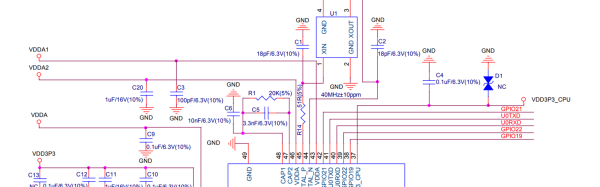
Disregarding the just barely hand-solderable package and the need for a PCB antenna, the ESP32-Pico requires very few support components. Really, the only thing going on in the reference schematic is a bunch of bypass caps. This is, by far, the easiest and smallest method to put WiFi, Bluetooth, and a powerful microcontroller in a project. It will surely be a very, very popular chip for hobbyist electronics for years to come. Of course, it will be even more popular if Espressif also manages to put this chip in a QFP package in addition to the QFN.

Unfortunately, apart from the PDF released by Espressif, the details on the EPS32-on-a-chip are sparse. We don’t know when we’ll be able to get our grubby hands on a tray, tube, or reel of these chips. That said, there’s enough information here to start designing a breakout board. Have at it — we’d love to see what the community comes up with.

Shout out to [Dave] for the tip.